👷🏾♀️
The Emoji
Woman Construction Worker: Medium-dark Skin Tone
U+1F477 U+1F3FE U+200D U+2640 U+FE0F · :woman_construction_worker_mediumdark_skin_tone:
Trend 48
Meaning layers
- interpretation
- Used to celebrate hustle culture, girlboss energy, or women doing hard physical work. Also deployed ironically when someone is 'building' something in their life — a business, a relationship, a body, or personal growth.
- tiktok usage
- Appears in 'glow up' videos, self-improvement content, and 'women in trades' representation posts. Gen Z uses it to hype women doing traditionally masculine jobs.
- irony level
- 3 / 10
Platform meanings
- meaning
- Represents women in trades, hustle and grind, self-improvement, or rebuilding oneself after a setback.
- trend usage
- Appears in 'women in construction' POV videos, #tradewomen content, and ironic 'rebuilding my life' trends.
- hashtags
- #WomenInTrades#GirlsWhoConstruct#TradeWomen#WomenWhoWork#BuildingMyself
- virality score
- 52 / 100
Cultural meanings
🇺🇸
Western / Gen-Z
Widely used as a feminist empowerment symbol celebrating women in trades and self-sufficiency; also deployed ironically in 'rebuilding myself' meme contexts.
🇵🇰
Pakistan & India
Used to represent women workers and celebrate the growing presence of women in construction and engineering fields, though still uncommon in casual chat due to social sensitivities around gender roles.
🌍
Middle East
Carries significant symbolic weight as it challenges traditional gender norms; occasionally used by progressive younger users to celebrate women breaking into male-dominated industries.
🌐
Global Neutral
Universally understood as a female construction worker; used across languages and cultures to signal hard work, building, and professional labor.
🇧🇩
Bangladesh
Resonates in discussions about the growing women's workforce in manufacturing and construction; used to celebrate female laborers and workers' rights.
🇱🇰
Sri Lanka
Used in professional contexts to highlight women entering skilled trades; increasingly seen in social media content about women's economic empowerment.
🇨🇳
China
Used practically to indicate construction or labor work; also appears in content about women's workforce equality and national development campaigns.
🇯🇵
Japan
Rarely used in casual chat but appears in professional contexts about gender diversity initiatives in the traditionally male construction industry.
🇰🇷
South Korea
Used in feminist discourse and career empowerment content; aligns with growing 'women in trades' movements challenging traditional career expectations.
🇹🇼
Taiwan
Associated with gender equality advocacy and used in professional posts celebrating women in engineering and construction sectors.
🇭🇰
Hong Kong
Used in urban development discussions and gender equality content; represents female professionals in the busy construction industry.
🇵🇭
Philippines
Celebrates the large female workforce in construction and overseas labor sectors; used with pride in OFW (overseas worker) communities.
🇮🇩
Indonesia
Appears in content about women's economic empowerment and breaking into skilled trades; used in labor rights and gender equality discussions.
🇹🇭
Thailand
Used to represent female workers in construction and skilled trades; occasionally appears in gender-neutral labor rights content.
🇻🇳
Vietnam
Associated with the strong tradition of women's labor contribution; used in content celebrating female workers in growing construction industries.
🇲🇾
Malaysia
Used in professional and empowerment contexts; appears in multicultural gender equity discussions about women entering skilled trade professions.
🇸🇦
Saudi Arabia
Carries growing significance as women enter the workforce under Vision 2030 reforms; used to celebrate pioneering women in construction and engineering roles.
🇦🇪
UAE
Used in professional contexts celebrating diverse women workers in the UAE's booming construction sector; seen in gender diversity workplace content.
🇪🇬
Egypt
Appears in content about women workers in construction and trades; used by progressive communities to challenge traditional gender roles in labor.
🇹🇷
Turkey
Used in feminist and labor rights discussions; represents women pushing back against gender-segregated work environments in construction.
🇮🇷
Iran
Used cautiously in underground or progressive social media circles to celebrate women's labor rights and presence in skilled professions despite restrictions.
🇳🇬
Nigeria
Celebrates women in construction and trades in one of Africa's most active building economies; used with pride in entrepreneurial and hustle culture content.
🇿🇦
South Africa
Used in content about women in construction and skilled trades; aligns with BEE (Black Economic Empowerment) and gender equity workplace discussions.
🇬🇧
UK & Ireland
Commonly used by women in trades and construction apprenticeships; featured in campaigns like 'Women Into Construction' and trades empowerment initiatives.
🇫🇷
France
Used in gender equality discourse and labor rights content; associated with campaigns promoting women in traditionally male professions.
🇩🇪
Germany
Appears in professional content about 'Frauen in Handwerksberufen' (women in craft/trade professions); valued in precise, literal professional communication.
🇪🇸
Spain & Italy
Used in feminist empowerment contexts and labor discussions; symbolizes women challenging machismo culture in traditionally male trade sectors.
🇧🇷
Brazil
Celebrates the growing number of women in Brazil's construction boom; used in empowerment content and labor rights discussions with high energy.
🇲🇽
Mexico
Used to celebrate hardworking women, often with cultural pride; resonates in communities where women increasingly enter skilled labor and construction.
🌎
Latin America
Broadly used across Latin America to celebrate women workers and challenge traditional gender roles in labor; associated with empowerment movements.
🇦🇺
Australia & NZ
Common in trades empowerment campaigns like 'Women in Trades'; used professionally and casually to celebrate women breaking into blue-collar careers.
How its meaning shifted
- 2010
This emoji did not exist in 2010; the concept of gendered profession emojis with skin tone modifiers was years away from Unicode adoption.
- 2015
Early versions of worker emojis began appearing; gendered construction worker with skin tone options was not yet available, limiting specific representation.
- 2020
Gained traction during COVID-19 as essential workers were celebrated; used to honor women in construction and labor who kept infrastructure functioning.
- 2026
Widely used in feminist empowerment content, Women in Trades advocacy, ironic 'rebuilding myself' meme culture, and professional representation on LinkedIn and TikTok.
See it on every platform
Compare with
Adjacent emojis
Share & embed
Frequently asked
01What does the 👷🏾♀️ Woman Construction Worker: Medium-dark Skin Tone emoji mean?
A woman wearing a hard hat and working in construction, shown with a medium-dark skin tone. Represents female construction workers, builders, and laborers in the trades.
02What does 👷🏾♀️ mean on TikTok?
Represents women in trades, hustle and grind, self-improvement, or rebuilding oneself after a setback.
03What does 👷🏾♀️ mean on WhatsApp?
Signals hard work, being busy with a project, or doing DIY tasks at home.
04What does 👷🏾♀️ mean in Gen-Z slang?
Used to celebrate hustle culture, girlboss energy, or women doing hard physical work. Also deployed ironically when someone is 'building' something in their life — a business, a relationship, a body, or personal growth.
05Is the 👷🏾♀️ emoji safe to use?
Represents a female construction worker or laborer in a professional and empowering context; celebrates women in skilled trades.
06What does 👷🏾♀️ mean in texting?
Signals a sense of capability and self-sufficiency. Psychologically tied to breaking gender norms and feeling proud of physical or practical labor — often used to reclaim spaces traditionally denied to women.
07What is the shortcode for 👷🏾♀️?
The shortcode for Woman Construction Worker: Medium-dark Skin Tone is :woman_construction_worker_mediumdark_skin_tone:
08What does 👷🏾♀️ mean in dating?
Rarely used as a direct flirt, but can signal 'I'm independent, strong, and don't need anyone to build things for me' — an indirect power move in dating contexts.
Safety & usage
- Safe meaning
- Represents a female construction worker or laborer in a professional and empowering context; celebrates women in skilled trades.
- Caution
- Rarely weaponized negatively, but could be used sarcastically to demean or stereotype working-class women in hostile online contexts.
Generally very safe to use. In rare cases, could be used dismissively or in a condescending way toward blue-collar workers. The skin tone specificity makes it more targeted in representation, which is a positive feature.
How it looks across platforms
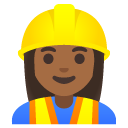
Appearance varies by platform and device. Google Noto, Twemoji, and OpenMoji are open-source.