👱🏿♀️
The Emoji
Woman: Dark Skin Tone, Blond Hair
U+1F471 U+1F3FF U+200D U+2640 U+FE0F · :woman_dark_skin_tone_blond_hair:
Trend 58
Meaning layers
- interpretation
- Used to represent confidence, boldness, and standing out — a dark-skinned woman owning her blond hair look unapologetically. Often signals a fierce, unbothered attitude.
- tiktok usage
- Appears in transformation videos, natural hair dyeing content, and 'that girl' aesthetic posts. Used when someone is serving a look or describing themselves as the main character.
- irony level
- 2 / 10
Platform meanings
- meaning
- Represents a dark-skinned woman with blond hair serving looks — used in transformation content, natural hair dyeing journeys, and main character energy posts.
- trend usage
- Paired with 'glow up' audios, bleaching-hair tutorials, 'that girl' aesthetic videos, and representation celebration content.
- hashtags
- #BlackGirlMagic#BlondHair#GlowUp#DarkSkinBeauty#HairTransformation
- virality score
- 62 / 100
Cultural meanings
🇺🇸
Western / Gen-Z
Widely embraced as a symbol of Black girl confidence and beauty autonomy — Gen Z celebrates this look as a bold reclamation of beauty standards that historically excluded dark-skinned women.
🇵🇰
Pakistan & India
Less culturally prominent but recognized in beauty and Bollywood-adjacent conversations — occasionally used to reference South Asian women with lighter dyed hair, though the dark skin tone makes it less commonly self-identified.
🌍
Middle East
Used by Arab and Gulf women of darker complexions who dye their hair blond, a practice increasingly visible in urban beauty culture across the region.
🌐
Global Neutral
Universally understood as a representation of a dark-skinned woman with blond hair — used for straightforward self-identification across cultures without heavy additional meaning.
🇧🇩
Bangladesh
Relatively uncommon in local usage but understood in urban digital spaces — occasionally used by Bangladeshi women with dyed hair to represent a bold beauty choice.
🇱🇰
Sri Lanka
Used infrequently but appears in beauty community chats — dark-skinned Sri Lankan women with dyed hair may use it as a representation emoji online.
🇨🇳
China
Rarely used in Chinese social media contexts due to low cultural relatability — may appear in discussions about international beauty diversity or K-pop adjacent content.
🇯🇵
Japan
Occasionally used in gyaru (gal) subculture spaces where tan skin and blond hair is an aesthetic — has niche recognition among fashion-forward communities.
🇰🇷
South Korea
Known in K-beauty and entertainment discussions, especially as representation of international beauty standards — used by Korean fans celebrating diverse global beauty.
🇹🇼
Taiwan
Used in beauty influencer communities and international pop culture discussions — seen as a symbol of bold, unconventional beauty choices.
🇭🇰
Hong Kong
Appears in cosmopolitan beauty discussions and among younger users engaging with global beauty trends, especially around hair coloring.
🇵🇭
Philippines
Used by Filipina women of darker skin tones who dye their hair blond — resonates in a country where colorism conversations are increasingly prominent.
🇮🇩
Indonesia
Emerging usage among dark-skinned Indonesian beauty content creators who dye their hair — used as a self-representation and empowerment symbol.
🇹🇭
Thailand
Used occasionally in Thai beauty communities, particularly among women who have darker skin tones and experiment with blond or golden hair dye.
🇻🇳
Vietnam
Rare but growing in usage among Vietnamese beauty influencers discussing inclusive beauty — seen as representing bold, non-traditional hair choices.
🇲🇾
Malaysia
Used in Malaysian beauty communities by darker-skinned Malay, Indian-Malaysian, or mixed-heritage women who dye their hair blond.
🇸🇦
Saudi Arabia
Used privately in female-only social media spaces — represents a bold beauty choice among Saudi women experimenting with hair color in more liberated contexts.
🇦🇪
UAE
More openly used in the cosmopolitan UAE digital space — dark-skinned women across African, South Asian, and Arab communities in Dubai use it to represent themselves.
🇪🇬
Egypt
Used by Egyptian women of Nubian or darker complexions in beauty conversations — represents a growing movement of embracing blond hair as a personal style choice.
🇹🇷
Turkey
Used in Turkish beauty and fashion communities by women with darker skin tones — seen as a representation of breaking from traditional Eurocentric beauty norms.
🇮🇷
Iran
Used privately in Iranian digital spaces — dark-skinned Iranian women may use it to represent themselves in beauty discussions, though publicly blond hair carries strong cultural signals.
🇳🇬
Nigeria
Highly relevant and widely used — Nigeria has a vibrant culture of dark-skinned women rocking blond wigs and dyed hair, and this emoji is celebrated as on-brand and accurate.
🇿🇦
South Africa
Widely embraced in South African digital spaces — Black South African women have a rich tradition of bold hair color experimentation, and this emoji resonates strongly.
🇬🇧
UK & Ireland
Used by the Black British community to represent afro-Caribbean and African women in the UK who sport blond hair — appears frequently in UK Black beauty spaces.
🇫🇷
France
Used in French beauty communities among the large African diaspora — represents Afro-French women reclaiming and celebrating their look in a historically Eurocentric beauty culture.
🇩🇪
Germany
Used by Afro-German communities and in diversity conversations — seen in spaces advocating for representation and challenging Germany's historically narrow beauty standards.
🇪🇸
Spain & Italy
Used by the African diaspora communities in Spain and Italy — appears in discussions about Afro-European beauty identity and growing visibility of dark-skinned women in media.
🇧🇷
Brazil
Highly relevant in Brazil given the country's large Afro-Brazilian population and rich culture of hair dyeing — represents empowerment and beauty diversity, especially in Bahia-centered content.
🇲🇽
Mexico
Used by Afro-Mexican communities and darker-skinned Mexican women with dyed hair — gains traction in spaces discussing colorism and representation in Mexican beauty standards.
🌎
Latin America
Used across Latin America by Afro-Latinx communities — represents the visible and proud intersection of dark skin and blond hair in a region with significant colorism history.
🇦🇺
Australia & NZ
Used by Aboriginal Australian, Pacific Islander, and African diaspora women in Australia and New Zealand — celebrated in Indigenous and multicultural beauty spaces as a symbol of self-expression.
How its meaning shifted
- 2010
This emoji combination did not exist in 2010 — emoji skin tone modifiers and ZWJ sequences for hair types had not yet been developed, making any nuanced representation impossible.
- 2015
Skin tone modifiers were introduced in 2015, but specific hair-type ZWJ sequences were not yet available — users at this time would have used generic woman emojis with limited skin tone options.
- 2020
By 2020, this emoji was available and used in growing conversations about Black beauty, natural hair, and representation — appeared frequently in the context of the global racial justice movement and beauty inclusivity discourse.
- 2026
Widely recognized and actively used across platforms — integrated into everyday self-representation by dark-skinned blond women globally, and featured prominently in beauty, empowerment, and cultural identity conversations.
See it on every platform
Compare with
Adjacent emojis
Share & embed
Frequently asked
01What does the 👱🏿♀️ Woman: Dark Skin Tone, Blond Hair emoji mean?
A woman with dark skin tone and blond hair, represented as a ZWJ sequence combining the woman emoji, dark skin tone modifier, and blond hair component.
02What does 👱🏿♀️ mean on TikTok?
Represents a dark-skinned woman with blond hair serving looks — used in transformation content, natural hair dyeing journeys, and main character energy posts.
03What does 👱🏿♀️ mean on WhatsApp?
Used to represent a dark-skinned blond woman — often used as a self-identifier in group chats or one-on-one conversations.
04What does 👱🏿♀️ mean in Gen-Z slang?
Used to represent confidence, boldness, and standing out — a dark-skinned woman owning her blond hair look unapologetically. Often signals a fierce, unbothered attitude.
05Is the 👱🏿♀️ emoji safe to use?
A straightforward representation of a dark-skinned woman with blond hair — used for self-identification, celebration, and inclusive beauty representation.
06What does 👱🏿♀️ mean in texting?
Carries emotional weight tied to identity and self-representation for Black women who dye their hair blond — a historically stigmatized choice that has been reclaimed as a form of empowerment and creative freedom.
07What is the shortcode for 👱🏿♀️?
The shortcode for Woman: Dark Skin Tone, Blond Hair is :woman_dark_skin_tone_blond_hair:
08What does 👱🏿♀️ mean in dating?
Used by dark-skinned blond women to represent themselves in bios or flirty messages, signaling boldness and individuality.
Safety & usage
- Safe meaning
- A straightforward representation of a dark-skinned woman with blond hair — used for self-identification, celebration, and inclusive beauty representation.
- Caution
- Extremely rarely used in toxic contexts — in fringe cases, may be deployed in racist threads that mock or fetishize the combination of dark skin and blond hair.
This emoji is generally safe and positive. Creators should be aware that images of dark-skinned blond women can attract colorist commentary in certain online spaces — moderate reply sections accordingly.
How it looks across platforms
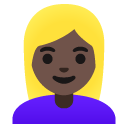
Appearance varies by platform and device. Google Noto, Twemoji, and OpenMoji are open-source.