👩🏿🦱
The Emoji
Woman: Dark Skin Tone, Curly Hair
U+1F469 U+1F3FF U+200D U+1F9B1 · :woman_dark_skin_tone_curly_hair:
Trend 68
Meaning layers
- interpretation
- Used to represent Black women, naturalistas, or anyone rocking curly/coily natural hair. Often used as a self-identifier by dark-skinned women with natural hair, or as a show of solidarity and celebration of natural Black beauty.
- tiktok usage
- Commonly placed in bios and captions by Black women creators to signal identity; appears in natural hair tutorials, 'that girl' aesthetics, and self-love content.
- irony level
- 2 / 10
Platform meanings
- meaning
- Identity marker and representation symbol used by Black women creators; signals natural hair content, melanin celebration, and Black girl magic energy.
- trend usage
- Featured in natural hair journey videos, 'get ready with me' Black beauty content, self-love trends, and 'that girl' aesthetic videos by Black women.
- hashtags
- #NaturalHair#BlackGirlMagic#MelaninPoppin#NaturalHairJourney#CurlyHairDontCare
- virality score
- 72 / 100
Cultural meanings
🇺🇸
Western / Gen-Z
Strongly associated with Black girl magic, natural hair movement, and melanin pride; widely used as a self-identifier and celebration of dark-skinned curly-haired women in the US, Canada, and Western Europe.
🇵🇰
Pakistan & India
Relatively rare in daily use; may be used by South Asian diaspora members with curly hair for partial identification, or in academic and DEI contexts discussing representation and racial diversity.
🌍
Middle East
Occasionally used by Arab women with curly hair for self-identification; also seen in expat communities and in discussions about diversity and multiculturalism in the region.
🌐
Global Neutral
Universally recognized as a representation of a dark-skinned woman with curly hair; carries positive connotations of diversity and inclusion across most global contexts.
🇧🇩
Bangladesh
Primarily understood literally as a depiction of a woman with dark skin and curly hair; not widely culturally specific in usage but recognized in international digital spaces.
🇱🇰
Sri Lanka
Used occasionally by Sri Lankan women with naturally curly hair for self-representation; cultural resonance is moderate and largely tied to global emoji awareness.
🇨🇳
China
Less commonly used in Chinese digital culture where skin tone modifier emojis are less prevalent; may appear in international or cosmopolitan contexts discussing diversity.
🇯🇵
Japan
Recognized as a diversity emoji but rarely used in mainstream Japanese digital communication; may appear in content about international culture, diversity education, or Black culture appreciation.
🇰🇷
South Korea
Used in K-pop fan communities discussing Black artists and cultural appreciation; occasionally seen in diversity and international culture discourse.
🇹🇼
Taiwan
Appears in discussions about racial diversity and international representation; used by Taiwanese people engaging with global social justice conversations.
🇭🇰
Hong Kong
More culturally resonant due to Hong Kong's international diversity; used in multicultural communities and among people engaging with global social media trends.
🇵🇭
Philippines
Used by Filipino women with darker skin tones and curly hair for some self-identification; also appears in discussions about colorism and Filipino beauty standards.
🇮🇩
Indonesia
Occasionally used by Indonesian women with curly or wavy hair; appears in discussions about hair texture diversity and natural beauty in the archipelago.
🇹🇭
Thailand
Rarely used in mainstream Thai digital culture due to different beauty standards; may appear in global trend-following content or international community discussions.
🇻🇳
Vietnam
Used primarily in international-facing content; Vietnamese users may employ it when discussing global diversity topics or engaging with Western social media trends.
🇲🇾
Malaysia
Used by Malaysian women of African or mixed heritage for self-representation; appears in diverse Malaysian online communities celebrating multicultural identity.
🇸🇦
Saudi Arabia
Used cautiously and primarily for literal representation; appears in international communities and expat groups within Saudi Arabia, or in educational content about diversity.
🇦🇪
UAE
More commonly used given the UAE's highly diverse expatriate population; Black and African expat communities use it for self-identification in digital spaces.
🇪🇬
Egypt
Used by Egyptian women with curly natural hair for self-identification; also appears in discussions about North African beauty standards and natural hair acceptance.
🇹🇷
Turkey
Occasionally used by Turkish women with curly hair for partial identification; appears in multicultural urban communities and global trend discussions.
🇮🇷
Iran
Rarely used in mainstream Iranian digital culture; may appear among diaspora communities or in internationally-influenced online spaces.
🇳🇬
Nigeria
Widely used and deeply resonant in Nigerian digital culture; represents Black women with natural Afro-textured hair and is a strong symbol of pride and identity for Nigerian women.
🇿🇦
South Africa
Highly culturally significant; used extensively by South African Black women to celebrate natural hair, melanin beauty, and identity in the post-apartheid context of reclaiming Black beauty.
🇬🇧
UK & Ireland
Popular among Black British and Irish women of African and Caribbean heritage; used in natural hair communities, Black British culture content, and UK-specific melanin celebration spaces.
🇫🇷
France
Used in Afro-French communities and among women of African and Caribbean descent in France; also appears in discussions about natural hair discrimination and Afro identity in France.
🇩🇪
Germany
Used by Afro-German women and Black communities in Germany for self-identification; appears in diversity and representation discussions in German digital spaces.
🇪🇸
Spain & Italy
Used by Afro-Spanish and Afro-Italian communities; also appears in discussions about natural hair acceptance and racial representation in Southern European contexts.
🇧🇷
Brazil
Widely used and culturally powerful in Brazil where it connects to Afro-Brazilian pride, natural hair movements like 'cabelo crespo' acceptance, and Black consciousness celebrations.
🇲🇽
Mexico
Used by Afro-Mexican women to celebrate their identity and heritage; appears in discussions about Afro-Mexican recognition and natural hair beauty standards.
🌎
Latin America
Significant across Latin America in communities celebrating Afro-Latinx identity; connected to movements reclaiming natural Afro-textured hair and dark skin beauty across the region.
🇦🇺
Australia & NZ
Used by Black and Indigenous Australian and Māori women with curly hair for self-representation; appears in diversity and multicultural content across Australian and New Zealand digital spaces.
How its meaning shifted
- 2010
Did not exist; diverse skin tone and hair component emojis were not yet available. Women were represented by a single default yellow-toned emoji with no hair texture variation.
- 2015
Skin tone modifiers were introduced in Unicode 8.0 but hair component combinations were not yet available; diverse women were still limited to basic skin tone variations without hair texture specificity.
- 2020
Became increasingly popular following the Unicode 12.0 hair component additions; gained significant traction during the BLM movement surge and growing natural hair representation discourse on social media.
- 2026
Firmly established as a core identity emoji for dark-skinned women with natural curly or coily hair; widely used across all major platforms in representation, self-love, and cultural pride contexts.
See it on every platform
Compare with
Adjacent emojis
Share & embed
Frequently asked
01What does the 👩🏿🦱 Woman: Dark Skin Tone, Curly Hair emoji mean?
Represents a woman with dark skin tone and curly hair, created through the combination of the woman emoji, dark skin tone modifier (Fitzpatrick scale type VI), and curly hair component.
02What does 👩🏿🦱 mean on TikTok?
Identity marker and representation symbol used by Black women creators; signals natural hair content, melanin celebration, and Black girl magic energy.
03What does 👩🏿🦱 mean on WhatsApp?
Used to represent oneself or a friend who is a dark-skinned woman with curly hair; casual self-identification in group chats.
04What does 👩🏿🦱 mean in Gen-Z slang?
Used to represent Black women, naturalistas, or anyone rocking curly/coily natural hair. Often used as a self-identifier by dark-skinned women with natural hair, or as a show of solidarity and celebration of natural Black beauty.
05Is the 👩🏿🦱 emoji safe to use?
Positive representation of a dark-skinned woman with curly hair; used for identity, celebration of natural beauty, and cultural pride. Completely safe and affirming in the vast majority of contexts.
06What does 👩🏿🦱 mean in texting?
For many users, this emoji carries deep psychological significance as a symbol of visibility and representation in digital spaces. Seeing oneself reflected in an emoji can reinforce positive self-image and cultural pride, particularly for Black women who have historically been underrepresented in mainstream beauty and media.
07What is the shortcode for 👩🏿🦱?
The shortcode for Woman: Dark Skin Tone, Curly Hair is :woman_dark_skin_tone_curly_hair:
08What does 👩🏿🦱 mean in dating?
Used by dark-skinned women with curly hair to describe themselves in dating profiles or bios; sometimes used by admirers to compliment or describe their attraction to natural-haired Black women.
Safety & usage
- Safe meaning
- Positive representation of a dark-skinned woman with curly hair; used for identity, celebration of natural beauty, and cultural pride. Completely safe and affirming in the vast majority of contexts.
- Caution
- Can be misused in racist mockery or stereotyping, though this is uncommon; occasionally weaponized in color politics discussions within Black communities regarding colorism.
Generally a safe and positive emoji. Users should be mindful that using it to represent someone without their consent or in tokenizing ways can be considered appropriative or reductive. Colorism discussions in some communities may create sensitive contexts around this emoji.
How it looks across platforms
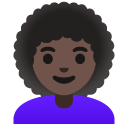


Appearance varies by platform and device. Google Noto, Twemoji, and OpenMoji are open-source.