🤦🏾♀️
The Emoji
Woman Facepalming: Medium-dark Skin Tone
U+1F926 U+1F3FE U+200D U+2640 U+FE0F · :woman_facepalming_mediumdark_skin_tone:
Trend 80
Meaning layers
- interpretation
- Used to express 'I can't believe this is happening,' 'why are people like this,' or reacting to someone doing or saying something incredibly obvious or dumb. Often self-directed to admit one's own mistakes.
- tiktok usage
- Appears in comment sections reacting to cringeworthy videos, stitches responding to bad takes, and as a caption reaction to relatable 'dumb things I've done' content.
- irony level
- 6 / 10
Platform meanings
- meaning
- Reaction to cringe, stupidity, or an unbelievable situation; often stacked with text overlay explaining the facepalm-worthy thing that just happened.
- trend usage
- Used in 'storytime' comment sections, duet reactions, and as a standalone caption emoji on videos about relatable disasters or embarrassing moments.
- hashtags
- #facepalm#relatable#whyislikeThis#icant#girlsbelike
- virality score
- 82 / 100
Cultural meanings
🇺🇸
Western / Gen-Z
The dominant expression of ironic exasperation online; heavily used in meme culture to react to absurdity with a blend of humor and genuine fatigue.
🇵🇰
Pakistan & India
Used widely in youth digital culture to react to ridiculous situations, family drama, or political absurdity; the skin tone variant resonates strongly with South Asian users.
🌍
Middle East
Expresses 'wallah how is this person like this' energy; common in youth social media across the region when reacting to obvious blunders or frustrating bureaucracy.
🌐
Global Neutral
Universally understood as 'this is ridiculous and I am exhausted by it' regardless of language or cultural context.
🇧🇩
Bangladesh
Popular among urban youth on Facebook and TikTok to react to social media chaos, viral fails, and relatable everyday frustrations.
🇱🇰
Sri Lanka
Used in WhatsApp groups and Facebook to express collective exasperation, especially during political or social media controversies.
🇨🇳
China
Less dominant compared to platform-native emoji on WeChat or Weibo but recognized among younger users familiar with global meme culture.
🇯🇵
Japan
Understood conceptually but the facepalm gesture is less culturally dominant than bowing or other expressions; used mainly in international-facing social media by younger Japanese users.
🇰🇷
South Korea
Embraced in online communities and Discord servers among younger Koreans, especially in gaming and K-pop fan spaces reacting to chaotic fan behavior.
🇹🇼
Taiwan
Used similarly to Western contexts among younger Taiwanese internet users; appears in PTT and Dcard discussions reacting to viral blunders.
🇭🇰
Hong Kong
Common in local meme groups and Telegram channels reacting to political or social absurdities with dark humor and exasperation.
🇵🇭
Philippines
Extremely popular — Filipinos are heavy emoji users and this fits naturally into the culture of reacting to local politics, celebrity drama, and group chat chaos.
🇮🇩
Indonesia
Widely used on Twitter/X and TikTok among Indonesian youth to express frustration with trending drama or obvious misinformation.
🇹🇭
Thailand
Popular in reaction to Thai drama both literal (lakorns) and figurative (social media controversies); fits the Thai internet humor of resigned disbelief.
🇻🇳
Vietnam
Used in Zalo and Facebook chats to express 'I give up explaining this' or react to something overwhelmingly obvious being missed.
🇲🇾
Malaysia
Common in WhatsApp groups and Twitter among Malaysian youth reacting to political gaffes or viral stupidity with characteristic dry humor.
🇸🇦
Saudi Arabia
Used by younger Saudis on Snapchat and Twitter to react to social media blunders; the skin tone is seen as more representative for many users in the region.
🇦🇪
UAE
Popular in multicultural Dubai-based online spaces; appreciated both by Emirati youth and expat communities who share meme language.
🇪🇬
Egypt
Fits naturally into Egyptian internet culture which thrives on sarcasm and reactions to absurdity; frequently used on Facebook and TikTok.
🇹🇷
Turkey
Common on Twitter and Instagram among Turkish youth reacting to political news, celebrity fails, and relatable daily chaos.
🇮🇷
Iran
Used on Instagram and Telegram among younger Iranians to react to absurd situations with a layer of dark, ironic humor.
🇳🇬
Nigeria
Beloved in Nigerian Twitter/X culture; pairs naturally with the culture of calling out nonsense and reacting to chaotic social media discourse.
🇿🇦
South Africa
Fits the South African social media culture of reacting to load-shedding frustrations, political absurdity, and everyday chaos with humor.
🇬🇧
UK & Ireland
Classic British and Irish dry humor vehicle; used to say 'absolute shambles' without typing it out, especially in reaction to political news.
🇫🇷
France
Used among younger French social media users with a tone of intellectual exasperation — 'mais vraiment' energy in emoji form.
🇩🇪
Germany
Appeals to German directness culture; used when someone does something inefficient or obviously wrong that could have been avoided.
🇪🇸
Spain & Italy
Expresses passionate exasperation; fits the expressive Mediterranean communication style when someone or something is just too much.
🇧🇷
Brazil
Hugely popular in Brazilian meme culture on Twitter and Instagram; paired with 'minha nossa' energy and reacting to Brazilian political and celebrity chaos.
🇲🇽
Mexico
Common reaction emoji in Mexican Twitter discourse and WhatsApp groups, especially when reacting to news that is somehow both surprising and completely predictable.
🌎
Latin America
Broadly used across Latin America to react to political satire, telenovela-level social media drama, and relatable everyday fails.
🇦🇺
Australia & NZ
Used with classic Aussie and Kiwi dry humor — 'mate what are you doing' energy, especially in sports discussions and political commentary.
How its meaning shifted
- 2010
The facepalm emoji did not yet exist; the gesture was expressed through text like '*facepalm*', ASCII faces, or the Picard facepalm meme image macro.
- 2015
Basic facepalm emoji arrived in Unicode 9.0 draft discussions; the concept was being expressed through 😑 or custom Slack/Discord emojis before official release.
- 2020
Fully mainstream across all platforms; the skin tone variants gained cultural traction as emoji diversity became a more prominent conversation, making 🤦🏾♀️ specifically more chosen and celebrated.
- 2026
A staple of digital communication vocabulary; used across generations with high contextual fluency, appears in branded content, news media reactions, and AI-generated social posts as a shorthand for collective exasperation.
See it on every platform
Adjacent emojis
- Often confused with
- person facepalmingwoman facepalmingnail polish
Share & embed
Frequently asked
01What does the 🤦🏾♀️ Woman Facepalming: Medium-dark Skin Tone emoji mean?
A woman with medium-dark skin tone pressing her palm against her face, expressing exasperation, disbelief, embarrassment, or frustration at something foolish or facepalm-worthy.
02What does 🤦🏾♀️ mean on TikTok?
Reaction to cringe, stupidity, or an unbelievable situation; often stacked with text overlay explaining the facepalm-worthy thing that just happened.
03What does 🤦🏾♀️ mean on WhatsApp?
Signals exasperation or disbelief in a group or private chat; often sent alone as a full reaction when words fail to capture how ridiculous something is.
04What does 🤦🏾♀️ mean in Gen-Z slang?
Used to express 'I can't believe this is happening,' 'why are people like this,' or reacting to someone doing or saying something incredibly obvious or dumb. Often self-directed to admit one's own mistakes.
05Is the 🤦🏾♀️ emoji safe to use?
Expressing frustration, exasperation, secondhand embarrassment, or self-deprecating humor in reaction to something dumb or avoidable.
06What does 🤦🏾♀️ mean in texting?
The facepalm gesture is a universal non-verbal cue of cognitive overload or disbelief; using it via emoji signals the user is processing something they find absurd, frustrating, or deeply obvious — often with a layer of resigned humor rather than pure anger.
07What is the shortcode for 🤦🏾♀️?
The shortcode for Woman Facepalming: Medium-dark Skin Tone is :woman_facepalming_mediumdark_skin_tone:
08What does 🤦🏾♀️ mean in dating?
Rarely flirtatious; sometimes used playfully when a crush says something cheesy or overly corny, softening the tease with a hint of 'you're such a dork but I like it.'
Safety & usage
- Safe meaning
- Expressing frustration, exasperation, secondhand embarrassment, or self-deprecating humor in reaction to something dumb or avoidable.
- Caution
- Can be used to condescendingly dismiss someone's opinion or mock a person's mistake in a bullying context, especially when spammed in reply to a vulnerable post.
Generally low-risk emoji; however, mass-replying with this emoji to a person's post can constitute pile-on behavior or online harassment in certain contexts.
How it looks across platforms
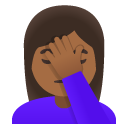
Appearance varies by platform and device. Google Noto, Twemoji, and OpenMoji are open-source.