🙍🏽♀️
The Emoji
Woman Frowning: Medium Skin Tone
U+1F64D U+1F3FD U+200D U+2640 U+FE0F · :woman_frowning_medium_skin_tone:
Trend 45
Meaning layers
- interpretation
- Used to express mild-to-heavy annoyance, being done with a situation, or passive disappointment. Often deployed ironically to say 'I'm not okay but I'm pretending to be fine.'
- tiktok usage
- Appears in comment sections when someone is relatably upset, disappointed by a plot twist, or reacting to cringe content. Also used self-deprecatingly in duets.
- irony level
- 6 / 10
Platform meanings
- meaning
- Signals disappointment, being betrayed by a situation, or reacting to something deeply unsatisfying. Medium skin tone makes it feel personal and specific.
- trend usage
- Used in POV videos, stitch reactions, and 'tell me without telling me' formats where someone is clearly upset but maintaining composure.
- hashtags
- #relatable#disappointment#moods#fyp#notokay
- virality score
- 52 / 100
Cultural meanings
🇺🇸
Western / Gen-Z
Widely used with ironic or self-deprecating humor to express relatable disappointment; often layered with sarcasm rather than genuine distress.
🇵🇰
Pakistan & India
Used by younger women on social media to express frustration with social expectations, family drama, or everyday struggles; generally understood as mild complaint.
🌍
Middle East
Used cautiously by younger women to express personal dissatisfaction online; may be interpreted more literally as distress in conservative contexts.
🌐
Global Neutral
Universally recognized as expressing female displeasure or disappointment; interpreted at face value across most cultural contexts.
🇧🇩
Bangladesh
Used among younger digital users to signal frustration or sadness; more commonly used in private chats than public posts due to conservative social norms.
🇱🇰
Sri Lanka
Deployed in casual conversations among youth to express disappointment or mild frustration, often in a relatable and humorous tone.
🇨🇳
China
Used on platforms like WeChat and Weibo to express personal frustration; the medium skin tone adds a layer of specificity that users appreciate for relatability.
🇯🇵
Japan
Less commonly used than Japanese-specific emoticons (kaomoji), but understood as expressing displeasure; the skin tone modifier is less emphasized culturally.
🇰🇷
South Korea
Used among younger Koreans on KakaoTalk and Twitter to signal disappointment or being upset; sometimes used in fan communities reacting to bad news.
🇹🇼
Taiwan
Understood as expressing sadness or frustration; used in LINE chats among friends to signal low moods or shared disappointment.
🇭🇰
Hong Kong
Used in casual messaging to express dissatisfaction or frustration, often paired with Cantonese slang for comedic or emphatic effect.
🇵🇭
Philippines
Popularly used on Facebook and TikTok to react to relatable disappointments; Filipinos often use it humorously in group chats.
🇮🇩
Indonesia
Common on WhatsApp and Twitter (X) to express being upset or let down; used by young women to communicate emotional states without lengthy explanation.
🇹🇭
Thailand
Used in LINE and Twitter conversations to signal frustration or sadness, often softened with humor in typical Thai communication style.
🇻🇳
Vietnam
Appears in Facebook and Zalo chats to express displeasure or being in a bad mood; younger users apply it with ironic humor.
🇲🇾
Malaysia
Used across WhatsApp and Instagram to convey disappointment or frustration; the medium skin tone resonates well with the diverse Malaysian user base.
🇸🇦
Saudi Arabia
Used primarily by younger women in private messaging to express emotional states discreetly; less common in public social media posts.
🇦🇪
UAE
Used by a cosmopolitan user base to express disappointment or frustration; the skin tone diversity is generally appreciated in the multicultural UAE context.
🇪🇬
Egypt
Used in casual messaging among youth to express frustration or being fed up; often paired with Arabic expressions for emphasis.
🇹🇷
Turkey
Common in Twitter and WhatsApp conversations to signal being upset or disappointed; used both sincerely and ironically by younger users.
🇮🇷
Iran
Used in private messaging apps like Telegram to express frustration or sadness, particularly among younger women navigating social restrictions.
🇳🇬
Nigeria
Used on Twitter and WhatsApp to express displeasure or disappointment; Nigerians often pair it with direct, witty commentary for comic effect.
🇿🇦
South Africa
Used across platforms to signal frustration or sadness; resonates with diverse users and is often used in a relatable, humorous tone.
🇬🇧
UK & Ireland
Used with dry humor and understatement to signal disappointment; fits naturally into British and Irish communication styles of expressing emotion indirectly.
🇫🇷
France
Used to express personal displeasure or frustration; French users may appreciate its subtle emotional expressiveness over more dramatic alternatives.
🇩🇪
Germany
Interpreted straightforwardly as expressing dissatisfaction; used in casual digital communication without heavy ironic layering.
🇪🇸
Spain & Italy
Used expressively to convey being upset or let down; Southern European users often pair it with exclamatory text for emotional amplification.
🇧🇷
Brazil
Used widely on Instagram, Twitter, and WhatsApp to express frustration, sadness, or relatable disappointment; Brazilians often apply it with humor.
🇲🇽
Mexico
Common in messaging apps to signal displeasure or being in a bad mood; used both genuinely and ironically in casual conversations.
🌎
Latin America
Broadly recognized across Latin America as expressing female displeasure; used in casual messaging and social media to signal emotional lows.
🇦🇺
Australia & NZ
Used with typical Australian and Kiwi self-deprecating humor to signal mild disappointment or frustration without taking it too seriously.
How its meaning shifted
- 2010
Skin tone modifiers and gender variants did not yet exist; base frowning person emoji was used generically for displeasure.
- 2015
Skin tone modifiers introduced in Unicode 8.0; early adoption was enthusiastic among users seeking more representative options, though usage was still straightforward.
- 2020
Usage expanded significantly with the rise of emoji-heavy social media culture; began acquiring ironic and self-deprecating layers beyond literal displeasure.
- 2026
Fully embedded in digital emotional vocabulary; used fluidly across ironic, sincere, aesthetic, and meme contexts, with medium skin tone normalized as inclusive default.
See it on every platform
Adjacent emojis
- Often confused with
- woman poutingcrying faceperson gesturing no
- Can replace
- pensive facedisappointed faceunamused face
Share & embed
Frequently asked
01What does the 🙍🏽♀️ Woman Frowning: Medium Skin Tone emoji mean?
A woman with a frowning or displeased expression, shown with medium skin tone. Part of the Unicode gender and skin tone modifier system.
02What does 🙍🏽♀️ mean on TikTok?
Signals disappointment, being betrayed by a situation, or reacting to something deeply unsatisfying. Medium skin tone makes it feel personal and specific.
03What does 🙍🏽♀️ mean on WhatsApp?
Sent to show that you are unhappy with something said or done — a non-verbal 'I'm not pleased with this.'
04What does 🙍🏽♀️ mean in Gen-Z slang?
Used to express mild-to-heavy annoyance, being done with a situation, or passive disappointment. Often deployed ironically to say 'I'm not okay but I'm pretending to be fine.'
05Is the 🙍🏽♀️ emoji safe to use?
Expressing personal disappointment, frustration, or sadness in a non-threatening and relatable way.
06What does 🙍🏽♀️ mean in texting?
This emoji communicates internalized frustration rather than explosive anger — it signals the emotional state of someone who is disappointed but holding back from full expression, often tied to helplessness or social exhaustion.
07What is the shortcode for 🙍🏽♀️?
The shortcode for Woman Frowning: Medium Skin Tone is :woman_frowning_medium_skin_tone:
08What does 🙍🏽♀️ mean in dating?
Not typically used in flirting. If sent, it likely signals that the sender is upset about something the other person did or said.
Safety & usage
- Safe meaning
- Expressing personal disappointment, frustration, or sadness in a non-threatening and relatable way.
- Caution
- Can be used passive-aggressively to signal displeasure at another person without direct communication, potentially fueling conflict.
Generally safe emoji with no NSFW connotations. In rare cases, may be used in passive-aggressive or manipulative messaging patterns.
How it looks across platforms
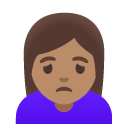
Appearance varies by platform and device. Google Noto, Twemoji, and OpenMoji are open-source.