💇🏿♀️
The Emoji
Woman Getting Haircut: Dark Skin Tone
U+1F487 U+1F3FF U+200D U+2640 U+FE0F · :woman_getting_haircut_dark_skin_tone:
Trend 58
Meaning layers
- interpretation
- Used to signal a glow-up in progress, a self-care day, a major transformation, or treating yourself unapologetically. Often signals 'I'm investing in myself' energy.
- tiktok usage
- Appears in 'new me' transformation videos, self-care vlogs, and 'I finally did it' haircut reveal content. Often paired with before/after clips.
- irony level
- 2 / 10
Platform meanings
- meaning
- Signals a glow-up, transformation, or self-care ritual in progress. Commonly signals a new era or identity shift.
- trend usage
- Used in haircut reveal videos, 'new chapter' montages, and self-care day-in-my-life content. Pairs with trending 'that girl' aesthetic content.
- hashtags
- #GlowUp#HairTransformation#SelfCareSunday#NewMe#BlackGirlMagic
- virality score
- 62 / 100
Cultural meanings
🇺🇸
Western / Gen-Z
Strongly associated with the self-care movement, glow-up culture, and celebrating Black feminine beauty. Widely used and understood as an empowerment symbol.
🇵🇰
Pakistan & India
Primarily interpreted literally as visiting a salon or beauty parlor. The dark skin tone modifier adds cultural resonance in communities discussing colorism and skin tone representation.
🌍
Middle East
Understood as a salon visit emoji; resonates in communities where women's hair care is a significant social and beauty ritual, especially in gender-segregated spaces.
🌐
Global Neutral
Universally recognized as someone receiving hair care services. The skin tone adds specificity and representation for darker-skinned communities worldwide.
🇧🇩
Bangladesh
Interpreted literally as a salon or beauty parlor visit. Less culturally loaded than in Western contexts; straightforwardly signals personal grooming.
🇱🇰
Sri Lanka
Used to represent visiting a beauty salon or getting hair done. Hair care is an important beauty ritual and the emoji is used in practical communication.
🇨🇳
China
Interpreted functionally as getting a haircut or visiting a hair salon. Skin tone modifiers are less culturally emphasized but the base emoji is widely understood.
🇯🇵
Japan
Seen as a grooming or beauty service emoji. Japan's strong beauty culture means it resonates in salon and hair care contexts, though the dark skin tone is less common in local usage.
🇰🇷
South Korea
Associated with beauty salon culture, which is extremely strong in South Korea. The emoji signals professional grooming and self-investment.
🇹🇼
Taiwan
Interpreted as a salon visit or haircut appointment. Used practically in messaging to indicate personal grooming plans.
🇭🇰
Hong Kong
Understood as a haircut or salon visit. Used practically with little additional cultural layering beyond the literal meaning.
🇵🇭
Philippines
Associated with salon culture and self-care. Filipino beauty culture is vibrant and the emoji resonates as a symbol of personal grooming and femininity.
🇮🇩
Indonesia
Used to signal salon visits or hair appointments. Beauty and grooming culture is significant and the emoji is understood in that practical context.
🇹🇭
Thailand
Associated with beauty salons and personal grooming. Thailand's thriving beauty industry makes this emoji recognizable and frequently used in that context.
🇻🇳
Vietnam
Interpreted as a salon or hair care visit. Used practically in communication about personal grooming without significant additional cultural meaning.
🇲🇾
Malaysia
Understood as a salon visit emoji. Used in everyday communication about grooming and self-care across Malaysia's multicultural communities.
🇸🇦
Saudi Arabia
Particularly resonant given the cultural significance of women-only salons in Saudi Arabia, where hair care is a major social and beauty ritual.
🇦🇪
UAE
Associated with the UAE's thriving luxury salon industry. The emoji signals self-care and beauty investment in a culture where appearance is highly valued.
🇪🇬
Egypt
Interpreted as a salon visit. Hair care is culturally significant for Egyptian women and the emoji is used practically in communication about beauty routines.
🇹🇷
Turkey
Associated with beauty salons and personal grooming. Turkish beauty culture is strong and the emoji is used practically to signal salon visits.
🇮🇷
Iran
Understood as a salon or hair care visit. Women-only beauty salons are culturally significant in Iran and the emoji resonates in that context.
🇳🇬
Nigeria
Carries strong cultural resonance — hair care is deeply significant in Nigerian culture and the dark skin tone makes it particularly representative and widely used.
🇿🇦
South Africa
Highly resonant in Black South African communities where hair care carries cultural and identity significance. Widely used to celebrate salon visits and natural hair care.
🇬🇧
UK & Ireland
Used in self-care and transformation contexts. The dark skin tone representation is valued in diverse UK communities, particularly within Black British culture.
🇫🇷
France
Interpreted as a salon visit with some association with the broader self-care aesthetic. France's diverse population makes the dark skin tone representation culturally inclusive.
🇩🇪
Germany
Primarily interpreted functionally as a haircut or salon appointment. Used practically in messaging without significant additional cultural layers.
🇪🇸
Spain & Italy
Associated with beauty salon culture and femininity. Used to signal salon visits or self-care days in these beauty-conscious cultures.
🇧🇷
Brazil
Highly resonant given Brazil's rich hair care culture and significant Afro-Brazilian community. The dark skin tone version is widely embraced and celebrated.
🇲🇽
Mexico
Used to signal salon visits or self-care days. Mexican beauty culture is vibrant and the emoji is understood practically and positively.
🌎
Latin America
Across Latin America, associated with salon culture and femininity. In countries with significant Afro-Latino populations, the dark skin tone adds cultural representation.
🇦🇺
Australia & NZ
Used in self-care and transformation contexts. The dark skin tone is valued for representation in diverse Australian and New Zealand communities.
How its meaning shifted
- 2010
Emoji did not exist yet. The base haircut emoji and skin tone/gender modifiers had not been introduced to Unicode.
- 2015
The base haircut emoji existed but gender and skin tone modifiers were just being introduced in Unicode 8.0. Usage was minimal and largely literal.
- 2020
Widely adopted alongside the surge in self-care culture and Black Lives Matter's influence on celebrating Black identity and beauty. Skin tone representation became a point of intentional use.
- 2026
Embedded in the self-care, soft life, and glow-up lexicon. Frequently used in content celebrating Black feminine beauty, transformation, and unapologetic self-investment.
See it on every platform
Compare with
Adjacent emojis
- Often confused with
- woman getting massagebarber polehaircut
- Can replace
- nail polishwoman in lotus positionsparkles
Share & embed
Frequently asked
01What does the 💇🏿♀️ Woman Getting Haircut: Dark Skin Tone emoji mean?
A woman with dark skin tone receiving a haircut or hair styling service, depicted sitting in a salon chair with scissors near her head.
02What does 💇🏿♀️ mean on TikTok?
Signals a glow-up, transformation, or self-care ritual in progress. Commonly signals a new era or identity shift.
03What does 💇🏿♀️ mean on WhatsApp?
Texted to friends to announce a salon appointment or hair appointment day. Casual shorthand for 'I'm getting my hair done.'
04What does 💇🏿♀️ mean in Gen-Z slang?
Used to signal a glow-up in progress, a self-care day, a major transformation, or treating yourself unapologetically. Often signals 'I'm investing in myself' energy.
05Is the 💇🏿♀️ emoji safe to use?
A woman with dark skin tone getting a haircut or hair styling service. Used to represent self-care, salon visits, beauty routines, and personal transformation.
06What does 💇🏿♀️ mean in texting?
Getting a haircut is psychologically linked to change, control, and identity reinvention. For Black women specifically, hair care carries deep cultural and emotional significance around beauty standards, self-expression, and community.
07What is the shortcode for 💇🏿♀️?
The shortcode for Woman Getting Haircut: Dark Skin Tone is :woman_getting_haircut_dark_skin_tone:
08What does 💇🏿♀️ mean in dating?
Rarely used as a flirt tool; more commonly signals independence and self-investment, which can be indirectly attractive. Sometimes sent to a partner as 'treating myself today, don't wait up.'
Safety & usage
- Safe meaning
- A woman with dark skin tone getting a haircut or hair styling service. Used to represent self-care, salon visits, beauty routines, and personal transformation.
- Caution
- No significant toxic usage patterns documented. Extremely rare misuse potential.
No notable warning flags. The emoji is overwhelmingly used positively to celebrate self-care and Black feminine beauty.
How it looks across platforms
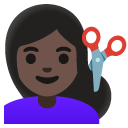
Appearance varies by platform and device. Google Noto, Twemoji, and OpenMoji are open-source.