💆🏿♀️
The Emoji
Woman Getting Massage: Dark Skin Tone
U+1F486 U+1F3FF U+200D U+2640 U+FE0F · :woman_getting_massage_dark_skin_tone:
Trend 55
Meaning layers
- interpretation
- Used to signal needing a break, being stressed out, or treating yourself. Often dropped when someone is mentally exhausted and craving peace. Also used aspirationally when posting self-care content.
- tiktok usage
- Appears in 'self-care Sunday' videos, mental health check-in trends, and 'hot girl summer' wellness content. Often paired with spa routines or relaxation aesthetic videos.
- irony level
- 3 / 10
Platform meanings
- meaning
- Represents relaxation, spa days, self-care routines, and mental health breaks. Dark skin tone version used by Black and dark-skinned creators for representation in wellness spaces.
- trend usage
- Used in 'soft life' trend videos, self-care routines, 'healing era' content, and luxury lifestyle aspirations. Frequently in captions for GRWM or wind-down videos.
- hashtags
- #SelfCareSunday#SoftLife#HealingEra#BlackGirlSelfCare#TreatYourself
- virality score
- 58 / 100
Cultural meanings
🇺🇸
Western / Gen-Z
Symbolizes the 'soft life' and healing era aesthetic, widely embraced by young Black women and allies. Represents unapologetic self-care and rest as a radical act.
🇵🇰
Pakistan & India
Associated with the culturally familiar concept of head massage (champi), making it relatable across South Asian households. Used when discussing stress relief or spa treatments.
🌍
Middle East
Connected to hammam and traditional spa culture common across the region. Used to reference women's wellness spaces and beauty rituals that are culturally significant.
🌐
Global Neutral
Universally understood as representing relaxation, massage, and self-care. The dark skin tone adds diversity representation without altering the core wellness meaning.
🇧🇩
Bangladesh
Associated with head massage traditions passed down generationally, especially hair oiling practices. Used in contexts of rest and recuperation after hard work.
🇱🇰
Sri Lanka
Linked to Ayurvedic massage and wellness traditions. Seen as a symbol of holistic health and self-care, especially relevant in spa and tourism contexts.
🇨🇳
China
Massage culture is deeply embedded in Chinese society. This emoji is used widely to express the desire for a massage, relaxation after work, or visiting a massage parlor.
🇯🇵
Japan
Associated with professional wellness culture, including shiatsu massage. Used in contexts of stress relief and the respected practice of self-care after overwork.
🇰🇷
South Korea
Tied to the thriving K-beauty and wellness industry. Used in self-care content, beauty routines, and spa culture that is increasingly mainstream and aspirational.
🇹🇼
Taiwan
Popular in wellness and relaxation contexts, especially foot and shoulder massage culture. Used casually to express exhaustion and desire for physical relief.
🇭🇰
Hong Kong
Used in fast-paced urban culture contexts to express the need for a break or massage after a demanding work week.
🇵🇭
Philippines
Massage parlors are common and affordable throughout the Philippines. This emoji is used casually when planning or enjoying a massage, representing accessible self-care.
🇮🇩
Indonesia
Associated with traditional Javanese massage and growing wellness tourism. Used by Indonesians to express relaxation goals or spa experiences.
🇹🇭
Thailand
Thailand is globally known for massage tourism. This emoji is commonly used in travel and wellness contexts, and by locals to represent traditional Thai massage culture.
🇻🇳
Vietnam
Used in contexts of relaxation and stress relief. Vietnamese users associate it with spa culture and post-work decompression, increasingly popular among urban youth.
🇲🇾
Malaysia
Reflects growing wellness and self-care culture in Malaysia. Used in lifestyle and beauty content, particularly among urban Malay women embracing self-care aesthetics.
🇸🇦
Saudi Arabia
Used among women in private contexts to represent spa days and self-care routines, which are culturally significant in women-only wellness spaces.
🇦🇪
UAE
Spa and wellness culture is prominent in the UAE. This emoji appears in luxury lifestyle content and among diverse expat communities enjoying high-end self-care.
🇪🇬
Egypt
Associated with hammam traditions and growing modern spa culture. Used by Egyptian women in self-care contexts, particularly in urban Cairo and Alexandria.
🇹🇷
Turkey
Deeply connected to the iconic Turkish hammam tradition. This emoji resonates strongly as a symbol of traditional cleansing and wellness rituals passed through generations.
🇮🇷
Iran
Used in the context of women's beauty and relaxation practices conducted privately. Reflects cultural appreciation for self-care rituals in women-only settings.
🇳🇬
Nigeria
Strongly embraced as part of the 'soft life' movement popular among Nigerian Gen Z and millennials. Dark skin tone representation is celebrated and intentional.
🇿🇦
South Africa
Used within the 'soft life' and self-care cultural movement gaining traction especially among Black South African women celebrating rest and luxury.
🇬🇧
UK & Ireland
Associated with spa days, bank holiday treats, and the growing wellness economy. Popular in Black British communities for its dual function of representation and self-care.
🇫🇷
France
Spa and beauty culture is prestigious in France. Used in wellness and beauty content, though the skin tone diversity is particularly noted and appreciated in diverse French communities.
🇩🇪
Germany
Associated with wellness culture (Wellness kultur) prominent in German society. Used in spa, sauna, and health retreat contexts across lifestyle content.
🇪🇸
Spain & Italy
Reflects the European wellness tradition. Used in lifestyle and beauty contexts, with increasing recognition of diverse skin tone representation in Mediterranean countries.
🇧🇷
Brazil
Connected to Brazil's vibrant beauty and self-care culture. Embraced by Black Brazilian women (mulheres negras) as a representation of their beauty and wellness identity.
🇲🇽
Mexico
Used in spa and self-care content. Resonates within Mexican wellness culture that blends indigenous healing traditions with modern spa experiences.
🌎
Latin America
Broadly used across Latin America in wellness and beauty contexts. Appreciated by Afro-Latinx communities as a representation of their identity in self-care spaces.
🇦🇺
Australia & NZ
Associated with spa days, wellness retreats, and the growing self-care industry. Used in lifestyle content and appreciated in Indigenous and Pacific Islander communities for diverse skin tone representation.
How its meaning shifted
- 2010
This specific emoji did not exist yet. Massage emojis were generic and lacked gender or skin tone modifiers, limiting personal representation.
- 2015
Skin tone modifiers were introduced by Unicode. Early adopters began using diverse skin tone variants to claim representation in digital wellness spaces.
- 2020
Gained significant traction during the pandemic self-care boom and the rise of 'soft life' culture. Black women began intentionally using the dark skin tone variant as an act of digital self-representation.
- 2026
Firmly established as a symbol of rest culture, anti-hustle movements, and Black feminine wellness aesthetics. Regularly used in creator economies, wellness branding, and everyday emotional communication.
See it on every platform
Compare with
Adjacent emojis
Share & embed
Frequently asked
01What does the 💆🏿♀️ Woman Getting Massage: Dark Skin Tone emoji mean?
A woman receiving a head or shoulder massage, displayed with a dark skin tone. The figure is typically shown seated or lying down with hands pressing on the head.
02What does 💆🏿♀️ mean on TikTok?
Represents relaxation, spa days, self-care routines, and mental health breaks. Dark skin tone version used by Black and dark-skinned creators for representation in wellness spaces.
03What does 💆🏿♀️ mean on WhatsApp?
Sent to friends or family to indicate needing rest, a massage, or a spa day. Commonly used after expressing stress or a long week.
04What does 💆🏿♀️ mean in Gen-Z slang?
Used to signal needing a break, being stressed out, or treating yourself. Often dropped when someone is mentally exhausted and craving peace. Also used aspirationally when posting self-care content.
05Is the 💆🏿♀️ emoji safe to use?
Represents self-care, relaxation, spa treatments, and wellness. Entirely positive in standard usage.
06What does 💆🏿♀️ mean in texting?
Psychologically associated with the parasympathetic nervous system response — signals a desire to decompress, release tension, and prioritize personal well-being. Often used when someone has hit a stress threshold.
07What is the shortcode for 💆🏿♀️?
The shortcode for Woman Getting Massage: Dark Skin Tone is :woman_getting_massage_dark_skin_tone:
08What does 💆🏿♀️ mean in dating?
Can be used flirtatiously to hint at wanting pampering or to suggest a couple's spa date. Sometimes sent to a partner as a subtle 'take care of me' signal.
Safety & usage
- Safe meaning
- Represents self-care, relaxation, spa treatments, and wellness. Entirely positive in standard usage.
- Caution
- Rarely used in toxic contexts. Could theoretically be used dismissively to tell someone to 'just relax' when minimizing valid concerns.
No significant safety concerns. The dark skin tone specificity may occasionally attract racially charged commentary in hostile online spaces, but the emoji itself is not problematic.
How it looks across platforms
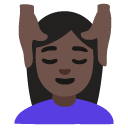
Appearance varies by platform and device. Google Noto, Twemoji, and OpenMoji are open-source.