💇
The Emoji
Person Getting Haircut
U+1F487 · :person_getting_haircut:
Trend 55
Meaning layers
- interpretation
- Used to signal a glow-up in progress, self-care mode, or a fresh start. Often dropped after a big life change or breakup to signal reinvention.
- tiktok usage
- Appears in 'new me' transformation videos, pre-glow-up content, and 'soft life era' posts where someone is treating themselves.
- irony level
- 4 / 10
Platform meanings
- meaning
- Symbol of transformation, self-care, and the 'new chapter' aesthetic. Frequently appears in glow-up montages and 'villain era' content.
- trend usage
- Paired with before/after transformations, post-breakup reinvention videos, and 'soft life' vlogs showing self-investment routines.
- hashtags
- #GlowUp#NewMe#SelfCare#HairTransformation#SalonDay
- virality score
- 62 / 100
Cultural meanings
🇺🇸
Western / Gen-Z
Strongly associated with the 'glow-up' and 'new chapter' narrative — getting a haircut after a breakup or big life change is a culturally recognized ritual, and this emoji encodes that entire arc.
🇵🇰
Pakistan & India
Primarily used literally to indicate a salon visit or haircut appointment; also seen in beauty parlour business promotions on WhatsApp and Instagram.
🌍
Middle East
Used straightforwardly for salon and grooming appointments; popular among women sharing beauty salon experiences, with gender-specific salons being a strong cultural context.
🌐
Global Neutral
Universally understood as representing a haircut or salon visit with no significant secondary meanings across most global audiences.
🇧🇩
Bangladesh
Used literally for haircut-related communication; also appears in small salon business promotions on Facebook and WhatsApp groups.
🇱🇰
Sri Lanka
Primarily literal usage to communicate salon visits; occasionally used in beauty business promotions on social media.
🇨🇳
China
Used casually for haircut appointments on WeChat and Weibo; carries minor superstition awareness as some dates (like the first month of the lunar year) are traditionally avoided for haircuts.
🇯🇵
Japan
Used practically for salon appointments; Japanese beauty culture's high standards for hair mean this emoji can signal meticulous self-care and presentation.
🇰🇷
South Korea
Deeply resonant given K-beauty culture's emphasis on hair as a key beauty element; used to signal salon visits, hair care routines, and transformation moments heavily influenced by idol aesthetics.
🇹🇼
Taiwan
Used similarly to mainland China for practical appointment communication, with growing usage in beauty lifestyle content on Instagram and Dcard.
🇭🇰
Hong Kong
Practical usage for salon bookings; also appears in lifestyle and beauty influencer content reflecting the city's sophisticated urban beauty culture.
🇵🇭
Philippines
Widely used for salon day announcements; the strong beauty salon culture in the Philippines makes this a common emoji in everyday social media posts.
🇮🇩
Indonesia
Used for salon visits and grooming updates; also appears in beauty business promotions on WhatsApp and Instagram, where the local salon industry is booming.
🇹🇭
Thailand
Common in beauty and self-care content; Thailand's thriving salon industry and beauty culture make this a frequently used emoji in lifestyle social media.
🇻🇳
Vietnam
Used practically for haircut appointments and beauty salon check-ins; increasingly appearing in lifestyle content as Vietnam's beauty industry grows.
🇲🇾
Malaysia
Used for salon visits across all communities; also appears in beauty business advertising and self-care lifestyle content on Instagram and TikTok.
🇸🇦
Saudi Arabia
Used in the context of gender-segregated salons; women's beauty salons are a significant social and cultural space, giving this emoji warm, community-oriented associations.
🇦🇪
UAE
Reflects the UAE's luxury salon culture; used in high-end beauty content, spa day announcements, and premium lifestyle posts in a cosmopolitan context.
🇪🇬
Egypt
Used casually for salon visits; beauty salons are important social gathering spaces for women, so this emoji can carry a communal, social outing connotation.
🇹🇷
Turkey
Used for barber shop and salon visits; Turkish barber culture (berber) is globally celebrated, giving this emoji a culturally proud undertone in some contexts.
🇮🇷
Iran
Used practically for salon appointments; women-only beauty salons hold significant social importance, and this emoji can implicitly reference that private social space.
🇳🇬
Nigeria
Used for salon and braiding shop visits; given the rich hair culture in Nigeria — including elaborate braiding traditions — this emoji can represent a broader range of hair experiences.
🇿🇦
South Africa
Used across communities for salon visits; resonates strongly in Black South African communities where hair salons are important cultural and social spaces.
🇬🇧
UK & Ireland
Used casually for haircut appointments; also used in the 'new me' transformation context popular in British pop culture, especially after dramatic personal events.
🇫🇷
France
Used practically for coiffeur (hairdresser) appointments; the French take hair styling seriously as part of overall aesthetic presentation, lending this emoji a certain chic connotation.
🇩🇪
Germany
Used straightforwardly for Friseur (hairdresser) appointments; practical in nature with limited secondary cultural meaning beyond the literal grooming context.
🇪🇸
Spain & Italy
Used for peluquería/parrucchiere visits; hair culture is significant in Mediterranean cultures, and this emoji appears in beauty content with a fashionable, stylish overtone.
🇧🇷
Brazil
Heavily associated with Brazil's world-renowned hair care culture; used enthusiastically for salon visits, Brazilian blowout posts, and beauty transformation content.
🇲🇽
Mexico
Used for salon visits and self-care days; appears in beauty influencer content and everyday social media posts celebrating personal grooming and style.
🌎
Latin America
Broadly used for salon day announcements across Latin America; the strong beauty culture across the region gives this emoji positive, celebratory associations.
🇦🇺
Australia & NZ
Used casually for haircut appointments and 'treat yourself' self-care days; also appears in the 'new look' reveal content popular on Australian TikTok and Instagram.
How its meaning shifted
- 2010
Rarely used; emoji were still gaining traction and this was primarily interpreted in its most literal sense — someone getting a haircut — with no cultural subtext.
- 2015
Gained usage as mobile messaging exploded; primarily literal for salon appointments but beginning to appear in self-care conversations as wellness culture grew.
- 2020
Surged during COVID-19 lockdowns when haircuts became impossible for months, used humorously and longingly; post-lockdown, adopted strongly into 'glow-up' and transformation content.
- 2026
Firmly embedded in the self-care, transformation, and 'new chapter' emoji vocabulary; used across platforms for everything from literal salon announcements to metaphorical life reinventions.
See it on every platform
Compare with
Emoji combinations
Adjacent emojis
- Often confused with
- barber polescissorscrayon
- Can replace
- scissorssparklesnail polish
Share & embed
Frequently asked
01What does the 💇 Person Getting Haircut emoji mean?
A person sitting in a salon chair receiving a haircut from a stylist, depicted with scissors near the head.
02What does 💇 mean on TikTok?
Symbol of transformation, self-care, and the 'new chapter' aesthetic. Frequently appears in glow-up montages and 'villain era' content.
03What does 💇 mean on WhatsApp?
Casually used to tell someone you're at the salon or heading to get a haircut, functioning as a simple activity update.
04What does 💇 mean in Gen-Z slang?
Used to signal a glow-up in progress, self-care mode, or a fresh start. Often dropped after a big life change or breakup to signal reinvention.
05Is the 💇 emoji safe to use?
Personal grooming, salon visits, self-care days, transformation moments, and haircut appointments.
06What does 💇 mean in texting?
Haircuts are psychologically linked to transformation and letting go. This emoji taps into the cathartic feeling of shedding the old self, often used after emotional upheaval or as a positive affirmation ritual.
07What is the shortcode for 💇?
The shortcode for Person Getting Haircut is :person_getting_haircut:
08What does 💇 mean in dating?
Sometimes used flirtatiously to hint at freshening up before a date, implying effort and self-presentation.
Safety & usage
- Safe meaning
- Personal grooming, salon visits, self-care days, transformation moments, and haircut appointments.
- Caution
- Extremely rarely, could be used in threatening contexts about cutting someone's hair without consent, but this is highly uncommon and context-dependent.
No significant safety concerns. This emoji is almost universally benign. In extremely rare edge cases, it could appear in harassment contexts related to hair, but this is not a known pattern.
How it looks across platforms
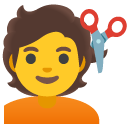


Appearance varies by platform and device. Google Noto, Twemoji, and OpenMoji are open-source.