🏋️♀️
The Emoji
Woman Lifting Weights
U+1F3CB U+FE0F U+200D U+2640 U+FE0F · :woman_lifting_weights:
Trend 78
Meaning layers
- interpretation
- Symbol of female empowerment, hustle culture, and 'that girl' aesthetic. Used to signal grind mentality, gym dedication, or ironically to express doing any kind of hard work — physical or emotional.
- tiktok usage
- Paired with motivational gym content, 'that girl' morning routines, and transformation videos. Also used ironically when someone is doing the bare minimum and calling it a grind.
- irony level
- 5 / 10
Platform meanings
- meaning
- Gym motivation, 'that girl' lifestyle signifier, and ironic hard-worker energy
- trend usage
- Used in gym transformation videos, morning routine content, 'POV: you finally started going to the gym' formats, and sarcastic 'carrying the emotional labor' duets
- hashtags
- #gymgirl#thatgirl#girlswholift#strongwomen#fitcheck
- virality score
- 82 / 100
Cultural meanings
🇺🇸
Western / Gen-Z
A core symbol of the 'that girl' and strong female aesthetic; used both sincerely for gym culture and ironically for emotional labor memes.
🇵🇰
Pakistan & India
Used primarily in literal fitness contexts by gym-going urban youth; also increasingly adopted by women on Instagram to signal fitness empowerment in a traditionally conservative space.
🌍
Middle East
Gaining traction in Gulf youth fitness culture as women's gym access expands; used cautiously but positively to celebrate female physical achievement.
🌐
Global Neutral
Universally understood as a woman exercising or being strong; safe and positive across most global contexts.
🇧🇩
Bangladesh
Used by urban, educated young women in fitness communities on Facebook and Instagram; signals modern, health-conscious identity.
🇱🇰
Sri Lanka
Seen in local gym and wellness social media communities; straightforward fitness symbol with growing empowerment connotations among younger women.
🇨🇳
China
Popular on Weibo and Xiaohongshu (RED) among fitness-focused young women; associated with the 'self-improvement girl' (自律女孩) aesthetic.
🇯🇵
Japan
Used in fitness and wellness contexts; carries a tone of personal discipline (自己管理) and is popular in female gym communities on Twitter and Instagram.
🇰🇷
South Korea
Tied to the 'healthy and beautiful' (헬시뷰티) trend; appears frequently alongside diet and workout content on Instagram and KakaoTalk.
🇹🇼
Taiwan
Used in fitness circles and women's empowerment content; straightforward and positive, appearing on Instagram and LINE.
🇭🇰
Hong Kong
Common in fitness and wellness Instagram content; carries both literal gym meaning and aspirational strong-woman energy.
🇵🇭
Philippines
Used in local gym communities and women's fitness groups on Facebook; also adopted in empowerment posts celebrating hardworking Filipino women.
🇮🇩
Indonesia
Appears in fitness content on Instagram and TikTok; positively received as a symbol of healthy living and increasingly of women's independence.
🇹🇭
Thailand
Popular in fitness and health content; also appears in posts celebrating Thai women athletes and gym culture influencers.
🇻🇳
Vietnam
Used in growing gym and wellness communities on Facebook and TikTok; signals a modern, health-focused lifestyle for young Vietnamese women.
🇲🇾
Malaysia
Common in fitness WhatsApp groups and Instagram posts; appreciated as a positive symbol of women's health and strength across ethnic communities.
🇸🇦
Saudi Arabia
Increasingly visible since women gained access to public gyms in 2018; used proudly by Saudi women on Instagram and Snapchat to celebrate their fitness freedom.
🇦🇪
UAE
Common in Dubai and Abu Dhabi fitness influencer culture; a symbol of the cosmopolitan, wellness-driven lifestyle popular in the Gulf's expat and local communities.
🇪🇬
Egypt
Used by fitness-conscious young Egyptian women on Instagram; signals modernity and health consciousness in urban social media circles.
🇹🇷
Turkey
Popular in Turkish fitness communities on Instagram and Twitter; used both literally and to celebrate strong, independent women (güçlü kadın).
🇮🇷
Iran
Used carefully in private messaging apps by women discussing fitness; carries extra significance as a quiet symbol of female strength and autonomy.
🇳🇬
Nigeria
Embraced in Nigerian fitness influencer culture on Instagram and TikTok; used to celebrate the 'strong Naija woman' archetype.
🇿🇦
South Africa
Common in local fitness communities across races and cultures; used to celebrate women's athletic achievements and gym dedication.
🇬🇧
UK & Ireland
Used in gym culture and women's fitness content; also popular in ironic British humor about women doing all the work in relationships or at the office.
🇫🇷
France
Appears in French fitness and sport content; used sincerely in athletic contexts and occasionally ironically in feminist commentary.
🇩🇪
Germany
Common in fitness-oriented posts and sport content; Germans use it straightforwardly to signal gym activity or athletic discipline.
🇪🇸
Spain & Italy
Used in fitness and wellness content; also adopted in celebratory posts about strong women, often with high-energy Latin flair.
🇧🇷
Brazil
Popular in Brazilian fitness culture, which is intensely gym-focused; used to celebrate the dedicated mulher sarada (fit woman) and appears constantly in fitness influencer content.
🇲🇽
Mexico
Common in Mexican fitness communities on Instagram and TikTok; used to celebrate strong, hardworking Mexican women in both athletic and life contexts.
🌎
Latin America
Broadly used across Latin America to celebrate female strength, gym culture, and the 'mujer fuerte' archetype in both fitness and life.
🇦🇺
Australia & NZ
Used casually in gym and outdoor fitness communities; also appears in ironic Aussie humor about women carrying everything in daily life.
How its meaning shifted
- 2010
Did not exist yet; general weightlifter emoji was male-only and rarely used outside niche fitness contexts.
- 2015
Introduced as part of gender-inclusive emoji updates; initially used mostly literally by fitness enthusiasts and female athletes.
- 2020
Exploded in usage with the rise of the 'strong women' empowerment aesthetic, gym TikTok, and the 'women carrying everything' ironic meme format.
- 2026
Firmly established as both a sincere gym-culture emoji and an ironic shorthand for female strength, emotional labor, and the 'that girl' aesthetic across all major platforms.
See it on every platform
Compare with
Emoji combinations
Adjacent emojis
- Often confused with
- man lifting weightsperson lifting weightswoman cartwheeling
- Can replace
- flexed bicepsfirewoman running
Share & embed
Frequently asked
01What does the 🏋️♀️ Woman Lifting Weights emoji mean?
A woman performing a weightlifting exercise, typically depicted lifting a barbell overhead. Represents physical fitness, strength training, and athletic effort.
02What does 🏋️♀️ mean on TikTok?
Gym motivation, 'that girl' lifestyle signifier, and ironic hard-worker energy
03What does 🏋️♀️ mean on WhatsApp?
Just hit the gym / going to work out / feeling strong today
04What does 🏋️♀️ mean in Gen-Z slang?
Symbol of female empowerment, hustle culture, and 'that girl' aesthetic. Used to signal grind mentality, gym dedication, or ironically to express doing any kind of hard work — physical or emotional.
05Is the 🏋️♀️ emoji safe to use?
Fitness, gym culture, female strength, hard work, determination, and empowerment
06What does 🏋️♀️ mean in texting?
Triggers associations with self-improvement and agency. For many women, this emoji carries significant emotional weight as a symbol of reclaiming physical space and strength in a traditionally male-dominated sphere.
07What is the shortcode for 🏋️♀️?
The shortcode for Woman Lifting Weights is :woman_lifting_weights:
08What does 🏋️♀️ mean in dating?
Used to signal to a potential partner that the sender is fit, disciplined, and health-conscious — a subtle flex. Sometimes sent after a gym date suggestion.
Safety & usage
- Safe meaning
- Fitness, gym culture, female strength, hard work, determination, and empowerment
- Caution
- Rarely weaponized; occasionally appears in toxic fitness culture shaming posts or extreme diet/workout content
Generally safe; minor risk of being used in body-shaming contexts if paired with negative commentary about women's bodies or in toxic hustle culture content promoting overtraining
How it looks across platforms
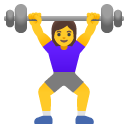
Appearance varies by platform and device. Google Noto, Twemoji, and OpenMoji are open-source.