🏋🏽♀️
The Emoji
Woman Lifting Weights: Medium Skin Tone
U+1F3CB U+1F3FD U+200D U+2640 U+FE0F · :woman_lifting_weights_medium_skin_tone:
Trend 74
Meaning layers
- interpretation
- Symbol of hustle, self-improvement, and 'that girl' energy. Used to signal gym dedication, morning routines, and the grind aesthetic. Also deployed ironically when doing the bare minimum.
- tiktok usage
- Dominates 'that girl' transformation videos, gym check-ins, and motivational montages. Frequently appears in 'gym arc' content where users document their fitness journeys.
- irony level
- 5 / 10
Platform meanings
- meaning
- Represents gym dedication, fitness arcs, and the 'that girl' aesthetic. Used to announce workout content or signal a lifestyle upgrade.
- trend usage
- Appears in gym transformation trends, 5AM routine videos, #GymTok content, and motivational POV videos. The medium skin tone variant is widely used for representation in fitness content.
- hashtags
- #GymTok#ThatGirl#GymArc#WomenWhoLift#FitnessMotivation
- virality score
- 78 / 100
Cultural meanings
🇺🇸
Western / Gen-Z
Core symbol of the 'that girl' aesthetic and gym culture empowerment. Used extensively across social media to signal fitness dedication, self-improvement, and disciplined femme identity.
🇵🇰
Pakistan & India
Increasingly common among urban youth and fitness influencer communities. Represents a modern, health-conscious woman breaking traditional sedentary lifestyle norms — carries a progressive, aspirational connotation.
🌍
Middle East
Growing usage in Gulf fitness communities and among women in urban centers reclaiming physical space. Carries additional weight as a symbol of women's empowerment and agency in traditionally conservative contexts.
🌐
Global Neutral
Universally understood as a symbol of female athletic strength and fitness. Crosses language barriers effectively as a representation of gym culture and physical dedication.
🇧🇩
Bangladesh
Emerging usage among urban youth and fitness-conscious social media users. Often associated with aspirational lifestyle content and modern women breaking expectations around physical activity.
🇱🇰
Sri Lanka
Used by urban fitness communities and gym enthusiasts. Growing among young women as a marker of modern health culture, though still less common in rural or traditional contexts.
🇨🇳
China
Popular on Weibo and Xiaohongshu (Little Red Book) among fitness influencers and '健身' (fitness) content creators. Represents the rising gym culture in Chinese cities and the 'fit girl' aesthetic.
🇯🇵
Japan
Used in fitness and health contexts on platforms like Twitter/X and Instagram. Resonates with the growing women's fitness movement (女性筋トレ) and gym culture that has expanded significantly in Japan.
🇰🇷
South Korea
Tied to the '헬스' (health/gym) culture and idol workout aesthetics. Used by fitness creators and women documenting their 'body profile' photo preparation journeys.
🇹🇼
Taiwan
Used in fitness communities and among health-conscious young women. Appears in gym content, yoga culture, and the broader wellness aesthetic popular on Taiwanese social media.
🇭🇰
Hong Kong
Common in fitness content and urban wellness communities. Reflects Hong Kong's health-conscious culture and active lifestyle branding popular among young professionals.
🇵🇭
Philippines
Used in gym content and fitness motivation posts on Facebook and Instagram. Represents a growing women's fitness movement and the popularity of gym culture among Filipino youth.
🇮🇩
Indonesia
Growing usage in fitness communities and Muslim women's empowerment content. The medium skin tone resonates broadly with Indonesian users' skin tones, adding to its representational appeal.
🇹🇭
Thailand
Used in gym and fitness content across Thai social media. Associated with 'strong girl' culture and the rising popularity of women's weightlifting influenced by Thai Olympic success.
🇻🇳
Vietnam
Increasingly used in urban Vietnamese fitness communities on Zalo and Facebook. Represents modern, health-focused femininity in a culture where women's gym culture is rapidly growing.
🇲🇾
Malaysia
Common in fitness and wellness content on Malaysian social media. Used across diverse ethnic communities to signal gym dedication and an active, health-conscious lifestyle.
🇸🇦
Saudi Arabia
Post-Vision 2030 reforms allowing women's gym access have made this emoji culturally significant. Used to celebrate women's newly normalized fitness freedoms and the growing Saudi female athletic community.
🇦🇪
UAE
Used actively in Dubai and Abu Dhabi's robust fitness culture. Represents the cosmopolitan, health-obsessed lifestyle common in the UAE's expat and local communities alike.
🇪🇬
Egypt
Emerging in Cairo's urban fitness scenes on Instagram and TikTok. Represents a modern Egyptian woman navigating fitness culture and pushing back against traditional expectations around women's physical activity.
🇹🇷
Turkey
Used in Turkish fitness communities and by women in gym culture content. Carries a dual meaning of physical strength and modern feminist identity in contemporary Turkish social media.
🇮🇷
Iran
Used discreetly in fitness communities and among diaspora. Carries symbolic weight as representation of Iranian women's resilience and physical agency amid restrictions on women's public athletic participation.
🇳🇬
Nigeria
Popular in Lagos fitness communities and among the growing Nigerian gym culture influencer space. Used to signal an active lifestyle and modern health consciousness among urban Nigerian women.
🇿🇦
South Africa
Common in South African gym culture and fitness content. Used across racial communities to signal dedication to health and fits naturally into the country's diverse, sport-loving cultural identity.
🇬🇧
UK & Ireland
Standard gym culture emoji used in fitness content, CrossFit communities, and women's sport advocacy contexts. Associated with strong, empowered femininity in British and Irish online spaces.
🇫🇷
France
Used in French fitness culture and sport content. In France it also fits into broader conversations about women in sport following high-profile French female athletes' visibility at major competitions.
🇩🇪
Germany
Common in German fitness and sport content, particularly in communities around functional fitness, CrossFit, and women's strength training. Reflects Germany's strong sport culture.
🇪🇸
Spain & Italy
Used in fitness and wellness content across Spanish and Italian social media. Resonates with Mediterranean wellness culture and the rising popularity of women's gym culture in Southern Europe.
🇧🇷
Brazil
Extremely popular in Brazil's highly active fitness culture. Used extensively in academia (gym) content, bodybuilding communities, and by the massive Brazilian fitness influencer ecosystem.
🇲🇽
Mexico
Common in Mexican fitness content on Instagram and TikTok. Represents 'chica fitness' culture and the growing women's strength training movement across Mexican urban centers.
🌎
Latin America
Broadly used across Latin American fitness communities as a universal signal of gym dedication and strong woman identity. Resonates with the booming fitness influencer culture across the region.
🇦🇺
Australia & NZ
Widely used in Australian and New Zealand gym culture and outdoor fitness content. Fits the region's active lifestyle identity and is common in CrossFit, functional fitness, and women's sport communities.
How its meaning shifted
- 2010
This specific emoji did not exist yet. Weightlifting emojis were not part of Unicode, and skin tone modifiers had not been introduced. Fitness online communities used text-based expressions or basic gym images.
- 2015
Emoji was introduced as part of Unicode 8.0 in 2015 with basic skin tone support. Early adoption was primarily literal — used in gym-related contexts and fitness app interfaces with limited cultural nuance.
- 2020
Gained significant cultural traction with the rise of 'that girl' TikTok aesthetic, quarantine home workout culture, and increased representation conversations. Became a staple in fitness content and women's empowerment posts.
- 2026
A fully embedded cultural symbol representing women's fitness culture, personal development arcs, and empowered femininity. Used both sincerely in gym content and ironically in meme culture, with strong cross-cultural adoption across global social media platforms.
See it on every platform
Compare with
Adjacent emojis
- Often confused with
- man lifting weightsperson lifting weightswoman bouncing ball
- Can replace
- flexed bicepsfiretrophy
Share & embed
Frequently asked
01What does the 🏋🏽♀️ Woman Lifting Weights: Medium Skin Tone emoji mean?
A woman with medium skin tone performing a weightlifting exercise, typically depicted pressing a barbell overhead. Represents strength training, fitness, gym culture, and athletic empowerment.
02What does 🏋🏽♀️ mean on TikTok?
Represents gym dedication, fitness arcs, and the 'that girl' aesthetic. Used to announce workout content or signal a lifestyle upgrade.
03What does 🏋🏽♀️ mean on WhatsApp?
Telling a friend you're at the gym, just finished a workout, or are proud of your fitness progress. Common in group fitness chats.
04What does 🏋🏽♀️ mean in Gen-Z slang?
Symbol of hustle, self-improvement, and 'that girl' energy. Used to signal gym dedication, morning routines, and the grind aesthetic. Also deployed ironically when doing the bare minimum.
05Is the 🏋🏽♀️ emoji safe to use?
A straightforward representation of a woman weightlifting. Used for fitness, motivation, empowerment, and gym culture content without harmful connotations in the vast majority of contexts.
06What does 🏋🏽♀️ mean in texting?
The emoji taps into self-efficacy psychology — the belief in one's capacity to execute behaviors to produce specific outcomes. It signals agency, physical autonomy, and a growth mindset, especially resonant for women reclaiming physical spaces historically male-dominated.
07What is the shortcode for 🏋🏽♀️?
The shortcode for Woman Lifting Weights: Medium Skin Tone is :woman_lifting_weights_medium_skin_tone:
08What does 🏋🏽♀️ mean in dating?
Used to signal an active, health-conscious lifestyle as a form of attractive self-presentation. Can imply 'I have discipline and take care of myself' as a subtle flex in dating profiles.
Safety & usage
- Safe meaning
- A straightforward representation of a woman weightlifting. Used for fitness, motivation, empowerment, and gym culture content without harmful connotations in the vast majority of contexts.
- Caution
- Rarely used in body-shaming contexts or toxic fitness culture discussions. Can occasionally appear in content promoting unhealthy body standards or extreme diet culture, though this is uncommon.
Generally safe for all audiences. Minor concern in contexts promoting extreme fitness obsession, disordered eating culture, or when used to shame sedentary individuals. Not commonly weaponized for harm.
How it looks across platforms
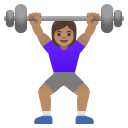
Appearance varies by platform and device. Google Noto, Twemoji, and OpenMoji are open-source.