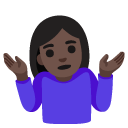
🤷🏿♀️
The Emoji
Woman Shrugging: Dark Skin Tone
U+1F937 U+1F3FF U+200D U+2640 U+FE0F · :woman_shrugging_dark_skin_tone:
Trend 82
Meaning layers
- interpretation
- Peak unbothered energy. Used to signal that you genuinely do not care, have no explanation, or are choosing chaos intentionally. Also used as a self-aware acknowledgment of doing something questionable.
- tiktok usage
- Appears in comment sections under chaotic or relatable content, often paired with captions like 'me explaining my life choices 🤷🏿♀️' or used as a reaction to drama the creator refuses to engage with.
- irony level
- 7 / 10
Platform meanings
- meaning
- Universal 'not my circus, not my monkeys' energy. Used to react to absurd situations or to own chaotic behavior without apology.
- trend usage
- Appears heavily in POV videos, story-times about unbothered moments, and comment sections of drama videos where users refuse to pick sides.
- hashtags
- #unbothered#idontcare#blackgirlmagic#notmyproblem#shruglife
- virality score
- 85 / 100
Cultural meanings
🇺🇸
Western / Gen-Z
The definitive unbothered emoji for Gen Z women in Western contexts, carrying strong connotations of self-assurance, chaos acceptance, and refusing to justify personal choices.
🇵🇰
Pakistan & India
Used by younger urban women to signal indifference to social pressure or family expectations, often in private chats with friends rather than public posts due to cultural conservatism.
🌍
Middle East
Increasingly used by young Arab women on social media to express frustration or neutrality, though the gender-specific nature makes it more common in private or female-only spaces.
🌐
Global Neutral
Broadly understood as 'I don't know' or 'I don't care' across cultures, making it one of the more universally readable gesture emojis regardless of linguistic context.
🇧🇩
Bangladesh
Primarily used by younger, internet-savvy women in urban centers to signal indifference or lack of information, though the dark skin tone can carry additional meaning as a representation choice.
🇱🇰
Sri Lanka
Used casually among young people to express uncertainty or nonchalance, though the specific skin tone and gender combination is sometimes overlooked in favor of the gesture's core meaning.
🇨🇳
China
Less commonly used due to Chinese platforms favoring domestic emoji sets, but on international platforms like Instagram or Twitter, Chinese users understand it as a 'whatever' gesture.
🇯🇵
Japan
The shrug gesture is less culturally native in Japan where more subtle expressions are preferred, so this emoji is often interpreted literally as confusion rather than confident indifference.
🇰🇷
South Korea
Popular among K-pop fan communities and younger Korean women on platforms like Twitter and Instagram to express playful indifference to drama or shipping wars.
🇹🇼
Taiwan
Used similarly to Western contexts among younger Taiwanese internet users, often in mixed English-Mandarin digital conversations to signal unbothered or carefree attitudes.
🇭🇰
Hong Kong
Common in bilingual online spaces to express detachment from political or social drama, carrying a subtle undertone of 'I'm not getting involved in this'.
🇵🇭
Philippines
Widely used and well-understood, especially in Filipina online communities where it expresses the local concept of 'bahala na' (come what may) attitude in digital form.
🇮🇩
Indonesia
Used among younger Indonesian women to express a casual 'santai' (relaxed) attitude, fitting naturally into the cultural appreciation for non-confrontational communication.
🇹🇭
Thailand
Interpreted as a friendly, non-confrontational expression of uncertainty — fits well with Thai communication norms that avoid direct conflict or strong negative expressions.
🇻🇳
Vietnam
Used by younger Vietnamese women on social media to signal a modern, independent attitude, sometimes as pushback against traditional expectations in a subtle digital way.
🇲🇾
Malaysia
Common across Malaysia's multicultural online spaces as a universal 'I don't know' or 'whatever' emoji, understood across Malay, Chinese, and Indian Malaysian communities.
🇸🇦
Saudi Arabia
Used primarily by young Saudi women in private group chats to express frustration or indifference, with the dark skin tone sometimes specifically chosen to show solidarity with diverse representation.
🇦🇪
UAE
Popular in Dubai and Abu Dhabi's cosmopolitan youth culture across expat and local communities alike, used casually across platforms to signal unbothered confidence.
🇪🇬
Egypt
Common in Egyptian youth online culture to express a resigned 'maalesh' (never mind) attitude, fitting naturally into a culture with rich traditions of fatalistic humor.
🇹🇷
Turkey
Used by younger Turkish women on social media to signal a modern, assertive personality — the emoji's indifference energy resonates with a generation pushing against traditional gender expectations.
🇮🇷
Iran
Used carefully by Iranian women on international platforms as a subtle expression of personal freedom and indifference to restrictive norms, carrying quiet subversive energy.
🇳🇬
Nigeria
One of the most culturally resonant uses globally — Nigerian women and the diaspora embrace this emoji as an extension of 'I'm unbothered' slay culture rooted in Afrobeats-era confidence.
🇿🇦
South Africa
Widely used across South African social media, particularly in Black South African online spaces where it aligns with local expressions of confidence and nonchalance.
🇬🇧
UK & Ireland
Common in British and Irish online culture with a distinctly dry humor flavor — often used to punctuate self-deprecating observations or to shut down pointless arguments.
🇫🇷
France
Resonates well in French digital culture where a Gallic shrug is already a cultural institution — this emoji is seen as the digital equivalent of the classic French 'bof' (meh).
🇩🇪
Germany
Used more literally than culturally — German users most often deploy it to signal genuine uncertainty rather than the ironic unbothered connotation common in Anglo-American spaces.
🇪🇸
Spain & Italy
Fits naturally into expressive Mediterranean communication culture, often paired with other emojis to dramatize stories of frustration or resigned acceptance.
🇧🇷
Brazil
Extremely popular in Brazilian digital culture, especially among Black Brazilian women in Afro-Brazilian online communities who use it to express confidence and self-ownership.
🇲🇽
Mexico
Used casually across Mexican social media with a 'ni modo' (what can you do) energy — the dark skin tone version is increasingly chosen as a representation of mestiza and Afro-Mexican women.
🌎
Latin America
Broadly understood across Latin American markets as a symbol of carefree confidence, fitting into a pan-regional digital culture that values expressive, personality-driven communication.
🇦🇺
Australia & NZ
Common in Australian and New Zealand online spaces, especially among BIPOC communities, carrying similar unbothered and 'she'll be right' energy with an added layer of cultural representation.
How its meaning shifted
- 2010
The base shrug emoji did not yet exist in this form — skin tone modifiers and gender sequences had not been standardized by Unicode, so representation was limited.
- 2015
Skin tone modifiers began rolling out with Unicode 8.0 (2015) and the woman shrugging variant emerged shortly after, initially used primarily as a straightforward 'I don't know' in text messages.
- 2020
By 2020, the emoji had become a cornerstone of Black girl internet culture, synonymous with unbothered confidence and widely used in memes, tweets, and TikTok captions.
- 2026
Now a fully culturally coded emoji in digital communication — its meaning extends far beyond confusion into a multi-layered symbol of feminine confidence, detachment, and self-possession, especially in Black and diaspora online communities.
See it on every platform
Compare with
Adjacent emojis
Share & embed
Frequently asked
01What does the 🤷🏿♀️ Woman Shrugging: Dark Skin Tone emoji mean?
A woman with dark skin tone shrugging her shoulders, palms facing upward, indicating uncertainty, indifference, or lack of knowledge.
02What does 🤷🏿♀️ mean on TikTok?
Universal 'not my circus, not my monkeys' energy. Used to react to absurd situations or to own chaotic behavior without apology.
03What does 🤷🏿♀️ mean on WhatsApp?
Casual 'I don't know' or 'whatever happens, happens' — often a conversation-ender when someone is tired of discussing a topic.
04What does 🤷🏿♀️ mean in Gen-Z slang?
Peak unbothered energy. Used to signal that you genuinely do not care, have no explanation, or are choosing chaos intentionally. Also used as a self-aware acknowledgment of doing something questionable.
05Is the 🤷🏿♀️ emoji safe to use?
A universally benign gesture of indifference, uncertainty, or unbothered confidence — poses no harm in standard use.
06What does 🤷🏿♀️ mean in texting?
The shrug gesture psychologically signals a detachment from responsibility or outcome. For dark-skin-toned women specifically, this emoji carries additional cultural weight as a symbol of unbothered resilience and Black female self-assurance online.
07What is the shortcode for 🤷🏿♀️?
The shortcode for Woman Shrugging: Dark Skin Tone is :woman_shrugging_dark_skin_tone:
08What does 🤷🏿♀️ mean in dating?
Used flirtatiously to play coy, like 'maybe I like you, maybe I don't 🤷🏿♀️' — signals playful indifference to keep the other person guessing.
Safety & usage
- Safe meaning
- A universally benign gesture of indifference, uncertainty, or unbothered confidence — poses no harm in standard use.
- Caution
- Can occasionally be used dismissively in arguments to gaslight or minimize someone's concerns — the 'whatever' energy becomes passive-aggressive when used to shut down legitimate grievances.
In rare cases used to dismiss mental health disclosures or serious concerns with false lightness — context-dependent. The skin tone specificity also means misuse by other groups as mockery is possible though uncommon.
How it looks across platforms
Appearance varies by platform and device. Google Noto, Twemoji, and OpenMoji are open-source.