🤷🏽♀️
The Emoji
Woman Shrugging: Medium Skin Tone
U+1F937 U+1F3FD U+200D U+2640 U+FE0F · :woman_shrugging_medium_skin_tone:
Trend 78
Meaning layers
- interpretation
- Used to express unbothered energy, plausible deniability, or a 'not my problem' attitude. Often signals that someone is done explaining themselves or simply does not care.
- tiktok usage
- Appears in captions and comments to punctuate relatable 'I gave up' moments, self-deprecating humor, or chaotic life decisions with zero regret.
- irony level
- 7 / 10
Platform meanings
- meaning
- Signals unbothered chaos energy, used to punctuate self-aware bad decisions or to cap off a story with maximum nonchalance.
- trend usage
- Frequently appears in 'POV: you did something dumb but feel no remorse' content, girl math trends, and 'soft life' era videos.
- hashtags
- #unbothered#girlmath#notmyproblem#itswhatiitis#shrug
- virality score
- 82 / 100
Cultural meanings
🇺🇸
Western / Gen-Z
Core emoji in Western Gen Z communication — universally understood as unbothered indifference or comedic resignation. Skin tone modifier makes it feel personal and intentional rather than generic.
🇵🇰
Pakistan & India
Used widely among urban youth on Instagram and WhatsApp to express 'kya karen' (what can we do) energy — fits naturally into fatalistic humor about life circumstances.
🌍
Middle East
Popular among younger Arab women on Instagram and TikTok to express nonchalance, especially in the context of navigating social expectations with quiet defiance.
🌐
Global Neutral
Broadly understood across cultures as a gesture of uncertainty or indifference — the medium skin tone makes it more universally relatable than lighter or darker alternatives for many users.
🇧🇩
Bangladesh
Used in urban digital spaces among youth to express helplessness about systemic issues or everyday chaos — a digital equivalent of 'ki korbo' (what can I do).
🇱🇰
Sri Lanka
Adopted by younger Sri Lankan social media users to react to absurd local news or relatable everyday struggles with dry humor.
🇨🇳
China
Less common on domestic platforms like WeChat due to native emoji ecosystems, but used by internationally connected youth on Instagram and Twitter to signal Western-coded casualness.
🇯🇵
Japan
Used by younger Japanese users familiar with Western internet culture; the shrug gesture is not a traditional Japanese expression, so it reads as a borrowed, modern-internet signal of indifference.
🇰🇷
South Korea
Adopted in K-pop fan communities and among digitally fluent youth — often used in reactions to idol drama or fandom discourse to signal 'not my problem' detachment.
🇹🇼
Taiwan
Used among digitally active youth in a similar Western-internet-influenced way — signals casual indifference or amused resignation in social media comments.
🇭🇰
Hong Kong
Common in bilingual social media contexts — used to signal nonchalance in English-language posts or mixed-language group chats, especially among younger users.
🇵🇭
Philippines
Widely used among Filipino youth on TikTok and Twitter — fits seamlessly into 'chill lang' (just chill) culture and is often paired with self-deprecating humor.
🇮🇩
Indonesia
Popular among urban Indonesian Gen Z on TikTok and Instagram — used to project a relaxed attitude and fits into the 'santai aja' (just relax) cultural vibe.
🇹🇭
Thailand
Used by Thai social media users to express mild confusion or carefree indifference, often in response to celebrity gossip or trending topics.
🇻🇳
Vietnam
Appears in Vietnamese youth social media to signal resignation or indifference, especially in reaction to stressful academic or work situations — a digital 'thôi kệ' (just let it go).
🇲🇾
Malaysia
Common in Malaysian group chats and social media among younger users — used across Malay, Chinese, and Indian Malaysian communities to signal casual unconcern.
🇸🇦
Saudi Arabia
Used by younger Saudi women on social media as a subtle expression of autonomy and unbothered confidence, sometimes carrying an undertone of quiet defiance.
🇦🇪
UAE
Popular in the multicultural UAE digital space — used by expats and Emirati youth alike to express indifference or casual humor in English-language posts.
🇪🇬
Egypt
Used among Egyptian youth on social media to express 'maalesh' (never mind / it doesn't matter) energy — fits the cultural tradition of fatalistic humor.
🇹🇷
Turkey
Common in Turkish social media among younger users to express 'ne yapayım' (what can I do) sentiment — used in reaction to both personal and political frustrations.
🇮🇷
Iran
Used by younger Iranians on Instagram and Telegram to project unbothered energy, sometimes carrying a layer of resilient indifference in the face of everyday challenges.
🇳🇬
Nigeria
Widely used in Nigerian Twitter and Instagram — pairs naturally with 'e don do' (it's over) or 'e be like' humor, fitting into the culture of laughing through adversity.
🇿🇦
South Africa
Popular across South African youth social media — used in English and mixed-language contexts to express resignation or humorous indifference to load shedding, politics, or daily chaos.
🇬🇧
UK & Ireland
Used with dry British and Irish humor — the shrug amplifies understatement, fitting perfectly into the cultural preference for expressing frustration without drama.
🇫🇷
France
Resonates culturally with the French 'bof' (meh) attitude — used to project intellectual detachment or fashionable indifference on social media.
🇩🇪
Germany
Used among younger Germans to signal casual uncertainty or to avoid committing to an opinion — slightly ironic given the cultural preference for directness.
🇪🇸
Spain & Italy
Popular among younger Mediterranean users — the shrug gesture maps well to local nonverbal communication traditions; used to express 'que será será' or 'pazienza' energy.
🇧🇷
Brazil
Heavily used in Brazilian social media — fits into the cultural humor of 'se vira' (figure it out) and is paired frequently with self-deprecating memes about daily chaos.
🇲🇽
Mexico
Common in Mexican social media to express 'ni modo' (oh well) resignation — used with humor and warmth rather than cold indifference.
🌎
Latin America
Broadly adopted across Latin America to express the widespread cultural philosophy of making peace with what you cannot control — warm, communal indifference.
🇦🇺
Australia & NZ
Used with classic Australian and Kiwi 'she'll be right' energy — the shrug is a natural digital extension of the cultural norm of not overreacting to problems.
How its meaning shifted
- 2010
The shrug emoji did not yet exist in this form; the concept was expressed via the ASCII kaomoji '¯\_(ツ)_/¯' in early internet culture.
- 2015
Basic shrug emojis began appearing post-Unicode 9 development; skin tone modifiers and gender variants were not yet standardized, limiting personalized use.
- 2020
The woman shrugging with medium skin tone became a staple of meme culture — heavily used during pandemic-era social media to express collective helplessness and dark humor.
- 2026
Deeply embedded in Gen Z and millennial digital vocabulary — used across all major platforms as a versatile signal of unbothered confidence, ironic indifference, and self-aware chaos.
See it on every platform
Compare with
Adjacent emojis
- Often confused with
- woman gesturing noperson gesturing okwaving hand
Share & embed
Frequently asked
01What does the 🤷🏽♀️ Woman Shrugging: Medium Skin Tone emoji mean?
A woman with medium skin tone raising both hands with palms up and shoulders raised, expressing uncertainty, indifference, or a lack of knowledge.
02What does 🤷🏽♀️ mean on TikTok?
Signals unbothered chaos energy, used to punctuate self-aware bad decisions or to cap off a story with maximum nonchalance.
03What does 🤷🏽♀️ mean on WhatsApp?
Casual 'I don't know' or 'I give up trying to explain' in group chats or one-on-one conversations.
04What does 🤷🏽♀️ mean in Gen-Z slang?
Used to express unbothered energy, plausible deniability, or a 'not my problem' attitude. Often signals that someone is done explaining themselves or simply does not care.
05Is the 🤷🏽♀️ emoji safe to use?
Expresses harmless indifference, uncertainty, or casual unbothered energy — entirely safe in most social contexts.
06What does 🤷🏽♀️ mean in texting?
Psychologically signals a disengagement from conflict or responsibility. Can be a defense mechanism against vulnerability — appearing nonchalant to avoid showing deeper frustration or anxiety.
07What is the shortcode for 🤷🏽♀️?
The shortcode for Woman Shrugging: Medium Skin Tone is :woman_shrugging_medium_skin_tone:
08What does 🤷🏽♀️ mean in dating?
Used flirtatiously to play coy — implying 'maybe' or 'who knows' when asked about feelings or plans, keeping the other person guessing.
Safety & usage
- Safe meaning
- Expresses harmless indifference, uncertainty, or casual unbothered energy — entirely safe in most social contexts.
- Caution
- Can be used passive-aggressively to dismiss someone's concerns or gaslight by feigning ignorance about a situation the sender is clearly aware of.
In conflict situations, repeated use can signal emotional unavailability or deliberate deflection — may come across as dismissive to sensitive recipients.
How it looks across platforms
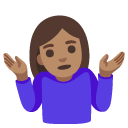
Appearance varies by platform and device. Google Noto, Twemoji, and OpenMoji are open-source.