🦸🏼♀️
The Emoji
Woman Superhero: Medium-light Skin Tone
U+1F9B8 U+1F3FC U+200D U+2640 U+FE0F · :woman_superhero_mediumlight_skin_tone:
Trend 68
Meaning layers
- interpretation
- Used to hype up a friend or oneself for doing something impressive, brave, or selfless. Conveys 'main character energy' or celebrating someone who is holding everything together.
- tiktok usage
- Appears in 'she said what she said' moments, girl boss transformations, and 'not all heroes wear capes' content where someone does something unexpectedly kind or powerful.
- irony level
- 4 / 10
Platform meanings
- meaning
- Represents transformation, female empowerment, and hyping up extraordinary moments or people. Used in POV videos and 'I did it' celebration clips.
- trend usage
- Heavily used in 'glow up' videos, female empowerment duets, and reaction content praising a woman for standing up for herself.
- hashtags
- #WomanSuperhero#ShesTheBoss#GirlPower#MainCharacter#SuperwomanVibes
- virality score
- 72 / 100
Cultural meanings
🇺🇸
Western / Gen-Z
Core emoji for celebrating female empowerment, used ironically and sincerely to hype up women doing impressive or even mundane-but-relatable things. Deeply embedded in girl-boss and anti-girl-boss cultural discourse.
🇵🇰
Pakistan & India
Used to celebrate strong women — mothers, sisters, or public figures — in a culture where female strength is increasingly celebrated online. Also popular in Bollywood fan communities praising action heroines.
🌍
Middle East
Gaining traction among younger, urban populations to express admiration for resilient women, often in contexts of social media activism or celebrating firsts for women in various fields.
🌐
Global Neutral
Universally understood as a symbol of female strength and heroism, transcending language barriers and used across cultures to celebrate women who go above and beyond.
🇧🇩
Bangladesh
Used by younger urban women on social media to celebrate achievements and express solidarity; growing in popularity as female empowerment narratives gain momentum online.
🇱🇰
Sri Lanka
Employed in social media contexts to celebrate women overcoming societal challenges or achieving professional firsts; resonates with younger, digitally connected populations.
🇨🇳
China
Used on platforms like WeChat and Weibo to celebrate independent, strong women — often in the context of career achievements or female solidarity, fitting the '独立女性' (independent woman) cultural narrative.
🇯🇵
Japan
Associated with female anime and manga heroines; used in fandom communities and among young women to express strength, often paired with warrior or magical girl aesthetics.
🇰🇷
South Korea
Popular in fan communities celebrating 'girl crush' idol aesthetics and female empowerment; also used to praise women who break societal norms or achieve in competitive fields.
🇹🇼
Taiwan
Used to celebrate progressive female figures and achievements in a society with strong gender equality discourse; common in feminist online communities and K-pop adjacent fandoms.
🇭🇰
Hong Kong
Appears in contexts celebrating resilient women, particularly those who navigate professional and personal challenges; also used in activist and feminist digital spaces.
🇵🇭
Philippines
Widely used to celebrate 'malakas na babae' (strong woman) energy — mothers, frontliners, and community leaders are frequently tagged with this emoji in social media tributes.
🇮🇩
Indonesia
Used to celebrate strong women, particularly mothers and professionals breaking barriers; resonates with Islamic feminist movements and modern empowerment narratives online.
🇹🇭
Thailand
Common in fan culture and beauty communities to celebrate women who are both powerful and glamorous; also used in LGBTQ+ communities to celebrate trans women and gender-nonconforming individuals.
🇻🇳
Vietnam
Emerging in younger digital spaces to celebrate ambitious women; pairs well with hustle culture narratives and female entrepreneurship content growing on Vietnamese social media.
🇲🇾
Malaysia
Used across ethnic communities to celebrate women achieving firsts or handling hardship with grace; also popular in cosplay and anime fan communities.
🇸🇦
Saudi Arabia
Increasingly used by younger Saudi women on social media to celebrate the expanding roles of women in society post-Vision 2030 reforms; represents a hopeful, aspirational tone.
🇦🇪
UAE
Used in diverse, cosmopolitan digital spaces to celebrate both local Emirati women breaking barriers and the multicultural expat female community achieving milestones.
🇪🇬
Egypt
Employed to celebrate women who defy expectations in a society navigating tradition and modernity; popular in feminist digital communities and among admirers of strong public female figures.
🇹🇷
Turkey
Used to celebrate resilient Turkish women navigating societal pressures; spikes around feminist awareness days and when prominent women make headlines for standing their ground.
🇮🇷
Iran
Used quietly but meaningfully in digital spaces to celebrate courageous women, especially in the context of the women's rights movement; carries significant emotional weight.
🇳🇬
Nigeria
Popular in celebrating 'Naija queens' — strong, successful, and resilient women; frequently used in Afrobeats fan communities celebrating female artists and in hustle-culture content.
🇿🇦
South Africa
Used to celebrate powerful women across communities — from Zulu queens to urban professionals — and resonates with Rainbow Nation narratives of female resilience and achievement.
🇬🇧
UK & Ireland
Used with both sincerity and dry irony — genuinely to praise impressive women but also sarcastically in self-deprecating humor about doing the bare minimum heroically.
🇫🇷
France
Employed in the context of celebrating women who embody 'la femme forte' archetype; also appears in feminist discourse and pop culture commentary.
🇩🇪
Germany
Used in professional and social contexts to acknowledge strong women — often without irony — in a culture that values competence and directness.
🇪🇸
Spain & Italy
Associated with passionate, fierce women — used to celebrate women who are bold, dramatic, and unapologetically powerful; popular in fandom and pop culture communities.
🇧🇷
Brazil
Widely used to celebrate 'mulher poderosa' (powerful woman) energy — from celebrating female athletes to everyday women managing complex lives with extraordinary grace.
🇲🇽
Mexico
Used to celebrate strong women rooted in the cultural archetype of the powerful Mexican mother ('mamá chingona') and increasingly in feminist activist digital spaces.
🌎
Latin America
Broadly used across Latin American countries to celebrate resilient women, female solidarity, and achievements in arts, sports, and activism; carries deep cultural resonance.
🇦🇺
Australia & NZ
Used with casual enthusiasm to hype up impressive women — common in both sincere empowerment contexts and laid-back ironic usage typical of Australian humor.
How its meaning shifted
- 2010
This emoji did not exist yet — superhero emojis were not part of the Unicode standard, and the concept of skin-toned female superhero emojis was years away.
- 2015
Still non-existent in standard sets; the broader push for diverse and gender-inclusive emoji representation was just beginning to gain traction in public discourse.
- 2020
Established as a go-to empowerment emoji following its 2018 introduction; heavily used during COVID-19 to celebrate frontline workers, particularly women in healthcare.
- 2026
Deeply embedded in everyday digital communication as a multipurpose emoji for empowerment, irony, and celebration; skin tone variants are used deliberately to signal inclusive representation.
See it on every platform
Compare with
Adjacent emojis
- Often confused with
- woman fairywoman mageperson superhero
- Can replace
- firecrownflexed biceps
Share & embed
Frequently asked
01What does the 🦸🏼♀️ Woman Superhero: Medium-light Skin Tone emoji mean?
A female superhero with medium-light skin tone, depicted wearing a superhero costume, often with a cape, symbolizing extraordinary power, heroism, and courage.
02What does 🦸🏼♀️ mean on TikTok?
Represents transformation, female empowerment, and hyping up extraordinary moments or people. Used in POV videos and 'I did it' celebration clips.
03What does 🦸🏼♀️ mean on WhatsApp?
Sent to praise a friend who handled a difficult situation like a champion, or to call someone your personal hero.
04What does 🦸🏼♀️ mean in Gen-Z slang?
Used to hype up a friend or oneself for doing something impressive, brave, or selfless. Conveys 'main character energy' or celebrating someone who is holding everything together.
05Is the 🦸🏼♀️ emoji safe to use?
Celebration of female strength, heroism, and empowerment; used to uplift and praise women in personal and professional contexts.
06What does 🦸🏼♀️ mean in texting?
Triggers associations with agency, strength, and altruism. Psychologically linked to identity affirmation and aspirational self-perception, especially among younger women seeking role models.
07What is the shortcode for 🦸🏼♀️?
The shortcode for Woman Superhero: Medium-light Skin Tone is :woman_superhero_mediumlight_skin_tone:
08What does 🦸🏼♀️ mean in dating?
Sent to a crush to say 'you saved my day' or to playfully position oneself as the strong, independent one in a flirty dynamic. Can imply 'I don't need saving but I'd let you try.'
Safety & usage
- Safe meaning
- Celebration of female strength, heroism, and empowerment; used to uplift and praise women in personal and professional contexts.
- Caution
- Rarely used negatively, but can be deployed sarcastically to mock women who are praised for basic tasks, subtly reinforcing low expectations.
Generally safe and positive; minimal misuse potential. Occasionally co-opted in political messaging to ironically critique or praise public female figures, which can be divisive.
How it looks across platforms
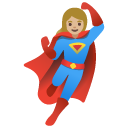
Appearance varies by platform and device. Google Noto, Twemoji, and OpenMoji are open-source.