🦹🏾♀️
The Emoji
Woman Supervillain: Medium-dark Skin Tone
U+1F9B9 U+1F3FE U+200D U+2640 U+FE0F · :woman_supervillain_mediumdark_skin_tone:
Trend 72
Meaning layers
- interpretation
- Used to signal unbothered confidence, chaotic energy, or 'I'm the villain in someone else's story and I don't care.' Often signals self-aware baddie energy or playful malevolence without actual ill intent.
- tiktok usage
- Appears in 'villain era' content where creators embrace being the antagonist of their own life narrative, often paired with dramatic music and power outfits.
- irony level
- 7 / 10
Platform meanings
- meaning
- Symbol of villain era content, chaotic confidence, and embracing your inner antagonist without guilt.
- trend usage
- Used in 'POV: you're the villain' trends, dark academia aesthetics, 'main character vs villain' comparisons, and 'I'm in my villain era' transformation videos.
- hashtags
- #villainera#badenergy#villainpov#darkaesthetic#unbothered
- virality score
- 74 / 100
Cultural meanings
🇺🇸
Western / Gen-Z
Central to the 'villain era' cultural movement where embracing your inner antagonist is seen as radical self-acceptance and empowerment. Widely used across all Gen Z platforms to signal confidence without apology.
🇵🇰
Pakistan & India
Used among younger urban populations familiar with Western internet culture; may also reference Bollywood villain archetypes or be used by women signaling boldness in traditionally restrictive social contexts.
🌍
Middle East
Primarily used by younger, internet-savvy users familiar with global meme culture; in more conservative contexts it may simply read as a costume emoji, but in creative communities it signals empowered defiance.
🌐
Global Neutral
Universally readable as a female villain character; even without cultural context, the dramatic aesthetic communicates mischief, power, and boldness regardless of regional internet culture.
🇧🇩
Bangladesh
Among digitally active youth, used similarly to global Gen Z contexts for villain era content; older users may interpret it literally as a fictional character emoji.
🇱🇰
Sri Lanka
Used primarily in entertainment and pop culture conversations; younger users borrow villain era energy from global trends to express confidence or dramatic flair.
🇨🇳
China
On platforms like WeChat and Douyin, may be used to signal '反派' (antagonist) energy or paired with C-drama villain aesthetic content; popular among fans of dark fantasy dramas.
🇯🇵
Japan
Connects to 'akuyaku' (villain) character culture in anime and manga; used by fans of villain characters in fandom spaces and occasionally in expressing 'gap moe' — endearing villain energy.
🇰🇷
South Korea
Associated with 'baddie' aesthetics and K-drama villain characters; used in fan communities and by individuals expressing powerful, dramatic confidence in line with Korean dark aesthetic trends.
🇹🇼
Taiwan
Used in gaming communities and fandom spaces referencing villain characters; younger users apply it in villain era contexts borrowed from global social media trends.
🇭🇰
Hong Kong
Blends Cantonese pop culture villain references with global internet culture; used to express being the antagonist in social situations with dry humor.
🇵🇭
Philippines
Widely understood through teleserye (soap opera) villain archetypes; used humorously when someone is acting dramatically or stirring up wholesome chaos in friend groups.
🇮🇩
Indonesia
Referenced in sinetron (Indonesian drama) villain comparisons; younger users on TikTok and Instagram use it in global villain era contexts with localized humor.
🇹🇭
Thailand
Connects to lakorn (Thai drama) villainess characters who are often glamorous and powerful; used to signal dramatic confidence or being unbothered by social criticism.
🇻🇳
Vietnam
Used among younger, socially media-active Vietnamese users primarily in gaming, entertainment, and pop culture contexts; may reference villain characters in popular Korean dramas or anime.
🇲🇾
Malaysia
Multi-cultural internet users connect it to both Western villain era culture and local drama archetypes; used to express bold, unapologetic behavior in a humorous register.
🇸🇦
Saudi Arabia
Among younger women particularly, this emoji can carry a quietly subversive empowerment meaning — embracing a powerful, rule-breaking persona in contexts where female boldness is culturally complex.
🇦🇪
UAE
Used in diverse, cosmopolitan social media contexts; the multicultural young population applies it similarly to global Gen Z usage with cosmopolitan flair and fashion-forward connotations.
🇪🇬
Egypt
References powerful female antagonist archetypes from Arabic drama; younger Egyptian social media users borrow global villain era connotations to express confidence and independence.
🇹🇷
Turkey
Connects to dizi (Turkish drama) villain female characters known for glamour and scheming; used humorously to caption dramatic or confident behavior in social media posts.
🇮🇷
Iran
Among young Iranians on social platforms, used to express defiant confidence and independence; carries subtle empowerment connotations for women navigating restrictive social environments.
🇳🇬
Nigeria
Used in Nollywood villain character contexts and Afrobeats culture; increasingly adopted in Gen Z internet spaces to signal bold, unapologetic energy with a uniquely Nigerian dramatic flair.
🇿🇦
South Africa
Blends township humor with global internet culture; used to celebrate bold, powerful, unapologetic femininity and to reference locally resonant villain archetypes in SA media.
🇬🇧
UK & Ireland
Used with British dry wit and self-deprecation; often placed after admitting to something mildly terrible to soften it with humor — 'yes I ate the last biscuit 🦹🏾♀️'.
🇫🇷
France
Applied with French ironic detachment; signals someone embracing their role as a social antagonist with a certain je ne sais quoi confidence rather than guilt.
🇩🇪
Germany
Used more literally in gaming and cosplay communities; in casual social media contexts, younger Germans apply it to signal bold or unconventional behavior with pragmatic humor.
🇪🇸
Spain & Italy
Connected to telenovela and Italian drama villain archetypes; used expressively and passionately to signal someone is done playing nice and ready to cause (fun) chaos.
🇧🇷
Brazil
Highly resonant with Brazilian internet culture's love of dramatic expression; used in 'vilã' energy content celebrating powerful, glamorous bad behavior with characteristic Brazilian flair.
🇲🇽
Mexico
References telenovela villain culture where the antagonist is often the most fabulous character; used to express bold confidence, stylish defiance, and unbothered attitude.
🌎
Latin America
Broadly connects to telenovela villain aesthetics across Latin America; signals powerful femininity and unapologetic boldness in social media content across the region.
🇦🇺
Australia & NZ
Used with laconic Aussie/Kiwi humor to downplay mischievous behavior; often paired with self-deprecating captions about doing something slightly chaotic or antisocial in a loveable way.
How its meaning shifted
- 2010
This emoji did not exist in 2010; the supervillain emoji category had not yet been introduced to Unicode.
- 2015
Still not in existence; emoji representation of superhero and villain archetypes had not yet been added to the Unicode standard.
- 2020
Introduced as part of Unicode 11.0 (approved 2018, widely deployed by 2020); initially used mostly in costume, Halloween, and fandom contexts with early adopters in Gen Z spaces.
- 2026
Firmly established as a cultural symbol for 'villain era' identity, dark feminine empowerment, and unapologetic self-expression; widely recognized across global Gen Z and millennial social media cultures with strong visual identity.
See it on every platform
Adjacent emojis
- Often confused with
- woman in tuxedowoman mageskull
- Can replace
- smiling face with hornswoman magecrown
Share & embed
Frequently asked
01What does the 🦹🏾♀️ Woman Supervillain: Medium-dark Skin Tone emoji mean?
A woman with supervillain characteristics, depicted with a dramatic costume and medium-dark skin tone. Part of the Unicode supervillain set introduced to represent fictional antagonist archetypes.
02What does 🦹🏾♀️ mean on TikTok?
Symbol of villain era content, chaotic confidence, and embracing your inner antagonist without guilt.
03What does 🦹🏾♀️ mean on WhatsApp?
Playful signal that the sender is about to do something mischievous or self-serving, often used humorously among close friends.
04What does 🦹🏾♀️ mean in Gen-Z slang?
Used to signal unbothered confidence, chaotic energy, or 'I'm the villain in someone else's story and I don't care.' Often signals self-aware baddie energy or playful malevolence without actual ill intent.
05Is the 🦹🏾♀️ emoji safe to use?
Playful expression of confidence, mischief, self-empowerment, and villain-coded identity; used humorously and positively in the vast majority of contexts.
06What does 🦹🏾♀️ mean in texting?
Reflects the psychological concept of reclaiming the 'shadow self' — embracing the parts of oneself deemed socially unacceptable, turning perceived negatives into sources of pride and power.
07What is the shortcode for 🦹🏾♀️?
The shortcode for Woman Supervillain: Medium-dark Skin Tone is :woman_supervillain_mediumdark_skin_tone:
08What does 🦹🏾♀️ mean in dating?
Signals playful danger — 'I might break your heart but you'll enjoy every second.' Used to tease a love interest with confident, slightly threatening charm.
Safety & usage
- Safe meaning
- Playful expression of confidence, mischief, self-empowerment, and villain-coded identity; used humorously and positively in the vast majority of contexts.
- Caution
- In rare cases, could be used to glorify genuinely harmful behavior, bully someone by casting them as the villain, or celebrate real-world cruelty under the guise of 'villain era' aesthetics.
Generally safe and positive in mainstream usage; context matters — affirming genuine harm as 'villain behavior' should be distinguished from the typical playful, ironic usage.
How it looks across platforms
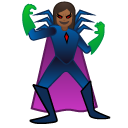
Appearance varies by platform and device. Google Noto, Twemoji, and OpenMoji are open-source.