💁🏿♀️
The Emoji
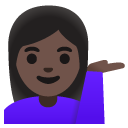
Woman Tipping Hand: Dark Skin Tone
U+1F481 U+1F3FF U+200D U+2640 U+FE0F · :woman_tipping_hand_dark_skin_tone:
Trend 78
Meaning layers
- interpretation
- Used to convey sass, confidence, passive-aggressive shade, or a 'not my problem' attitude. Often means 'obviously', 'duh', or 'whatever you say'. Also used to express unbothered confidence or clapping back at someone.
- tiktok usage
- Appears in comment sections to signal 'I said what I said' energy or when someone is being sarcastic and unbothered. Commonly used in response to drama or unsolicited opinions.
- irony level
- 8 / 10
Platform meanings
- meaning
- Signals unbothered confidence, sarcastic helpfulness, or throwing shade while maintaining composure. The dark skin tone version is widely celebrated as a representation of Black girl energy and confidence.
- trend usage
- Used in POV videos, hot take comments, and any content where the creator is asserting themselves unapologetically. Often synced to trending audio with confident or petty themes.
- hashtags
- #unbothered#blackgirlmagic#sassyvibes#notmyproblem#slayszn
- virality score
- 82 / 100
Cultural meanings
🇺🇸
Western / Gen-Z
The quintessential sassy, unbothered emoji for Gen Z in Western contexts — used almost exclusively for ironic helpfulness, confident shade, and 'I said what I said' energy.
🇵🇰
Pakistan & India
Used among younger, urban social media users to signal sass or confidence, especially in Bollywood fan communities and online drama. The dark skin tone may carry colorism-related sensitivity in some contexts.
🌍
Middle East
Used by younger Arabic-speaking users on platforms like Instagram and TikTok to signal confidence or to present information. The dark skin tone is appreciated for representation in diverse communities.
🌐
Global Neutral
Broadly understood as a confident, helpful, or sassy gesture across most global audiences familiar with internet culture.
🇧🇩
Bangladesh
Used among younger social media users to convey confidence or a 'whatever' attitude, though awareness of the sarcastic nuance varies. More commonly used in straightforward helpful contexts.
🇱🇰
Sri Lanka
Seen in younger online circles as a symbol of confidence or sass, primarily imported through Indian and Western social media influence.
🇨🇳
China
Less commonly used due to different emoji cultural defaults on Chinese platforms (WeChat, Weibo), but recognized by internationally connected users as a confident or sassy gesture.
🇯🇵
Japan
The gesture doesn't directly map to a Japanese cultural equivalent, so it's often read literally as an information-giving pose. Used in bilingual or internationally influenced communities.
🇰🇷
South Korea
Used by K-pop fan communities and younger internet users to signal confidence or 'serving face' energy, often in fan edits and idol content commentary.
🇹🇼
Taiwan
Used similarly to mainland China — more literal interpretation among older users, while younger, internationally connected users adopt the sassy connotation.
🇭🇰
Hong Kong
English-fluent, internationally connected population means the sarcastic and confident usage is well understood, especially in younger digital communities.
🇵🇭
Philippines
Widely used by Filipino Gen Z and millennials with the same sassy, confident connotation as Western usage. Very popular in Filipino Twitter and TikTok communities.
🇮🇩
Indonesia
Popular among younger Indonesian social media users, often used to signal confident comebacks or a stylish, unbothered attitude in Instagram and TikTok content.
🇹🇭
Thailand
Used by younger Thai social media users, particularly in the LGBTQ+ community and K-pop fan circles, to signal sass and confidence.
🇻🇳
Vietnam
Increasingly used among Vietnamese Gen Z on TikTok and Instagram with the sassy connotation, influenced by American internet culture.
🇲🇾
Malaysia
Common among Malaysian youth on Twitter (X) and Instagram to signal confidence, petty moments, or sarcastic helpfulness, mirroring Western usage closely.
🇸🇦
Saudi Arabia
Used by younger, social media-savvy Saudi users, particularly women, to signal confidence or sass. The skin tone representation is positively received in more diverse regional contexts.
🇦🇪
UAE
In the cosmopolitan UAE social media landscape, widely used with the sarcastic and confident connotation by younger, multi-cultural users.
🇪🇬
Egypt
Used by younger Egyptian social media users to express confidence or a dismissive 'whatever' attitude, popular on Egyptian Twitter and TikTok.
🇹🇷
Turkey
Common among Turkish Gen Z and millennials on Twitter and Instagram to signal sass, confidence, or petty comebacks.
🇮🇷
Iran
Used by younger Iranians on international platforms (Instagram, Telegram) to signal confidence or sarcasm, often in commentary on cultural or social topics.
🇳🇬
Nigeria
Strongly embraced, particularly the dark skin tone modifier, as a symbol of Black confidence, sass, and 'slay' energy. Aligns deeply with Afrobeats culture and social media aesthetics.
🇿🇦
South Africa
Widely used across South African social media to signal confident 'no filter' energy. The dark skin tone is celebrated as representation in the local context.
🇬🇧
UK & Ireland
Used with the same sarcastic, unbothered connotation as American Gen Z, fitting naturally into British banter and 'I'm not arguing with you' culture.
🇫🇷
France
Used by younger, internet-fluent French users to signal confidence or mild sarcasm. The skin tone modifier is generally appreciated in multicultural French online spaces.
🇩🇪
Germany
Understood among younger German internet users familiar with Anglo-American meme culture. Deployed for confident or slightly sarcastic statements.
🇪🇸
Spain & Italy
Popular among younger Spanish and Italian social media users, especially on Instagram and TikTok, to signal confidence or playful attitude.
🇧🇷
Brazil
Very widely used in Brazilian social media for sass, confidence, and petty comebacks. Brazilian internet culture embraces expressive emoji use enthusiastically.
🇲🇽
Mexico
Used by younger Mexican social media users with the sassy connotation, popular in Twitter/X and TikTok communities for confident or shade-throwing moments.
🌎
Latin America
Broadly embraced across Latin America as a symbol of confidence and sass, adapted into local internet culture with enthusiasm across TikTok and Instagram.
🇦🇺
Australia & NZ
Used with the same ironic, confident connotation as UK and US. Fits naturally into Australian 'taking the piss' humor culture and NZ casual social media tone.
How its meaning shifted
- 2010
Emoji culture was nascent in 2010 and this specific combination (woman + dark skin tone modifier) did not yet exist. The base 'information desk person' emoji was in early Unicode stages and used literally.
- 2015
Skin tone modifiers were introduced in Unicode 8.0 (2015), making this emoji newly available. Used primarily for representation and inclusion purposes — a literal 'helpful person at a desk' with newly celebrated diversity.
- 2020
Fully adopted into Gen Z sarcasm and sass culture. The 'unbothered' and 'I'm just saying' connotations were firmly established, particularly in Black internet culture and broader social media communities.
- 2026
A classic, deeply embedded cultural emoji shorthand for confidence, sassy comebacks, and unapologetic self-assurance. The dark skin tone version is specifically celebrated as an icon of Black girl excellence and representation in emoji culture.
See it on every platform
Adjacent emojis
Share & embed
Frequently asked
01What does the 💁🏿♀️ Woman Tipping Hand: Dark Skin Tone emoji mean?
A woman with dark skin tone holding her hand up near her face in an 'information desk' or 'tipping hand' gesture, as if offering assistance or presenting information.
02What does 💁🏿♀️ mean on TikTok?
Signals unbothered confidence, sarcastic helpfulness, or throwing shade while maintaining composure. The dark skin tone version is widely celebrated as a representation of Black girl energy and confidence.
03What does 💁🏿♀️ mean on WhatsApp?
Used to say 'I told you so', 'obviously', or to present a point with mock-professional helpfulness. Very common in group chats for petty moments.
04What does 💁🏿♀️ mean in Gen-Z slang?
Used to convey sass, confidence, passive-aggressive shade, or a 'not my problem' attitude. Often means 'obviously', 'duh', or 'whatever you say'. Also used to express unbothered confidence or clapping back at someone.
05Is the 💁🏿♀️ emoji safe to use?
An expression of confidence, sass, helpfulness, or playful attitude. Widely used for empowerment and lighthearted sarcasm with no harmful intent.
06What does 💁🏿♀️ mean in texting?
The gesture mimics the classic 'hair flip' energy — a psychological signal of self-assurance and boundary-setting. It can also represent performed helpfulness masking underlying sarcasm, a defense mechanism common in online communication.
07What is the shortcode for 💁🏿♀️?
The shortcode for Woman Tipping Hand: Dark Skin Tone is :woman_tipping_hand_dark_skin_tone:
08What does 💁🏿♀️ mean in dating?
Used playfully to indicate confidence or to tease a partner, often when someone is showing off or being coy. Can mean 'you're welcome for this' in a flirtatious context.
Safety & usage
- Safe meaning
- An expression of confidence, sass, helpfulness, or playful attitude. Widely used for empowerment and lighthearted sarcasm with no harmful intent.
- Caution
- Can be used to deliver passive-aggressive shade, dismissive condescension, or to mock someone under the guise of 'just being helpful'. In rare cases weaponized in online harassment as a dismissive gesture.
Generally safe and positive. Occasionally used in passive-aggressive or bullying contexts, but this is not the primary or dominant usage. The skin tone modifier makes it particularly meaningful for representation — misuse in mocking Black women's communication styles can carry racist undertones.
How it looks across platforms
Appearance varies by platform and device. Google Noto, Twemoji, and OpenMoji are open-source.