👯♀️
The Emoji
Women With Bunny Ears
U+1F46F U+200D U+2640 U+FE0F · :women_with_bunny_ears:
Trend 85
Meaning layers
- interpretation
- Used to signify 'bestie energy,' hype squad vibes, going out with the girls, or matching outfits/costumes. Represents the iconic duo or squad doing everything together.
- tiktok usage
- Appears in 'bestie reveal' videos, synced dance duets, Halloween costume content, and 'me and my person' aesthetic clips.
- irony level
- 3 / 10
Platform meanings
- meaning
- Symbol of bestie duo energy, synchronized dancing, and girls' night or costume content.
- trend usage
- Used in duet videos, POV best friend skits, Halloween content, and 'we are the same person' trend clips.
- hashtags
- #bestievibes#girlsnightout#bunnygirls#bffgoals#matchingoutfits
- virality score
- 82 / 100
Cultural meanings
🇺🇸
Western / Gen-Z
Core bestie emoji — universally understood as girls' night, matching energy, and female friendship celebration. Almost always positive and celebratory in tone.
🇵🇰
Pakistan & India
Used among urban, social-media-savvy young women for best friend posts and girls' hangout content; less common in conservative or rural social media spaces due to the costume connotation.
🌍
Middle East
Used cautiously — in younger, urban circles it signals female friendship and fun, but the bunny ear/costume imagery may be avoided in more traditional contexts.
🌐
Global Neutral
Broadly understood as a symbol of female friendship, duo energy, and synchronized fun; safe and positive in most global contexts.
🇧🇩
Bangladesh
Emerging use among urban Gen Z women on Instagram and TikTok to celebrate female friendships; still relatively niche compared to face emoji.
🇱🇰
Sri Lanka
Used in young women's social media for best friend appreciation posts; the bunny ear imagery is treated as a fun, innocent costume reference.
🇨🇳
China
Popular on Weibo and Xiaohongshu among young women for posting with best friends; associated with the 'kawaii' aesthetic imported from Japan and the concept of '闺蜜 (guīmì)' — intimate female friendship.
🇯🇵
Japan
Deeply resonant — bunny girl imagery has rich cultural roots in anime and idol culture; used enthusiastically to reference synchronized idol dance culture and '仲良し (nakayoshi)' best friend energy.
🇰🇷
South Korea
Very popular in K-pop fan communities and among young women; associated with idol group choreography, '베프 (bestie)' culture, and matching fan outfit posts.
🇹🇼
Taiwan
Used similarly to mainland China and Japan; common in girl group fan accounts and best friend social posts on Instagram and Dcard.
🇭🇰
Hong Kong
Used in a fun, playful context for girls' night and costume content; the dual female energy is embraced in Hong Kong's cosmopolitan youth culture.
🇵🇭
Philippines
Widely used among young Filipina women on Facebook, TikTok, and Instagram to celebrate female friendships and matching OOTDs (outfit of the day).
🇮🇩
Indonesia
Popular among young women on Instagram and TikTok; used to celebrate close female friendships and group outings, often paired with aesthetic or K-pop inspired content.
🇹🇭
Thailand
Common in Thai girl group and idol fan communities; also used widely for best friend content with the same energy as 'คู่หู (best duo)' culture in Thai social media.
🇻🇳
Vietnam
Used on TikTok and Zalo among young women to signal close female friendships; K-pop influence makes the synchronized, idol-like imagery very relatable.
🇲🇾
Malaysia
Used freely in urban youth culture for female friendship posts; the bunny ear connotation is seen as fun and fashionable rather than suggestive.
🇸🇦
Saudi Arabia
Used by young women in private or semi-private social media contexts to celebrate friendships; the bunny costume element may be toned down in meaning to simply 'girls together.'
🇦🇪
UAE
Common in Dubai and Abu Dhabi youth culture on Instagram and TikTok; the cosmopolitan, fashion-forward social scene makes this emoji very at home in girls' night and event content.
🇪🇬
Egypt
Used among young Egyptian women online to signal close female friendships; mostly seen in urban digital spaces and fashion/lifestyle accounts.
🇹🇷
Turkey
Popular among young Turkish women on Instagram for bestie posts; the playful costume imagery aligns well with Turkey's vibrant party and lifestyle culture in major cities.
🇮🇷
Iran
Used in private social media spaces among young women to celebrate female friendship; the playful, costume-based imagery is shared discreetly in a culture where such expression is limited publicly.
🇳🇬
Nigeria
Gaining traction among Nigerian Gen Z women on Instagram and TikTok; used for squad content and female friendship appreciation posts, especially in Lagos-centered lifestyle culture.
🇿🇦
South Africa
Used freely among young South African women for girls' night and party content; the emoji slots naturally into the vibrant South African social media lifestyle scene.
🇬🇧
UK & Ireland
Very popular for bachelorette (hen do) party content, girls' nights out, and festival/Halloween costume posts; one of the definitive 'girls trip' emojis.
🇫🇷
France
Used among young French women for friend group posts and soirée content; the aesthetic, synchronized imagery aligns with French appreciation for chic, coordinated looks.
🇩🇪
Germany
Used for carnival (Karneval) costumes, girls' night content, and best friend appreciation posts; the synchronized, orderly imagery aligns with German group event culture.
🇪🇸
Spain & Italy
Highly popular for fiesta and girls' night out content; the duo energy resonates strongly with Southern European cultures that celebrate female friendship and social gatherings effusively.
🇧🇷
Brazil
Extremely popular for carnival costume posts, best friend content, and girls' night on Instagram and TikTok; Brazilian social media culture's emphasis on fun and female bonding makes this a top emoji.
🇲🇽
Mexico
Used for girls' trips, quinceañera planning content, and best friend posts; the celebratory, duo energy fits well with Mexican social media culture's warmth and communal spirit.
🌎
Latin America
Broadly embraced across Latin America as a symbol of female friendship, fiesta energy, and matching outfits; very high usage on Instagram and TikTok.
🇦🇺
Australia & NZ
Common for Schoolies, hens nights, festival content, and best friend posts; the playful, party-centric imagery is a staple of Australian and New Zealand young women's social media.
How its meaning shifted
- 2010
Barely in use — emoji was not yet widely adopted, and the concept of gendered emoji variants did not yet exist; the base party/bunny emoji was used sparingly.
- 2015
Became available as a ZWJ (Zero Width Joiner) sequence and began appearing in early Instagram posts about Halloween costumes and party culture; usage was limited to fashion-forward users.
- 2020
Exploded in usage during TikTok's rise and the 'bestie era' of social media; became a definitive symbol of female friendship, girls' trips, and bachelorette content. Widely adopted across demographics.
- 2026
Deeply embedded in digital language as the canonical 'bestie duo' emoji; used across all platforms in both sincere and ironic contexts, part of the standard vocabulary for female friendship and party culture.
See it on every platform
Emoji combinations
Adjacent emojis
- Often confused with
- rabbit facebunny earsmen with bunny ears
- Can replace
- dancing womantwo heartssparkling heart
Share & embed
Frequently asked
01What does the 👯♀️ Women With Bunny Ears emoji mean?
Two women wearing bunny ears (as in a costume or headband), often depicted as dancing or posing together in a synchronized way.
02What does 👯♀️ mean on TikTok?
Symbol of bestie duo energy, synchronized dancing, and girls' night or costume content.
03What does 👯♀️ mean on WhatsApp?
Sent between close female friends to signal 'we're doing this together' or to hype up plans like parties or trips.
04What does 👯♀️ mean in Gen-Z slang?
Used to signify 'bestie energy,' hype squad vibes, going out with the girls, or matching outfits/costumes. Represents the iconic duo or squad doing everything together.
05Is the 👯♀️ emoji safe to use?
A fun, celebratory emoji representing female friendship, matching outfits, party culture, and bestie energy. Almost universally positive.
06What does 👯♀️ mean in texting?
Taps into the psychological need for belonging and mirroring — the synchronized imagery reinforces feelings of deep connection, being seen, and shared identity with a close friend or partner.
07What is the shortcode for 👯♀️?
The shortcode for Women With Bunny Ears is :women_with_bunny_ears:
08What does 👯♀️ mean in dating?
Occasionally used flirtatiously to suggest two people are 'a matching pair' or hint at costumes/roleplay in a fun, non-serious way.
Safety & usage
- Safe meaning
- A fun, celebratory emoji representing female friendship, matching outfits, party culture, and bestie energy. Almost universally positive.
- Caution
- Occasionally co-opted to mock performative female friendships or used sarcastically to imply two people are acting superficially or in a 'mean girls' dynamic.
The bunny ear imagery has historical association with Playboy aesthetics; in most contexts this is not foregrounded, but users in conservative cultural contexts should be aware of this connotation.
How it looks across platforms
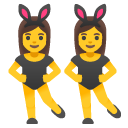
Appearance varies by platform and device. Google Noto, Twemoji, and OpenMoji are open-source.