👯♂️
The Emoji
Men With Bunny Ears
U+1F46F U+200D U+2642 U+FE0F · :men_with_bunny_ears:
Trend 58
Meaning layers
- interpretation
- Used to signal best friend energy, bromance, or two guys who are inseparable and doing everything together. Also used ironically to hype up a male friend duo or indicate synchronized chaotic behavior.
- tiktok usage
- Appears in 'bestie check' videos, duo dances, and 'we move together' content. Often placed in captions when two male friends do something simultaneously or hilariously in sync.
- irony level
- 6 / 10
Platform meanings
- meaning
- Represents best friend duos, synchronized behavior, or two guys doing the exact same thing at the same time.
- trend usage
- Frequently appears in duet videos, synchronized dance challenges, and 'we are the same person' trend captions. Also used in POV skits about inseparable male friends.
- hashtags
- #BestieEnergy#MeAndTheBoys#BromanticDuo#SynchedUp#DuoBestFriend
- virality score
- 62 / 100
Cultural meanings
🇺🇸
Western / Gen-Z
Widely used among Gen Z males in the US, UK, Canada, and Australia to express best friend energy and bromance without social stigma, often paired with irony.
🇵🇰
Pakistan & India
Less commonly used due to potential misinterpretation as effeminate or associated with LGBTQ+ themes in conservative contexts; mostly used by urban, progressive youth to denote close male friendships.
🌍
Middle East
Rarely used in Gulf or Levantine social media due to cultural sensitivities around gender expression; may be misread as referencing homosexuality, which carries significant stigma.
🌐
Global Neutral
Universally interpretable as a symbol of male friendship, duo performance, or synchronized behavior, making it broadly understandable across cultures when context is clear.
🇧🇩
Bangladesh
Used sparingly by younger, urban social media users; more likely to be replaced by regional friendship emojis or hands-together symbols due to cultural norms around masculinity.
🇱🇰
Sri Lanka
Occasionally used by younger generations on Instagram and TikTok to celebrate male friendships, but adoption is limited compared to Western usage.
🇨🇳
China
Used on Weibo and Douyin primarily to reference male idol duo pairings (ship culture), often tied to K-pop or C-pop fan communities celebrating bromance (兄弟情).
🇯🇵
Japan
Strongly associated with 'buddy' culture and male performance duos; resonates with the concept of コンビ (kombi/duo) in comedy and entertainment, making it popular in fan circles.
🇰🇷
South Korea
Heavily used in K-pop fan culture to represent male idol ship pairings or duo members; one of the most culturally resonant uses of this emoji globally.
🇹🇼
Taiwan
Used similarly to South Korea in idol fan culture; also used among college-aged males to celebrate close friendships in a playful, non-threatening way.
🇭🇰
Hong Kong
Used in Cantonese meme culture to represent two guys acting silly together or in reference to Cantopop or TVB duo entertainers.
🇵🇭
Philippines
Popular in OPM fan communities and among BL (Boys Love) media fans; used to celebrate male duo friendships with warmth and enthusiasm.
🇮🇩
Indonesia
Used among younger Indonesians on TikTok and Instagram to express close male friendships; sensitivity around LGBTQ+ connotations varies significantly by community.
🇹🇭
Thailand
Thailand's progressive social attitudes and BL drama culture make this emoji widely accepted and warmly used to represent male duo friendships or romantic pairings in fan contexts.
🇻🇳
Vietnam
Used by younger generations to express friendship or reference K-pop duo pairings; broader societal adoption is limited by traditional gender norms.
🇲🇾
Malaysia
Used cautiously due to conservative religious norms in some communities; more freely used among urban, non-Malay youth or in entertainment fan communities.
🇸🇦
Saudi Arabia
Extremely rarely used; potential LGBTQ+ associations make it socially and legally sensitive, with usage confined to very private or anonymous online spaces.
🇦🇪
UAE
Limited use due to cultural and legal sensitivity; may appear in expatriate communities or anonymous social media contexts representing male performer duos.
🇪🇬
Egypt
Rarely used publicly; in conservative Egyptian social media, it may be associated with gender non-conformity, making it uncommon outside urban progressive circles.
🇹🇷
Turkey
Occasionally used among younger Turks on Twitter and Instagram to represent male friend groups or reference Western duo performance acts; generally not mainstream.
🇮🇷
Iran
Highly restricted in public use due to social and political context; may appear anonymously in fan communities referencing Western or Korean entertainment duos.
🇳🇬
Nigeria
Used mostly in Afrobeats fan communities and among Lagos-based youth to celebrate male artist duos or express Nollywood bromance, with humor being the primary tone.
🇿🇦
South Africa
Used with relative openness in urban centers like Johannesburg and Cape Town to celebrate male friendships; adoption mirrors Western Gen Z usage in progressive communities.
🇬🇧
UK & Ireland
Widely used with ironic humor to describe two lads who are always together; fits seamlessly into British banter culture and 'the boys' group-chat energy.
🇫🇷
France
Used casually to represent male friendship (copains); in French internet culture, may also reference duo comedy acts or the iconic 'les deux amis' trope.
🇩🇪
Germany
Used straightforwardly to represent male friendship duos; German internet culture tends to use it more literally than ironically, often for duo sports or activity contexts.
🇪🇸
Spain & Italy
Embraced with warmth to represent close male friendships; in Mediterranean culture, male physical closeness is normalized, making this emoji feel natural and positive.
🇧🇷
Brazil
Widely used on Brazilian TikTok and Twitter to celebrate 'os manos' (the bros) moments, duo dances, and funk duo performers; high cultural resonance.
🇲🇽
Mexico
Used to celebrate male friendship and duo comedian/entertainer pairings; fits well with Mexican 'carnal' (brother) friendship culture on social media.
🌎
Latin America
Broadly used across Latin America to represent male best friend duos, reggaeton artist pairs, and synchronized 'we move together' cultural moments.
🇦🇺
Australia & NZ
Used freely in the context of 'mates' culture; represents the classic Aussie and Kiwi male friendship dynamic, often with self-deprecating humor.
How its meaning shifted
- 2010
This emoji variant did not yet exist; the base 👯 (People with Bunny Ears) was used gender-neutrally, mostly to represent showgirls or Halloween costumes.
- 2015
Still not formally part of the emoji standard; male duo friendship representation relied on generic people emojis or combinations of other symbols.
- 2020
The men's variant was introduced and gained traction during the pandemic era, where 'me and my bestie' content surged; used heavily in TikTok duets and synchronized challenge videos.
- 2026
Firmly established as a bromance and male-duo emoji; used across platforms with layered meaning including genuine friendship, K-pop ship culture, ironic humor, and LGBTQ+ representation.
See it on every platform
Compare with
Adjacent emojis
- Opposite
- person alonebroken heartno entry
- Often confused with
- women with bunny earsrabbit faceparty popper
- Can replace
- men holding handshandshakeflexed biceps
Share & embed
Frequently asked
01What does the 👯♂️ Men With Bunny Ears emoji mean?
Two men depicted wearing bunny ears, often shown dancing side by side in synchronized poses, representing the Playboy Bunny costume concept applied to male figures.
02What does 👯♂️ mean on TikTok?
Represents best friend duos, synchronized behavior, or two guys doing the exact same thing at the same time.
03What does 👯♂️ mean on WhatsApp?
Sent between two male friends to affirm their close bond, often after making matching plans or decisions simultaneously.
04What does 👯♂️ mean in Gen-Z slang?
Used to signal best friend energy, bromance, or two guys who are inseparable and doing everything together. Also used ironically to hype up a male friend duo or indicate synchronized chaotic behavior.
05Is the 👯♂️ emoji safe to use?
Represents male friendship, bromance, synchronized fun, and duo performance in a wholesome and celebratory context.
06What does 👯♂️ mean in texting?
Reflects the psychological need for male homosocial bonding expressed in a playful, non-threatening way. The bunny ears add a layer of silliness that lowers social guards, making affectionate male friendship feel safe to express publicly.
07What is the shortcode for 👯♂️?
The shortcode for Men With Bunny Ears is :men_with_bunny_ears:
08What does 👯♂️ mean in dating?
Rarely used in direct flirting; when it is, it signals a lighthearted 'we're a fun duo' vibe to a potential partner, implying the sender is social and not serious.
Safety & usage
- Safe meaning
- Represents male friendship, bromance, synchronized fun, and duo performance in a wholesome and celebratory context.
- Caution
- Can be used to mock or belittle two men perceived as overly close, effeminate, or suspected of being gay in homophobic contexts.
In certain cultural or political contexts, this emoji may be weaponized to demean male friendships through homophobic insinuation. Usage should be mindful of audience and platform culture.
How it looks across platforms
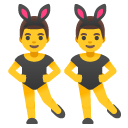
Appearance varies by platform and device. Google Noto, Twemoji, and OpenMoji are open-source.