✍🏼
The Emoji
Writing Hand: Medium-light Skin Tone
U+270D U+1F3FC · :writing_hand_mediumlight_skin_tone:
Trend 58
Meaning layers
- interpretation
- Used to signal that someone is about to drop wisdom, spill receipts, or craft a long response. Also used to indicate note-taking on something important or calling out someone in writing.
- tiktok usage
- Appears in comment sections when someone is 'taking notes' on advice, drama, or a tutorial. Often paired with a notepad emoji to signal serious engagement.
- irony level
- 4 / 10
Platform meanings
- meaning
- Signals someone is actively taking notes, writing content, or about to drop a long-form response or opinion piece in the comments.
- trend usage
- Appears in 'note-taking' trends, journaling aesthetics, study-with-me content, and comment threads where users dramatically document advice.
- hashtags
- #journaling#notestaking#writingcommunity#studytok#contentcreator
- virality score
- 62 / 100
Cultural meanings
🇺🇸
Western / Gen-Z
Used heavily to signal note-taking, dropping receipts, or authoring content — carries a blend of creative and confrontational energy depending on context.
🇵🇰
Pakistan & India
Commonly used by students and professionals to indicate study, exam prep, or formal writing. Also appears in creative writing and poetry communities online.
🌍
Middle East
Widely used across academic and professional contexts to signal writing tasks, document signing, or formal correspondence.
🌐
Global Neutral
Universally understood as representing the act of writing — one of the least ambiguous emojis across cultures and languages.
🇧🇩
Bangladesh
Popular among students to indicate note-taking or exam preparation. Also used in professional and academic social media contexts.
🇱🇰
Sri Lanka
Used primarily in educational and professional settings to indicate writing tasks, assignments, or formal documentation.
🇨🇳
China
Used in studious contexts aligned with China's strong exam culture — frequently appears in study-related posts and academic communities.
🇯🇵
Japan
Associated with the cultural value placed on careful, deliberate writing and note-taking. Common in academic, journaling, and stationery-enthusiast communities.
🇰🇷
South Korea
Tied to study culture (공부) and the popularity of stationery aesthetics. Frequently appears in study content and journaling communities.
🇹🇼
Taiwan
Common in creative writing, journaling, and stationery communities. Reflects a strong local appreciation for handwritten culture and calligraphy.
🇭🇰
Hong Kong
Used in professional, academic, and creative contexts. The writing hand emoji carries weight in a city with a highly literate and document-oriented culture.
🇵🇭
Philippines
Used broadly to signal writing tasks, school assignments, or creative endeavors. Also appears humorously when someone is about to compose a lengthy message.
🇮🇩
Indonesia
Popular among students and young professionals to indicate productivity and writing. The skin tone variation is appreciated as part of inclusive representation.
🇹🇭
Thailand
Common in academic and professional content. Also used in creative writing communities and among bloggers and content creators.
🇻🇳
Vietnam
Frequently used by students to signal study and note-taking. Also appears in literary and journaling communities on Vietnamese social media.
🇲🇾
Malaysia
Used across academic, professional, and creative writing contexts. The medium-light skin tone is seen as relatively inclusive for the diverse Malaysian population.
🇸🇦
Saudi Arabia
Used in formal and educational contexts to represent writing, documentation, or signing. Aligns with the cultural respect for formal written language.
🇦🇪
UAE
Common in professional and multicultural contexts given the UAE's cosmopolitan nature. Used by writers, professionals, and students across industries.
🇪🇬
Egypt
Used to signal writing, documentation, and authorship. The literary tradition of Arabic culture gives this emoji additional cultural resonance.
🇹🇷
Turkey
Used in academic, journaling, and creative writing communities. Appears in study content and professional posts indicating written work.
🇮🇷
Iran
Associated with the strong literary tradition in Persian culture. Used by writers, poets, and academics to signal creative and formal writing.
🇳🇬
Nigeria
Used widely by students, writers, and professionals. Nigerian social media users also deploy it humorously when 'writing up' someone in a witty response.
🇿🇦
South Africa
Common in academic and creative writing contexts across South African social media. Also used in multicultural professional settings.
🇬🇧
UK & Ireland
Used across professional, academic, and creative contexts. British users often deploy it with dry wit when 'taking note' of something absurd.
🇫🇷
France
Associated with literary culture and the French tradition of writing and letters. Common in journaling, blogging, and intellectual online communities.
🇩🇪
Germany
Used in highly practical contexts — signing documents, taking meeting notes, or formal writing. Reflects German precision and documentation culture.
🇪🇸
Spain & Italy
Used in creative and expressive writing contexts. The romantic literary traditions of both cultures give this emoji an additional layer of artistic meaning.
🇧🇷
Brazil
Popular among students and content creators. Also used playfully to indicate someone is 'writing a response' or documenting drama in online discussions.
🇲🇽
Mexico
Common in academic and creative contexts. Mexican users also use it humorously in social media to preface a long or dramatic message.
🌎
Latin America
Broadly used across Latin America in student, professional, and creative writing contexts. Also appears in humorous 'about to respond' formats.
🇦🇺
Australia & NZ
Used casually across writing, study, and creative content. Australians may use it with dry humor when 'jotting down' someone's mistake.
How its meaning shifted
- 2010
Rarely used as emoji culture was in its infancy. When present, it was interpreted purely literally as the act of writing or signing a document.
- 2015
Gained traction with the introduction of skin tone modifiers in 2015. Used primarily for literal writing contexts — note-taking, journaling, signing.
- 2020
Became more culturally layered during the pandemic journaling boom and the rise of 'receipts' culture online. Note-taking and accountability uses surged.
- 2026
Now firmly established in content creator, academic, and accountability cultures. Used across ironic, creative, and professional registers with nuanced contextual meaning.
See it on every platform
Adjacent emojis
- Opposite
- eyesmouth with microphoneear
- Often confused with
- writing handindex pointing upnail polish
Share & embed
Frequently asked
01What does the ✍🏼 Writing Hand: Medium-light Skin Tone emoji mean?
A hand holding a pen or pencil in a writing position, shown with a medium-light skin tone modifier. Represents the act of writing, signing, authoring, or creating written content.
02What does ✍🏼 mean on TikTok?
Signals someone is actively taking notes, writing content, or about to drop a long-form response or opinion piece in the comments.
03What does ✍🏼 mean on WhatsApp?
Signals that the sender is writing something, working on a document, or composing a longer message. Sometimes used humorously when someone is about to send a long paragraph.
04What does ✍🏼 mean in Gen-Z slang?
Used to signal that someone is about to drop wisdom, spill receipts, or craft a long response. Also used to indicate note-taking on something important or calling out someone in writing.
05Is the ✍🏼 emoji safe to use?
Represents writing, note-taking, journaling, authorship, signing documents, or creative expression.
06What does ✍🏼 mean in texting?
Writing as a gesture signals intentionality and deliberate thought. It can convey concentration, creative drive, or the act of bearing witness — psychologically linked to the need to record, express, and communicate.
07What is the shortcode for ✍🏼?
The shortcode for Writing Hand: Medium-light Skin Tone is :writing_hand_mediumlight_skin_tone:
08What does ✍🏼 mean in dating?
Rarely used as a direct flirt, but can appear when someone says 'writing your name on my heart' or sarcastically signing off a romantic message with flair.
Safety & usage
- Safe meaning
- Represents writing, note-taking, journaling, authorship, signing documents, or creative expression.
- Caution
- Can be used as a subtle threat implying 'I'm documenting this' or 'compiling receipts' in online conflict situations.
Generally safe. In confrontational contexts, the emoji can carry an implicit threat of public exposure or documented callouts, but this is context-dependent and not inherently harmful.
How it looks across platforms
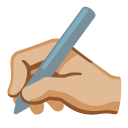


Appearance varies by platform and device. Google Noto, Twemoji, and OpenMoji are open-source.