👨🏾❤️👨🏿
The Emoji
Couple With Heart: Man, Man, Medium-dark Skin Tone, Dark Skin Tone
U+1F468 U+1F3FE U+200D U+2764 U+FE0F U+200D U+1F468 U+1F3FF · :couple_with_heart_man_man_mediumdark_skin_tone_dark_skin_tone:
Trend 58
Meaning layers
- interpretation
- Used to celebrate queer male relationships, show support for Black and Brown LGBTQ+ love, or express 'couple goals' energy between two men of color.
- tiktok usage
- Appears in videos celebrating Black and Brown queer love, Pride content, relationship milestones, or as a diversity-affirming flourish in captions.
- irony level
- 1 / 10
Platform meanings
- meaning
- Symbol of Black and Brown queer male love; used in couple videos, Pride TikToks, and LGBTQ+ awareness content.
- trend usage
- Frequently paired with trending sounds about love and relationships, or used in 'day in my life' content by queer men of color.
- hashtags
- #BlackQueerLove#PrideTikTok#LGBTQCouple#QueerMenOfColor#RepresentationMatters
- virality score
- 62 / 100
Cultural meanings
🇺🇸
Western / Gen-Z
A celebrated symbol of queer love and intersectional identity; widely used without irony to affirm Black and Brown gay relationships and signal allyship or personal identity.
🇵🇰
Pakistan & India
Rarely used openly due to social and legal stigma around homosexuality; may appear in urban, progressive, or anonymous online spaces among LGBTQ+ youth seeking community.
🌍
Middle East
Largely avoided due to legal prohibitions and deep cultural taboos around same-sex relationships; its use is confined to anonymous or diaspora accounts.
🌐
Global Neutral
Understood internationally as a same-sex male couple emoji with skin tone diversity; interpreted as a positive symbol of representation by most neutral observers.
🇧🇩
Bangladesh
Extremely rare in public use given conservative social norms; occasionally seen in diaspora or internationally connected online communities.
🇱🇰
Sri Lanka
Used only in very progressive or LGBTQ+-specific online spaces; social conservatism limits its mainstream visibility.
🇨🇳
China
Same-sex couple emoji are subject to platform censorship; when used, it appears in niche LGBTQ+ communities or among internationally aware youth.
🇯🇵
Japan
Used within Japan's visible but often private LGBTQ+ community; the skin tone specificity is noted and valued by the intersectional queer community.
🇰🇷
South Korea
Appears in queer online spaces and among younger, globally connected users; public display remains limited due to social conservatism.
🇹🇼
Taiwan
Embraced warmly given Taiwan's progressive stance as the first Asian country to legalize same-sex marriage; used freely in Pride and relationship contexts.
🇭🇰
Hong Kong
Used among LGBTQ+ communities and activists, particularly in the context of advocacy; carries added meaning given political constraints on public expression.
🇵🇭
Philippines
Used in LGBTQ+ communities and among the generally tolerant younger population; the skin tone specificity resonates in a country with diverse skin tones.
🇮🇩
Indonesia
Limited to LGBTQ+ underground or diaspora communities due to strong social and religious conservatism; rarely used in public digital spaces.
🇹🇭
Thailand
Thailand's visible LGBT culture means this emoji is used relatively openly, though the skin tone nuance may be less specifically noted.
🇻🇳
Vietnam
Seen in progressive youth online spaces and LGBTQ+ communities; broader public use is constrained by conservative social norms.
🇲🇾
Malaysia
Confined to private or anonymous LGBTQ+ online spaces due to legal and religious restrictions on same-sex relationships.
🇸🇦
Saudi Arabia
Essentially absent from mainstream use due to strict legal prohibition of same-sex relationships; extremely rare even in private digital communication.
🇦🇪
UAE
Used only in very private or anonymous contexts; public display of same-sex affection, including digital, carries legal risk.
🇪🇬
Egypt
Largely avoided in public digital spaces due to legal and social hostility toward LGBTQ+ expression; used only in anonymous or diaspora contexts.
🇹🇷
Turkey
Used in LGBTQ+ communities, particularly in Istanbul's visible queer scene; increasingly cautious use given growing social conservatism.
🇮🇷
Iran
Absent from mainstream digital use due to severe legal penalties; diaspora communities abroad may use it to assert identity.
🇳🇬
Nigeria
Rarely used publicly due to legal prohibitions on same-sex relationships; diaspora and anonymous online LGBTQ+ Nigerians may use it for community-building.
🇿🇦
South Africa
More freely used than most of Africa given South Africa's progressive constitution protecting LGBTQ+ rights; used in urban queer and ally communities.
🇬🇧
UK & Ireland
Enthusiastically used in queer communities and by allies; the skin tone specificity is recognized and appreciated as a representation of diverse LGBTQ+ identities.
🇫🇷
France
Used in LGBTQ+ communities and among secular, progressive youth; France's tradition of laïcité supports public acceptance of diverse relationship emojis.
🇩🇪
Germany
Recognized as a positive symbol of LGBTQ+ representation; used in queer communities, Pride events, and by diversity advocates.
🇪🇸
Spain & Italy
Used in queer communities in Spain freely; Italy's more conservative culture means use is more concentrated in urban progressive circles.
🇧🇷
Brazil
Widely used given Brazil's massive and vibrant LGBTQ+ community; the skin tone combination resonates strongly with Afro-Brazilian queer visibility.
🇲🇽
Mexico
Used in LGBTQ+ communities and progressive urban spaces; resonates with intersectional conversations about queer and racial identity in Mexico.
🌎
Latin America
Broadly used in LGBTQ+ communities across Latin America; carries extra meaning in countries with significant Afro-Latino populations celebrating intersectional identity.
🇦🇺
Australia & NZ
Freely and positively used in LGBTQ+ communities and by allies following same-sex marriage legalization; the skin tone diversity is recognized and valued.
How its meaning shifted
- 2010
This specific emoji sequence did not exist; same-sex couple emoji were not yet part of Unicode, and skin tone modifiers had not been introduced.
- 2015
Basic same-sex couple emoji began appearing in Unicode 8.0 with skin tone modifiers, but multi-person sequences with mixed skin tones were not yet standardized.
- 2020
The fully formed mixed-skin-tone same-sex couple emoji became more consistently supported across platforms; usage grew significantly during global Pride visibility and BLM intersectionality conversations.
- 2026
A well-established, widely used emoji representing Black and Brown queer male love; recognized as a meaningful symbol of intersectional visibility in mainstream digital communication.
See it on every platform
Adjacent emojis
- Often confused with
- people hugginghandshakefamily man man boy
- Can replace
- red heartrainbow flagmen holding hands
Share & embed
Frequently asked
01What does the 👨🏾❤️👨🏿 Couple With Heart: Man, Man, Medium-dark Skin Tone, Dark Skin Tone emoji mean?
A couple with a heart between them, depicting two men with medium-dark and dark skin tones respectively, representing a romantic male same-sex couple.
02What does 👨🏾❤️👨🏿 mean on TikTok?
Symbol of Black and Brown queer male love; used in couple videos, Pride TikToks, and LGBTQ+ awareness content.
03What does 👨🏾❤️👨🏿 mean on WhatsApp?
Signals a romantic relationship between two men; used to tell friends about a partner or celebrate couple milestones.
04What does 👨🏾❤️👨🏿 mean in Gen-Z slang?
Used to celebrate queer male relationships, show support for Black and Brown LGBTQ+ love, or express 'couple goals' energy between two men of color.
05Is the 👨🏾❤️👨🏿 emoji safe to use?
A positive representation of a same-sex male romantic couple with skin tone diversity; used to celebrate love, identity, and visibility.
06What does 👨🏾❤️👨🏿 mean in texting?
Carries significant emotional weight for Black and Brown gay and queer men, functioning as a symbol of visibility and self-affirmation in spaces where their identity is often erased or marginalized.
07What is the shortcode for 👨🏾❤️👨🏿?
The shortcode for Couple With Heart: Man, Man, Medium-dark Skin Tone, Dark Skin Tone is :couple_with_heart_man_man_mediumdark_skin_tone_dark_skin_tone:
08What does 👨🏾❤️👨🏿 mean in dating?
Used by queer men of color on dating apps or DMs to signal romantic interest, indicate they are part of the community, or to affirm a developing relationship.
Safety & usage
- Safe meaning
- A positive representation of a same-sex male romantic couple with skin tone diversity; used to celebrate love, identity, and visibility.
- Caution
- Can be weaponized by bad actors to mock or bait homophobic reactions; occasionally used in harassment contexts targeting LGBTQ+ individuals.
While the emoji itself is positive, its use in certain cultural or religious contexts may provoke hostility. Platforms should be aware of it being used as bait in targeted harassment campaigns against LGBTQ+ users.
How it looks across platforms
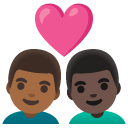
Appearance varies by platform and device. Google Noto, Twemoji, and OpenMoji are open-source.