🧏♂️
The Emoji
Deaf Man
U+1F9CF U+200D U+2642 U+FE0F · :deaf_man:
Trend 42
Meaning layers
- interpretation
- Used to signal 'I'm not listening,' 'I can't hear you,' or 'talk to the hand' — often deployed humorously when someone wants to tune out unsolicited opinions or drama.
- tiktok usage
- Appears in comment sections when someone wants to express they're ignoring criticism or bad takes; also used in Deaf awareness content and ASL tutorial videos.
- irony level
- 5 / 10
Platform meanings
- meaning
- Represents Deaf culture content, ASL tutorials, or casual dismissal of negativity in comment sections.
- trend usage
- Commonly placed in Deaf awareness duets, '#DeafTikTok' content, and comment threads trolling tone-deaf creators.
- hashtags
- #DeafTikTok#ASL#DeafCommunity#NotListening#DeafAwareness
- virality score
- 52 / 100
Cultural meanings
🇺🇸
Western / Gen-Z
Primarily used as a casual 'not listening' dismissal or as genuine Deaf Pride representation; widely understood in both contexts among younger Western audiences.
🇵🇰
Pakistan & India
Less commonly understood as a Deaf-specific symbol; may be generally interpreted as a disability or accessibility icon rather than Deaf cultural identity.
🌍
Middle East
Recognized mainly in medical or disability contexts; Deaf community visibility is lower, so cultural nuance of the emoji may be lost on general audiences.
🌐
Global Neutral
Universally recognized as representing deafness or hearing impairment at a surface level, even if the deeper Deaf cultural identity layer is not understood.
🇧🇩
Bangladesh
Interpreted primarily as a disability symbol; ASL and Deaf Pride cultural context is not widely known, so it reads as a general accessibility emoji.
🇱🇰
Sri Lanka
Similar to broader South Asian interpretation — seen as a disability or impairment symbol rather than a cultural identity marker.
🇨🇳
China
Generally interpreted as a sign for hearing impairment; Deaf cultural pride movements exist but are less mainstream, so the emoji is read more medically.
🇯🇵
Japan
Understood as a hearing impairment symbol; Japan has its own sign language (JSL) culture and deaf community, so some users recognize the cultural depth.
🇰🇷
South Korea
Recognized as a disability emoji; growing awareness of Deaf culture in Korea means younger users may grasp the identity layer more readily.
🇹🇼
Taiwan
Interpreted as hearing impairment or disability; Taiwan has an active Deaf community, so contextual use varies between medical and cultural identity meanings.
🇭🇰
Hong Kong
Read as a disability or accessibility symbol; bilingual sign language culture in HK means some users connect it to Deaf community identity.
🇵🇭
Philippines
Generally seen as a disability icon; informal use as 'not listening' is also catching on among younger Filipino social media users.
🇮🇩
Indonesia
Primarily a disability symbol in Indonesian digital culture; the 'ignoring' meme usage is emerging among younger, social-media-savvy users.
🇹🇭
Thailand
Interpreted as a hearing impairment or disability symbol; Deaf cultural identity context is less prominent in mainstream Thai social media.
🇻🇳
Vietnam
Read as disability representation; limited cultural penetration of Deaf Pride context means it functions mostly as an accessibility emoji.
🇲🇾
Malaysia
Dual interpretation: disability symbol in formal contexts and 'not listening' expression in casual younger online culture.
🇸🇦
Saudi Arabia
Viewed primarily as a disability or medical symbol; Deaf community visibility in public digital culture is limited.
🇦🇪
UAE
With a more international and diverse digital population, UAE users may be more familiar with both the identity and the humorous 'ignoring' interpretations.
🇪🇬
Egypt
Generally understood as a disability icon; informal 'not listening' usage is emerging on social platforms among younger Egyptians.
🇹🇷
Turkey
Recognized as a hearing-impairment emoji; the casual dismissal usage is picking up on Turkish Twitter and TikTok among Gen Z.
🇮🇷
Iran
Interpreted as a disability symbol; limited Deaf cultural visibility online means the emoji is rarely used beyond medical or accessibility contexts.
🇳🇬
Nigeria
Seen as a disability or accessibility symbol; growing social media culture means the humorous 'ignoring' usage is spreading among younger Nigerians.
🇿🇦
South Africa
Understood as both disability representation and a 'not hearing this' expression; South Africa's multilingual Deaf community context adds depth.
🇬🇧
UK & Ireland
Well understood in both Deaf Pride and humorous 'ignoring' contexts; BSL (British Sign Language) community visibility enhances cultural recognition.
🇫🇷
France
Recognized as a hearing impairment emoji; France's active Deaf community and LSF (French Sign Language) culture give it cultural resonance beyond generic disability use.
🇩🇪
Germany
Interpreted as disability representation with growing recognition of Deaf cultural identity; DGS (German Sign Language) community uses it as an identity marker.
🇪🇸
Spain & Italy
Generally understood as a hearing impairment symbol; Deaf cultural pride is present but less mainstream, so identity-layer usage is less widespread.
🇧🇷
Brazil
Recognized as a hearing impairment or Libras (Brazilian Sign Language) community symbol; younger Brazilians also use it humorously for 'ignoring.'
🇲🇽
Mexico
Interpreted as disability representation; growing LSM (Mexican Sign Language) community awareness is increasing the cultural identity usage of this emoji.
🌎
Latin America
Generally read as a disability symbol across Latin America; informal 'not listening' usage is spreading through regional TikTok and Instagram cultures.
🇦🇺
Australia & NZ
Well understood in both Deaf cultural identity and humorous dismissal contexts; Auslan community visibility in Australia enhances meaningful recognition.
How its meaning shifted
- 2010
This emoji did not exist yet; deafness was represented awkwardly with generic disability symbols or ear emojis, and Deaf community visibility in digital spaces was minimal.
- 2015
Still absent from Unicode; the broader emoji landscape was expanding but Deaf-specific representation had not arrived, leaving communities to use workarounds like 🙉 or 👂.
- 2020
Newly introduced in Unicode 12.0 (2019), the emoji was actively adopted by Deaf community advocates, ASL educators, and disability rights organizations as a landmark representation milestone.
- 2026
Firmly established in two parallel usages — genuine Deaf Pride and community identity on one hand, and casual 'not listening / ignoring drama' shorthand on the other — with Deaf TikTok driving mainstream visibility.
See it on every platform
Adjacent emojis
- Opposite
- earspeaking headloudspeaker
- Often confused with
- person gesturing noperson shruggingsee no evil monkey
Share & embed
Frequently asked
01What does the 🧏♂️ Deaf Man emoji mean?
A male-presenting person making the sign-language gesture for 'deaf' — touching the finger to the ear and then the mouth — representing deafness or the Deaf community.
02What does 🧏♂️ mean on TikTok?
Represents Deaf culture content, ASL tutorials, or casual dismissal of negativity in comment sections.
03What does 🧏♂️ mean on WhatsApp?
Informally means 'I'm not listening' or signals a Deaf/hard-of-hearing identity in group chats.
04What does 🧏♂️ mean in Gen-Z slang?
Used to signal 'I'm not listening,' 'I can't hear you,' or 'talk to the hand' — often deployed humorously when someone wants to tune out unsolicited opinions or drama.
05Is the 🧏♂️ emoji safe to use?
Represents Deaf identity, hearing loss, or the Deaf community; also used humorously to mean 'I'm not listening.'
06What does 🧏♂️ mean in texting?
Carries a dual emotional weight — it can signal genuine pride and identity for Deaf individuals, while also being co-opted as a casual 'I'm tuning you out' expression, reflecting how disability symbols are sometimes appropriated for humor.
07What is the shortcode for 🧏♂️?
The shortcode for Deaf Man is :deaf_man:
08What does 🧏♂️ mean in dating?
Rarely used in flirting; occasionally dropped as a playful 'I didn't hear that — say it again?' response to a compliment.
Safety & usage
- Safe meaning
- Represents Deaf identity, hearing loss, or the Deaf community; also used humorously to mean 'I'm not listening.'
- Caution
- Can be used mockingly toward someone who is genuinely Deaf or hard of hearing, which constitutes ableist harassment.
Using this emoji to mock or belittle Deaf or hard-of-hearing individuals is ableist. The 'not listening' ironic usage should be deployed carefully to avoid trivializing Deaf identity.
How it looks across platforms
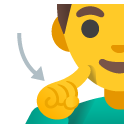
Appearance varies by platform and device. Google Noto, Twemoji, and OpenMoji are open-source.