🧏♀️
The Emoji
Deaf Woman
U+1F9CF U+200D U+2640 U+FE0F · :deaf_woman:
Trend 52
Meaning layers
- interpretation
- Used to signal 'I'm not listening to that,' 'not hearing this nonsense,' or sarcastically dismissing drama or unwanted opinions.
- tiktok usage
- Paired with 'sorry, can't hear the negativity' captions or used in response to drama and criticism with ironic detachment.
- irony level
- 6 / 10
Platform meanings
- meaning
- Represents 'unbothered' energy, ignoring drama, or proudly representing Deaf/HoH identity.
- trend usage
- Featured in Deaf TikTok content, sign language tutorials, and ironic 'not listening to hate' response videos.
- hashtags
- #DeafTikTok#NotListening#DeafCulture#Unbothered#SignLanguage
- virality score
- 58 / 100
Cultural meanings
🇺🇸
Western / Gen-Z
Widely used as 'unbothered' shorthand and also embraced genuinely in Deaf TikTok and Gen Z accessibility conversations. Dual-use between identity pride and ironic dismissal is very common.
🇵🇰
Pakistan & India
Primarily understood literally as representing a deaf woman; less cultural irony layering. Used in accessibility awareness posts and occasionally by users to signal 'not listening to family drama.'
🌍
Middle East
Used mainly in literal accessibility contexts; Deaf community advocates use it for visibility. Sarcastic unbothered usage is emerging among younger urban users.
🌐
Global Neutral
Universally understood as a representation of Deaf or hard-of-hearing women and sign language communication; the dismissive usage is context-dependent.
🇧🇩
Bangladesh
Predominantly literal interpretation — represents deaf individuals and disability awareness. Increasingly used in NGO and social work contexts advocating for inclusion.
🇱🇰
Sri Lanka
Used in disability advocacy and awareness campaigns; less common in casual ironic contexts. Community organizations use it to signal inclusivity.
🇨🇳
China
The dismissal/not-listening usage is more dominant among younger users on WeChat and Weibo. Literal Deaf representation is secondary in mainstream online culture.
🇯🇵
Japan
Used by disability rights advocates and in sign language education content. Less ironic usage; cultural norms favor direct communication emoji over sarcastic deployment.
🇰🇷
South Korea
Popular among younger users on KakaoTalk and Instagram to signal selective indifference. Also used genuinely in Deaf culture communities and sign language content.
🇹🇼
Taiwan
Used in both Deaf community spaces and ironically by younger users to dismiss unwanted input. Social media accessibility conversations actively feature it.
🇭🇰
Hong Kong
Dual use — Deaf community visibility and ironic 'not listening to this government/drama' expression during social discourse.
🇵🇭
Philippines
Used humorously among friends to say 'not hearing your gossip' and also sincerely in disability awareness campaigns across social platforms.
🇮🇩
Indonesia
Primarily literal in older demographics; younger users on TikTok Indonesia use it sarcastically to ignore criticism or unwanted commentary.
🇹🇭
Thailand
Used in disability inclusion content and by sign language educators. Younger Thai users sometimes deploy it to signal cute indifference to drama.
🇻🇳
Vietnam
Mainly literal usage in disability and accessibility content. Slowly gaining traction among Vietnamese Gen Z as a 'not listening' reaction emoji.
🇲🇾
Malaysia
Used by Deaf Malaysian community members for visibility and by general users to dismiss drama, especially on Twitter/X and TikTok Malaysia.
🇸🇦
Saudi Arabia
Primarily used in disability advocacy and inclusive design discussions. Sarcastic dismissal usage is emerging among younger Saudi social media users.
🇦🇪
UAE
Used in multicultural expat contexts for both Deaf representation and as a lighthearted 'not listening to negativity' symbol in cosmopolitan online spaces.
🇪🇬
Egypt
Used in awareness campaigns for disability inclusion and by some users to humorously signal ignoring family or societal pressure.
🇹🇷
Turkey
Seen in Deaf culture advocacy posts and occasionally in political discourse where users signal they are 'done listening' to a particular narrative.
🇮🇷
Iran
Used in disability rights content; among younger users it sometimes represents ignoring censorship or unwanted state messaging in coded online communication.
🇳🇬
Nigeria
Used in Deaf community advocacy and accessibility posts. Also used humorously among friends to signal not engaging with someone's 'nonsense.'
🇿🇦
South Africa
Featured in disability visibility campaigns and Deaf culture content. Younger South Africans use it ironically to dismiss drama in group chats.
🇬🇧
UK & Ireland
Well understood in both Deaf culture and ironic 'not arsed' British humor contexts. Used in Deaf awareness content and casually to dismiss online arguments.
🇫🇷
France
Used in disability rights and accessibility discussions; ironic dismissal usage aligns with French cultural value of not engaging with frivolity.
🇩🇪
Germany
Primarily used in disability inclusion and sign language education contexts. Ironic usage is less common; straightforward Deaf representation is dominant.
🇪🇸
Spain & Italy
Used in Deaf community posts and accessibility advocacy. Younger users in both countries use it to signal dramatic indifference in expressive communication styles.
🇧🇷
Brazil
Very popular in the ironic 'não to nem aí' (couldn't care less) register on Twitter/X and TikTok. Also used genuinely in Deaf Brazilian community content.
🇲🇽
Mexico
Used by Deaf Mexican community members for visibility and by younger users as a humorous 'ni en cuenta' (not even acknowledging it) dismissal emoji.
🌎
Latin America
Broadly used across Latin America both for genuine Deaf representation and as a lighthearted way to signal ignoring negativity or peer pressure.
🇦🇺
Australia & NZ
Commonly used in Deaf/HoH community spaces and casuallydeployed in group chats to mean 'nah, not listening to that mate.' High dual-use frequency.
How its meaning shifted
- 2010
Did not exist; Deaf representation in emoji was entirely absent and the concept of gender-inclusive disability emoji had not yet been developed.
- 2015
Still non-existent; early proposals for diverse emoji were in discussion but deaf-specific emoji had not been submitted to Unicode yet.
- 2020
Newly introduced (Unicode 12.0, 2019); initial usage was almost entirely sincere — Deaf representation, ASL content, and disability advocacy on emerging platforms.
- 2026
Dual usage is firmly established: sincere Deaf community identity marker and mainstream ironic 'not listening to this' dismissal emoji, especially among Gen Z globally.
See it on every platform
Adjacent emojis
- Often confused with
- person shruggingnail polishwoman gesturing ok
Share & embed
Frequently asked
01What does the 🧏♀️ Deaf Woman emoji mean?
A woman making the ASL/deaf sign near her ear and mouth, representing a deaf woman or sign language communication.
02What does 🧏♀️ mean on TikTok?
Represents 'unbothered' energy, ignoring drama, or proudly representing Deaf/HoH identity.
03What does 🧏♀️ mean on WhatsApp?
Telling someone you're not listening to their drama or complaints.
04What does 🧏♀️ mean in Gen-Z slang?
Used to signal 'I'm not listening to that,' 'not hearing this nonsense,' or sarcastically dismissing drama or unwanted opinions.
05Is the 🧏♀️ emoji safe to use?
Represents Deaf women, sign language, disability pride, and selective boundary-setting in communication.
06What does 🧏♀️ mean in texting?
Carries dual emotional weight — genuine representation for Deaf communities and a coping/dismissal mechanism for those setting emotional boundaries online.
07What is the shortcode for 🧏♀️?
The shortcode for Deaf Woman is :deaf_woman:
08What does 🧏♀️ mean in dating?
Rarely used in flirting; occasionally used humorously to say 'I didn't hear you say something annoying' or to play ignorant about commitment talk.
Safety & usage
- Safe meaning
- Represents Deaf women, sign language, disability pride, and selective boundary-setting in communication.
- Caution
- Can be used to mock or dismiss someone's valid concerns by implying they are not worth hearing — a subtle form of gaslighting or silencing.
Avoid using this emoji to mock or invalidate Deaf individuals or to sarcastically dismiss serious accessibility or disability-related conversations. Context sensitivity is important.
How it looks across platforms
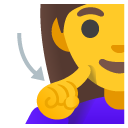
Appearance varies by platform and device. Google Noto, Twemoji, and OpenMoji are open-source.