🧏🏾♂️
The Emoji
Deaf Man: Medium-dark Skin Tone
U+1F9CF U+1F3FE U+200D U+2642 U+FE0F · :deaf_man_mediumdark_skin_tone:
Trend 44
Meaning layers
- interpretation
- Used to signal 'I'm not listening to that,' 'deaf to the drama,' or 'I can't hear the negativity.' Also used in solidarity with the deaf community or to express selective hearing in a playful way.
- tiktok usage
- Appears in videos about ignoring toxic people, blocking out negativity, or celebrating deaf culture and sign language content creators.
- irony level
- 5 / 10
Platform meanings
- meaning
- Represents tuning out negativity, deaf pride, or selective awareness in video contexts.
- trend usage
- Used in POV videos about ignoring drama, deaf culture awareness content, and sign language learning trends.
- hashtags
- #DeafTikTok#DeafCulture#SignLanguage#TuneItOut#DeafPride
- virality score
- 52 / 100
Cultural meanings
🇺🇸
Western / Gen-Z
Primarily used to signal selective hearing or tuning out negativity; also embraced genuinely in deaf community advocacy content.
🇵🇰
Pakistan & India
Mainly understood in its literal sense as referring to a deaf person; metaphorical uses are less common but growing among urban youth.
🌍
Middle East
Used respectfully to refer to deaf individuals; the deaf community in Arab countries uses it for representation in digital spaces.
🌐
Global Neutral
Universally recognized as a symbol of deafness or hearing impairment; metaphorical interpretations vary by region.
🇧🇩
Bangladesh
Primarily literal in meaning; used in disability awareness campaigns and social media posts about hearing accessibility.
🇱🇰
Sri Lanka
Understood as a representation of deafness; used in NGO and disability support content online.
🇨🇳
China
Used in accessibility and disability awareness contexts; the metaphorical 'not listening' interpretation is understood by younger, internationally connected users.
🇯🇵
Japan
Associated with disability representation and inclusivity campaigns; used carefully given cultural sensitivity around disability expression.
🇰🇷
South Korea
Used in disability advocacy content and occasionally by idol fan communities to humorously indicate they're ignoring criticism of their favorites.
🇹🇼
Taiwan
Used in disability rights discourse and occasionally in humorous social media posts about ignoring drama.
🇭🇰
Hong Kong
Used in accessibility discussions and among younger users as a playful 'not listening' emoji in group chats.
🇵🇭
Philippines
Recognized as a disability symbol; used in inclusive education and deaf community content online.
🇮🇩
Indonesia
Used in disability awareness content; younger users adopt the metaphorical 'not hearing the hate' meaning.
🇹🇭
Thailand
Seen in disability representation posts; also used by youth culture to express indifference to criticism.
🇻🇳
Vietnam
Used primarily in literal contexts related to deaf communities and hearing accessibility campaigns.
🇲🇾
Malaysia
Used in disability awareness content; also adopted in casual chat to mean ignoring someone or something.
🇸🇦
Saudi Arabia
Used in formal disability awareness and accessibility-related content; metaphorical uses are less prevalent.
🇦🇪
UAE
Appears in inclusivity campaigns and multicultural digital spaces; younger expat communities also use the metaphorical meaning.
🇪🇬
Egypt
Used in disability support content; casual metaphorical use is growing especially among Cairo's youth digital culture.
🇹🇷
Turkey
Used in disability rights and accessibility posts; also seen in social media humor about ignoring negative comments.
🇮🇷
Iran
Used primarily in disability-related contexts; social media youth culture occasionally uses it for the 'not listening' metaphor.
🇳🇬
Nigeria
Used in disability representation content; Afrobeats and Nigerian social media culture sometimes use it humorously to indicate ignoring haters.
🇿🇦
South Africa
Used in disability awareness and inclusivity campaigns; informal use includes expressing indifference to drama.
🇬🇧
UK & Ireland
Used for deaf community representation and in ironic digital culture to mean 'not hearing that mate.'
🇫🇷
France
Seen in disability advocacy and inclusivity discussions; philosophical undertone of willful ignorance in ironic usage.
🇩🇪
Germany
Used in accessibility and disability rights contexts; Germans may use it straightforwardly without heavy metaphorical layering.
🇪🇸
Spain & Italy
Used in disability representation content; younger users incorporate it in expressive social media posts about ignoring criticism.
🇧🇷
Brazil
Used in disability awareness and deaf community content; also popular in memes about selective hearing or ignoring drama.
🇲🇽
Mexico
Appears in disability representation posts and casual chat humor around 'no escucho eso' (I don't hear that) vibes.
🌎
Latin America
Broadly used in deaf community and accessibility spaces; adopted in youth culture for expressing selective indifference.
🇦🇺
Australia & NZ
Used in disability inclusion content and casually in chats as a lighthearted 'not listening to that' expression.
How its meaning shifted
- 2010
The emoji did not yet exist; deaf representation in digital communication was limited to text abbreviations like 'deaf' or hearing loss symbols.
- 2015
Early versions of deaf-related emojis were being proposed; representation emojis were gaining traction in Unicode discussions but not yet released.
- 2020
Introduced and adopted primarily for representation and accessibility advocacy; metaphorical usage began emerging in meme culture.
- 2026
Dual usage firmly established — genuine deaf community identity marker and widely understood metaphor for 'tuning out'; normalized across platforms and cultures.
See it on every platform
Adjacent emojis
- Often confused with
- person shruggingnail polishface with hand over mouth
- Can replace
- earspeak no evil monkeyzipper mouth face
Share & embed
Frequently asked
01What does the 🧏🏾♂️ Deaf Man: Medium-dark Skin Tone emoji mean?
A male figure with medium-dark skin tone touching their ear or making a gesture associated with deafness or hearing impairment, used to represent deaf men or the deaf community.
02What does 🧏🏾♂️ mean on TikTok?
Represents tuning out negativity, deaf pride, or selective awareness in video contexts.
03What does 🧏🏾♂️ mean on WhatsApp?
Used to tell someone you're not listening or to show support for the deaf community in conversation.
04What does 🧏🏾♂️ mean in Gen-Z slang?
Used to signal 'I'm not listening to that,' 'deaf to the drama,' or 'I can't hear the negativity.' Also used in solidarity with the deaf community or to express selective hearing in a playful way.
05Is the 🧏🏾♂️ emoji safe to use?
Represents deaf or hard of hearing individuals with medium-dark skin tone; used for community representation, accessibility advocacy, and disability awareness.
06What does 🧏🏾♂️ mean in texting?
Carries dual emotional weight — genuine representation and pride for the deaf community, while also symbolizing emotional self-protection and boundary-setting for those using it metaphorically.
07What is the shortcode for 🧏🏾♂️?
The shortcode for Deaf Man: Medium-dark Skin Tone is :deaf_man_mediumdark_skin_tone:
08What does 🧏🏾♂️ mean in dating?
Rarely used in flirting; may be used humorously as 'I don't hear your excuses' or 'I'm not listening to that red flag.'
Safety & usage
- Safe meaning
- Represents deaf or hard of hearing individuals with medium-dark skin tone; used for community representation, accessibility advocacy, and disability awareness.
- Caution
- Could be used mockingly to dismiss someone's opinion or belittle communication; rarely weaponized but possible in hostile online spaces.
Using this emoji to mock or imitate deafness, dismiss someone's voice, or stereotype deaf individuals is harmful and offensive. Context matters greatly.
How it looks across platforms
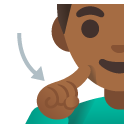
Appearance varies by platform and device. Google Noto, Twemoji, and OpenMoji are open-source.