🧏🏼
The Emoji
Deaf Person: Medium-light Skin Tone
U+1F9CF U+1F3FC · :deaf_person_mediumlight_skin_tone:
Trend 45
Meaning layers
- interpretation
- Used to signal 'I'm not listening to that,' 'I can't hear the negativity,' or as a way to indicate tuning out toxic energy. Also used genuinely by Deaf/HoH community members for representation.
- tiktok usage
- Appears in videos about ignoring drama, toxic people, or bad advice. Sometimes used in ASL education content or Deaf creator spaces to signal community membership.
- irony level
- 4 / 10
Platform meanings
- meaning
- Represents ignoring negativity, Deaf identity representation, or ASL/sign language content.
- trend usage
- Featured in 'can't hear the hate' trend, Deaf creator visibility content, and ASL challenge videos.
- hashtags
- #DeafTikTok#ASL#IgnoreTheHaters#DeafCommunity#SignLanguage
- virality score
- 52 / 100
Cultural meanings
🇺🇸
Western / Gen-Z
Widely used both for genuine Deaf identity representation and as a metaphor for ignoring negativity. TikTok's Deaf creator community has normalized its positive, empowered usage.
🇵🇰
Pakistan & India
Primarily understood in its literal sense — representing a deaf person. Growing awareness through sign language education content on social media has increased its inclusive usage.
🌍
Middle East
Used mainly in accessibility and disability awareness contexts. Sign language has distinct regional variants (ArSL) and this emoji appears in related educational content.
🌐
Global Neutral
Universally recognized as representing a deaf person or sign language user. The cross-cultural 'not listening' metaphor is increasingly understood globally through Western social media influence.
🇧🇩
Bangladesh
Understood literally as representing deafness or hearing impairment. Limited ironic or metaphorical use; appears primarily in disability advocacy and education contexts.
🇱🇰
Sri Lanka
Used in disability awareness circles and sign language education. Sri Lanka School for the Deaf communities have begun using it in social media outreach.
🇨🇳
China
Interpreted as representing hearing disability (聋哑). Used in accessibility content and by Deaf community members. Metaphorical 'ignoring' use is emerging among younger users via Western social media.
🇯🇵
Japan
Associated with sign language (手話) and Deaf culture. Used respectfully in disability representation content. The 'unbothered' ironic usage is not common — literal interpretation dominates.
🇰🇷
South Korea
Used in Korean Deaf community spaces and disability awareness campaigns. K-pop fan communities occasionally use it sarcastically for 'not hearing criticism of their faves.'
🇹🇼
Taiwan
Used in disability representation and sign language learning content. Taiwanese Sign Language (TSL) education accounts use it as a community identifier.
🇭🇰
Hong Kong
Used in Deaf community outreach and accessibility advocacy. Given the culturally sensitive political climate, it also occasionally appears as metaphor for government ignoring public voices.
🇵🇭
Philippines
Used in Filipino Sign Language (FSL) education and Deaf community content. Literal usage predominates. Growing community of Deaf Filipino creators uses it for identity.
🇮🇩
Indonesia
Appears in BISINDO (Indonesian Sign Language) education content and disability inclusion campaigns. Literal interpretation is standard; metaphorical use is limited.
🇹🇭
Thailand
Used in Thai Sign Language educational contexts and Deaf community representation. Associated with disability pride and inclusion messaging.
🇻🇳
Vietnam
Primarily literal usage in Vietnamese Deaf community contexts. Used in sign language awareness posts and disability rights advocacy content.
🇲🇾
Malaysia
Used in Malaysian Sign Language (BIM) educational content and Deaf community spaces. Appears in inclusive design and accessibility awareness campaigns.
🇸🇦
Saudi Arabia
Used mainly in disability awareness content and accessibility campaigns aligned with Vision 2030 inclusion goals. Literal interpretation dominates.
🇦🇪
UAE
Appears in Dubai and Abu Dhabi accessibility initiative content. The UAE's push for inclusive society has made this emoji visible in official and community disability advocacy.
🇪🇬
Egypt
Used in Egyptian Sign Language awareness content and disability representation posts. Occasionally appears in political commentary as a symbol of authorities 'not hearing' public concerns.
🇹🇷
Turkey
Used in Turkish Sign Language (TİD) education and Deaf community content. Also occasionally used in political discourse metaphorically to represent being ignored.
🇮🇷
Iran
Limited to Deaf community educational and advocacy contexts. Used in Persian-language sign language content. Political metaphor use is rare but exists in diaspora communities.
🇳🇬
Nigeria
Used in disability representation and sign language education in Nigeria. Growing Deaf community on social media uses it for visibility and identity affirmation.
🇿🇦
South Africa
Used in SASL (South African Sign Language) educational content — SASL being officially recognized. Appears in disability rights and inclusive education campaigns.
🇬🇧
UK & Ireland
Used genuinely for Deaf representation (BSL community) and ironically as 'not hearing that' dismissal. BSL gained official recognition in 2022, boosting community emoji visibility.
🇫🇷
France
Used in LSF (Langue des Signes Française) community content and disability awareness. Also appears ironically in French social media for 'I'm choosing not to engage with this discourse.'
🇩🇪
Germany
Used in DGS (Deutsche Gebärdensprache) community contexts and accessibility campaigns. Literal usage predominates; sarcastic use is secondary and mainly among younger users.
🇪🇸
Spain & Italy
Used in sign language education (LSE/LIS) and Deaf community content. Occasionally used metaphorically in social media to indicate ignoring political noise or personal drama.
🇧🇷
Brazil
Used in LIBRAS (Língua Brasileira de Sinais) community, which has a strong social media presence. Both genuine identity use and metaphorical 'blocking out negativity' use are common.
🇲🇽
Mexico
Used in LSM (Lengua de Señas Mexicana) educational content and Deaf representation. Metaphorical 'not listening' use also exists in Mexican internet culture.
🌎
Latin America
Across Latin America, primarily used for Deaf community representation and sign language education. The 'ignoring' metaphor is understood but literal use remains dominant.
🇦🇺
Australia & NZ
Used in Auslan and NZSL community content. Australia's strong disability rights culture means this emoji is widely and positively used for Deaf identity and advocacy.
How its meaning shifted
- 2010
Emoji did not exist yet. Deaf representation in digital communication was largely absent from mainstream emoji sets.
- 2015
Still not in Unicode. Disability advocacy groups were pushing for more inclusive emoji representation, laying groundwork for its eventual addition.
- 2020
Added to Unicode 12.0 (2019) and gaining traction. Initial use was primarily literal — Deaf community members and ASL advocates using it for identity and education. 'Can't hear the hate' metaphorical use beginning to emerge.
- 2026
Established dual usage: genuine Deaf identity/community symbol and mainstream metaphor for intentional disengagement. Featured in accessibility-positive content, Deaf creator economies on TikTok/Instagram, and sarcastic 'unbothered' internet culture.
See it on every platform
Compare with
Adjacent emojis
- Opposite
- earspeaking headloudspeaker
- Often confused with
- person gesturing okperson shruggingraised back of hand
Share & embed
Frequently asked
01What does the 🧏🏼 Deaf Person: Medium-light Skin Tone emoji mean?
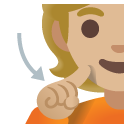
A person using sign language hand gesture near the ear/face, representing a deaf individual or the act of communicating through sign language. The medium-light skin tone modifier applies a Fitzpatrick scale tone to the base emoji.
02What does 🧏🏼 mean on TikTok?
Represents ignoring negativity, Deaf identity representation, or ASL/sign language content.
03What does 🧏🏼 mean on WhatsApp?
Signals that the sender is choosing not to engage with what was said, or used by Deaf/HoH users for identity expression.
04What does 🧏🏼 mean in Gen-Z slang?
Used to signal 'I'm not listening to that,' 'I can't hear the negativity,' or as a way to indicate tuning out toxic energy. Also used genuinely by Deaf/HoH community members for representation.
05Is the 🧏🏼 emoji safe to use?
Represents the Deaf community and sign language users. Used for disability representation, accessibility awareness, and Deaf Pride. Metaphorically used to express intentional disengagement from negativity.
06What does 🧏🏼 mean in texting?
Carries dual emotional weight — genuine pride and identity representation for Deaf individuals, while also functioning as a metaphorical 'blocking out' mechanism for those seeking to express emotional detachment from negativity.
07What is the shortcode for 🧏🏼?
The shortcode for Deaf Person: Medium-light Skin Tone is :deaf_person_mediumlight_skin_tone:
08What does 🧏🏼 mean in dating?
Rarely used in flirting. Could be used humorously like 'not listening to excuses 🧏🏼' when a partner is being defensive. Occasionally used by Deaf individuals in dating profiles for representation.
Safety & usage
- Safe meaning
- Represents the Deaf community and sign language users. Used for disability representation, accessibility awareness, and Deaf Pride. Metaphorically used to express intentional disengagement from negativity.
- Caution
- Could potentially be misused to mock someone for being deaf or to dismissively indicate ignoring someone in a hurtful way during arguments.
Using this emoji to mock or belittle someone with hearing loss is insensitive. When used as 'not listening,' context matters — dismissing genuine concerns with this emoji in serious conversations can come across as invalidating.
How it looks across platforms


Appearance varies by platform and device. Google Noto, Twemoji, and OpenMoji are open-source.