🧏🏻♀️
The Emoji
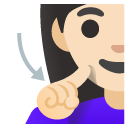
Deaf Woman: Light Skin Tone
U+1F9CF U+1F3FB U+200D U+2640 U+FE0F · :deaf_woman_light_skin_tone:
Trend 45
Meaning layers
- interpretation
- Used to signal 'not listening,' 'I can't hear you,' 'ignoring this,' or 'talking to the hand' energy. Also genuinely used by deaf/HoH Gen Z individuals to represent their identity.
- tiktok usage
- Appears in videos about selective hearing, ignoring drama, blocking out negativity, or proudly representing deaf culture and ASL content.
- irony level
- 5 / 10
Platform meanings
- meaning
- Represents deaf identity in ASL/deaf culture content, or ironically signals ignoring drama and negativity in trending skits.
- trend usage
- Common in deaf TikTok (#DeafTok) community, ASL tutorials, disability awareness challenges, and 'me ignoring problems' trend videos.
- hashtags
- #DeafTok#ASL#DeafCulture#HardOfHearing#DeafAwareness
- virality score
- 55 / 100
Cultural meanings
🇺🇸
Western / Gen-Z
Widely understood both as deaf identity representation and as a meme for ignoring drama; #DeafTok has made it a recognized symbol of the deaf community online.
🇵🇰
Pakistan & India
Primarily interpreted as a disability symbol; may also be used to express 'not listening' in frustrated family or relationship conversations on WhatsApp.
🌍
Middle East
Used in disability awareness contexts and occasionally in informal chats to indicate someone is being ignored or not hearing properly.
🌐
Global Neutral
Universally recognized as representing a deaf or hard-of-hearing person; the 'ignoring' connotation is a secondary, culturally dependent reading.
🇧🇩
Bangladesh
Mainly used in disability and inclusivity discussions; relatively low casual meme usage but growing awareness through social media content.
🇱🇰
Sri Lanka
Appears in disability advocacy posts and community awareness content; limited ironic or meme usage compared to Western contexts.
🇨🇳
China
Used in accessibility discussions and occasionally to signal 'I'm not listening' but less prominent than other dismissal emojis in Chinese digital culture.
🇯🇵
Japan
In Japan, used carefully and respectfully in disability awareness contexts; the ironic 'ignoring' use is less common due to cultural sensitivity around disability depiction.
🇰🇷
South Korea
Seen in disability inclusion content and occasionally in K-pop fan communities to indicate 'not listening to antis/haters' with a lighthearted tone.
🇹🇼
Taiwan
Used in inclusive education and disability rights conversations online; younger users also adopt the 'not listening' meme interpretation.
🇭🇰
Hong Kong
Appears in social media discussions about accessibility and sign language; also used informally to brush off unwanted opinions.
🇵🇭
Philippines
Commonly used in disability awareness campaigns and by deaf Filipino communities on social media; 'not listening' meme use is growing among younger Filipinos.
🇮🇩
Indonesia
Used in disability representation content and advocacy; increasingly adopted by Gen Z in Bahasa Indonesia meme culture for 'ignoring' contexts.
🇹🇭
Thailand
Seen in deaf community social media content and inclusivity posts; ironic use for 'not listening' is emerging among Thai youth online.
🇻🇳
Vietnam
Primarily appears in disability awareness and social inclusion campaigns; meme usage of 'not listening' is less developed compared to Western platforms.
🇲🇾
Malaysia
Used in bilingual (Bahasa/English) disability advocacy content; younger Malaysian users adopt the 'tuning out' interpretation in casual chats.
🇸🇦
Saudi Arabia
Appears respectfully in disability awareness and charitable content during awareness campaigns; ironic or meme use is less culturally accepted.
🇦🇪
UAE
Used in multicultural Dubai/Abu Dhabi digital spaces for disability inclusion content; expat communities may use the ironic 'not listening' meaning more freely.
🇪🇬
Egypt
Primarily seen in disability awareness posts; occasionally used colloquially to indicate someone is 'not hearing' an argument or refusing to engage.
🇹🇷
Turkey
Used in disability advocacy and social media awareness posts; Gen Z Turkish users have begun adopting the dismissive/ignoring interpretation in meme contexts.
🇮🇷
Iran
Appears in health and disability discussions; used carefully due to social media context but growing awareness in younger online communities.
🇳🇬
Nigeria
Used in disability awareness and inclusion conversations; also adopted humorously in Nigerian Twitter/X culture for 'not hearing nonsense' dismissal energy.
🇿🇦
South Africa
Appears in disability rights and inclusive education content; adopted by South African youth in meme contexts to signal ignoring negativity.
🇬🇧
UK & Ireland
Well understood as deaf identity representation; also used sarcastically in British humor culture to indicate 'not listening to this nonsense, mate.'
🇫🇷
France
Used in disability awareness content and occasionally in casual French digital culture to signal deliberate non-engagement with someone's argument.
🇩🇪
Germany
Primarily used in serious disability inclusion and accessibility discourse; less ironic usage compared to Anglophone countries.
🇪🇸
Spain & Italy
Appears in disability advocacy and used casually by younger users to signal 'I'm not listening to your drama' in Mediterranean expressive digital culture.
🇧🇷
Brazil
Widely adopted both for genuine deaf community representation and as a meme for ignoring nonsense, fitting Brazilian internet humor culture well.
🇲🇽
Mexico
Used in disability awareness and increasingly in Mexican meme culture to represent 'not hearing' toxic behavior or bad advice.
🌎
Latin America
Across Latin America, functions as both disability representation and a lighthearted way to signal tuning out drama or negativity.
🇦🇺
Australia & NZ
Understood both as deaf identity and as casual shorthand for 'not listening'; Australian internet culture embraces the ironic dismissal use.
How its meaning shifted
- 2010
Emoji did not exist in this form; disability representation in early emoji sets was minimal and skin tone modifiers had not yet been introduced.
- 2015
Skin tone modifiers began rolling out; disability-specific emojis were being advocated for but this specific emoji was not yet available.
- 2020
Introduced as part of emoji 12.0/12.1 expansion; primarily used by deaf communities for identity representation and early meme usage began emerging.
- 2026
Firmly established in two roles: genuine deaf/HoH identity symbol in disability communities and a widely recognized internet shorthand for ignoring drama or bad takes.
See it on every platform
Adjacent emojis
- Often confused with
- person gesturing nowaving handraised hand
- Can replace
- earmuted speakerface with rolling eyes
Share & embed
Frequently asked
01What does the 🧏🏻♀️ Deaf Woman: Light Skin Tone emoji mean?
A woman with light skin tone placing one or both hands near her ear or face, representing a deaf or hard-of-hearing person, often associated with sign language and deaf culture.
02What does 🧏🏻♀️ mean on TikTok?
Represents deaf identity in ASL/deaf culture content, or ironically signals ignoring drama and negativity in trending skits.
03What does 🧏🏻♀️ mean on WhatsApp?
Signals that someone is not listening or is choosing to ignore a message; also genuinely used by deaf users for identity expression.
04What does 🧏🏻♀️ mean in Gen-Z slang?
Used to signal 'not listening,' 'I can't hear you,' 'ignoring this,' or 'talking to the hand' energy. Also genuinely used by deaf/HoH Gen Z individuals to represent their identity.
05Is the 🧏🏻♀️ emoji safe to use?
Representation of deaf and hard-of-hearing individuals; disability pride and identity expression; advocacy for accessibility and inclusion.
06What does 🧏🏻♀️ mean in texting?
Carries dual emotional weight — genuine pride and identity for the deaf community, and a symbolic assertion of self-protection or emotional boundary-setting for broader audiences.
07What is the shortcode for 🧏🏻♀️?
The shortcode for Deaf Woman: Light Skin Tone is :deaf_woman_light_skin_tone:
08What does 🧏🏻♀️ mean in dating?
Rarely used flirtatiously; may be sent to signal 'I'm not listening to your excuses' after an argument or to playfully say 'I can't hear the nonsense you're saying.'
Safety & usage
- Safe meaning
- Representation of deaf and hard-of-hearing individuals; disability pride and identity expression; advocacy for accessibility and inclusion.
- Caution
- Could be used mockingly to dismiss someone's valid concerns by implying they are 'not worth listening to,' which can be ableist in certain contexts.
Using this emoji to mock or trivialize actual deaf/HoH experiences is considered ableist. The ironic 'not listening' usage, while popular, should not be used in contexts that demean disability.
How it looks across platforms
Appearance varies by platform and device. Google Noto, Twemoji, and OpenMoji are open-source.