🧏🏼♀️
The Emoji
Deaf Woman: Medium-light Skin Tone
U+1F9CF U+1F3FC U+200D U+2640 U+FE0F · :deaf_woman_mediumlight_skin_tone:
Trend 48
Meaning layers
- interpretation
- Used to signal 'I'm not listening to you,' 'I can't hear the negativity,' or to express deliberate ignorance of drama or toxic energy. Also used genuinely by Deaf/HoH community members for identity expression.
- tiktok usage
- Appears in videos about ignoring drama, toxic people, or unwanted advice. Often paired with 'deaf to the haters' captions or Deaf culture awareness content.
- irony level
- 4 / 10
Platform meanings
- meaning
- Represents Deaf culture pride, hard-of-hearing identity, or metaphorically 'tuning out' negativity and drama in video captions and overlays.
- trend usage
- Used in Deaf TikTok community videos, ASL tutorial content, 'ignoring toxicity' trend videos, and disability awareness campaigns.
- hashtags
- #DeafTikTok#DeafCulture#HardOfHearing#DeafToTheHaters#DisabilityAwareness
- virality score
- 52 / 100
Cultural meanings
🇺🇸
Western / Gen-Z
Widely used both as Deaf identity representation and sarcastically as 'immune to negativity' — the dual-use is well understood and appreciated in Western Gen Z spaces.
🇵🇰
Pakistan & India
Primarily understood literally as representing a Deaf woman; Deaf community members use it for identity, though the metaphorical 'ignoring' usage is emerging in urban youth culture.
🌍
Middle East
Used mainly in literal contexts to represent Deaf/HoH individuals; growing use in Gulf youth communities for 'not listening to drama' sentiment.
🌐
Global Neutral
Universally recognized as a disability representation emoji; the metaphorical dismissal usage is context-dependent across global platforms.
🇧🇩
Bangladesh
Primarily seen as a literal representation of Deaf women; used by disability advocates and Deaf community organizations on social media.
🇱🇰
Sri Lanka
Used in disability awareness campaigns and by Deaf community members; metaphorical usage is minimal but growing among younger social media users.
🇨🇳
China
Interpreted mainly as a disability representation emoji; used in accessibility advocacy content, though skin tone variations carry less significance culturally.
🇯🇵
Japan
Used in Deaf community spaces and disability inclusion content; Japan's robust sign language community embraces it as a positive identity symbol.
🇰🇷
South Korea
Popular in Deaf awareness content and K-content accessibility discussions; Gen Z Koreans also adopt the 'not listening to haters' usage.
🇹🇼
Taiwan
Used in Deaf culture celebration and disability visibility content; also adopted in youth culture for dismissing negativity online.
🇭🇰
Hong Kong
Appears in disability rights advocacy and Deaf community posts; the 'tuning out' metaphorical use is understood in younger digital communities.
🇵🇭
Philippines
Used by Filipino Deaf community members and disability advocates; also adopted casually by youth to express ignoring drama or gossip.
🇮🇩
Indonesia
Primarily used in disability awareness and Deaf community contexts; emerging among Indonesian youth as 'not listening to negativity' shorthand.
🇹🇭
Thailand
Used in Thai Deaf community spaces and accessibility content; occasionally adopted in youth culture for expressing selective inattention.
🇻🇳
Vietnam
Appears in disability representation and Deaf culture content; metaphorical usage is growing among Vietnamese social media users.
🇲🇾
Malaysia
Used by Deaf community members and disability advocates; dual usage — both literal and metaphorical — is gaining traction in Malaysian youth spaces.
🇸🇦
Saudi Arabia
Primarily interpreted as disability representation; used in accessibility and inclusion campaigns, with limited metaphorical usage due to cultural communication norms.
🇦🇪
UAE
Used in inclusive workplace and diversity content common in UAE's multicultural digital spaces; both literal and empowerment usages are recognized.
🇪🇬
Egypt
Used in Egyptian Deaf community and disability advocacy content; youth communities are beginning to adopt the 'ignoring negativity' usage.
🇹🇷
Turkey
Appears in Turkish Deaf community posts and disability visibility campaigns; younger users also use it to express tuning out unwanted opinions.
🇮🇷
Iran
Used in Persian Deaf community spaces; disability representation is the primary interpretation, with limited but growing metaphorical use.
🇳🇬
Nigeria
Used in Nigerian disability advocacy and Deaf community content; also popular among youth to express 'not hearing' toxic energy or gossip.
🇿🇦
South Africa
Used in South African disability inclusion content and Deaf culture spaces; dual meaning — literal and metaphorical — is well understood in digital communities.
🇬🇧
UK & Ireland
Used for Deaf identity representation and, very commonly, for sarcastic 'can't hear your nonsense' dismissal energy among British and Irish social media users.
🇫🇷
France
Used in French Deaf community and disability advocacy posts; the metaphorical dismissal usage is understood in French youth digital culture.
🇩🇪
Germany
Appears in German accessibility and Deaf culture content; used in professional contexts for inclusion discussions and casually for expressing disengagement.
🇪🇸
Spain & Italy
Used in Iberian and Italian Deaf community spaces; also adopted in youth culture for expressing dramatic indifference to criticism or drama.
🇧🇷
Brazil
Widely used by Brazilian Deaf community (Surdo community) and disability advocates; also popular in Brazilian youth culture to signal ignoring haters.
🇲🇽
Mexico
Used in Mexican Deaf community and disability rights content; youth adoption for 'tuning out drama' is strong, especially on TikTok and Instagram.
🌎
Latin America
Across Latin America, used both for Deaf identity representation and as a bold statement of ignoring negativity; the empowerment reading resonates strongly.
🇦🇺
Australia & NZ
Used in Australian and New Zealand Deaf community spaces and disability inclusion content; the 'immune to negativity' usage is very common among Gen Z users.
How its meaning shifted
- 2010
This emoji did not exist in 2010; deaf-related communication was represented through text or generic hand gesture emojis if at all.
- 2015
Still nonexistent as a standalone emoji; disability representation in emoji was largely absent, with advocacy groups beginning to push for inclusion.
- 2020
Newly introduced (Unicode 12.0, 2019), primarily used earnestly by Deaf/HoH community members for identity representation and disability awareness; metaphorical usage just beginning.
- 2026
Dual usage fully established — both sincere Deaf/HoH identity expression and widespread metaphorical 'unbothered/immune to negativity' usage; integrated into mainstream Gen Z digital vocabulary.
See it on every platform
Adjacent emojis
- Often confused with
- person gesturing noperson shruggingnail polish
- Can replace
- deaf personraised handear
Share & embed
Frequently asked
01What does the 🧏🏼♀️ Deaf Woman: Medium-light Skin Tone emoji mean?
A woman with medium-light skin tone placing her hand near her ear to indicate deafness or hard-of-hearing status, part of the disability representation emoji set introduced to promote inclusivity.
02What does 🧏🏼♀️ mean on TikTok?
Represents Deaf culture pride, hard-of-hearing identity, or metaphorically 'tuning out' negativity and drama in video captions and overlays.
03What does 🧏🏼♀️ mean on WhatsApp?
Sent when someone wants to signal they aren't listening or don't want to engage with a topic, or genuinely to express Deaf/HoH identity.
04What does 🧏🏼♀️ mean in Gen-Z slang?
Used to signal 'I'm not listening to you,' 'I can't hear the negativity,' or to express deliberate ignorance of drama or toxic energy. Also used genuinely by Deaf/HoH community members for identity expression.
05Is the 🧏🏼♀️ emoji safe to use?
Represents Deaf/HoH identity, disability visibility, and is used positively for empowerment, awareness, and community expression.
06What does 🧏🏼♀️ mean in texting?
This emoji carries dual emotional weight — genuine pride and identity for Deaf/HoH individuals, and a metaphorical assertion of personal boundaries for others who use it to signal emotional self-protection from negativity.
07What is the shortcode for 🧏🏼♀️?
The shortcode for Deaf Woman: Medium-light Skin Tone is :deaf_woman_mediumlight_skin_tone:
08What does 🧏🏼♀️ mean in dating?
Rarely used in flirting contexts; may occasionally appear as 'I didn't hear you say that' playful deflection during banter or teasing.
Safety & usage
- Safe meaning
- Represents Deaf/HoH identity, disability visibility, and is used positively for empowerment, awareness, and community expression.
- Caution
- Can be used mockingly to dismiss someone's concerns entirely, which may come across as ableist or dismissive in certain contexts.
Be mindful not to use this emoji to mock or trivialize Deaf/HoH experiences; when used sarcastically in contexts where Deaf people may see it, it could be perceived as appropriating or mocking disability identity.
How it looks across platforms
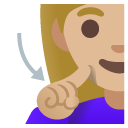
Appearance varies by platform and device. Google Noto, Twemoji, and OpenMoji are open-source.