🦻🏿
The Emoji
Ear With Hearing Aid: Dark Skin Tone
U+1F9BB U+1F3FF · :ear_with_hearing_aid_dark_skin_tone:
Trend 34
Meaning layers
- interpretation
- Used to signal 'I'm listening' or 'say that again' in casual contexts, sometimes as a symbol of Deaf Pride or disability awareness. Also used sarcastically to imply someone is ignoring you or 'playing deaf'.
- tiktok usage
- Appears in Deaf TikTok (DeafTok) content, accessibility advocacy videos, and occasionally as a reaction meaning 'I literally cannot hear you' directed at people saying something absurd.
- irony level
- 4 / 10
Platform meanings
- meaning
- Symbol of Deaf/HoH identity and community; reaction emoji meaning disbelief or 'I need to hear that again'; used heavily in DeafTok hashtag community.
- trend usage
- DeafTok creators use it in transitions, duets with hearing creators, and educational content about hearing aid technology and sign language.
- hashtags
- #DeafTok#HearingAid#DeafPride#HardOfHearing#DisabilityAwareness
- virality score
- 38 / 100
Cultural meanings
🇺🇸
Western / Gen-Z
Embraced as a symbol of Deaf Pride and disability identity; used with pride and in awareness content; also adopted sarcastically for 'not listening' humor.
🇵🇰
Pakistan & India
Primarily used literally to discuss hearing loss or hearing aid access; community awareness about hearing health in rural areas adds depth to its use.
🌍
Middle East
Used in medical and family health contexts; hearing loss discussions are often private, so this emoji appears more in medical professional contexts than casual use.
🌐
Global Neutral
Universally understood as a symbol of hearing assistance technology and hearing disability; used respectfully across most global contexts.
🇧🇩
Bangladesh
Mainly used in health communication contexts; disability representation is growing but the emoji is primarily associated with literal hearing loss.
🇱🇰
Sri Lanka
Used in healthcare and NGO communications about hearing health access; less common in casual social media use.
🇨🇳
China
Associated with medical and accessibility discussions; Deaf communities in China use it on platforms like Weibo to signal community membership.
🇯🇵
Japan
Used respectfully in disability inclusion content; Japan's growing accessibility movement has increased its visibility in awareness campaigns.
🇰🇷
South Korea
Appears in K-content accessibility discussions and by deaf Korean creators on platforms like Instagram and YouTube; associated with progressive inclusion.
🇹🇼
Taiwan
Used in disability rights advocacy and accessibility discussions; Taiwan's strong digital rights community incorporates it in inclusion conversations.
🇭🇰
Hong Kong
Appears in accessibility and social welfare discussions; the deaf community uses it on social media as an identity marker.
🇵🇭
Philippines
Used in health outreach content about hearing loss prevention and hearing aid access; growing use in disability pride communities.
🇮🇩
Indonesia
Primarily seen in health and education contexts; NGO communications about deaf education use it frequently.
🇹🇭
Thailand
Associated with hearing health campaigns by government and NGOs; Deaf Thai community uses it on social media for identity expression.
🇻🇳
Vietnam
Used in health communication content; disability awareness campaigns increasingly use this emoji in social media outreach.
🇲🇾
Malaysia
Appears in multicultural disability inclusion content; used by hearing healthcare professionals and deaf community advocates.
🇸🇦
Saudi Arabia
Used in medical and family health contexts; hearing health awareness is gaining traction and this emoji appears in related campaigns.
🇦🇪
UAE
Common in Dubai/Abu Dhabi's active disability inclusion and accessible city initiatives; used professionally and in community advocacy.
🇪🇬
Egypt
Used in health awareness contexts; growing social media presence of deaf Egyptian creators has increased its use as an identity symbol.
🇹🇷
Turkey
Appears in disability rights discussions and hearing health content; Turkish deaf community uses it on social media to signal identity.
🇮🇷
Iran
Primarily used in health and medical communication contexts; deaf community members use it cautiously on social platforms.
🇳🇬
Nigeria
Used in health outreach content about hearing loss, which is common in areas with untreated infections; disability pride use is growing.
🇿🇦
South Africa
Active in disability rights and inclusion discussions, especially post-constitutional emphasis on accessibility; used in advocacy and community contexts.
🇬🇧
UK & Ireland
Used in NHS hearing health content, disability advocacy, and by deaf British creators; carries strong Deaf Pride connotations.
🇫🇷
France
Associated with advocacy for deaf education rights and sign language recognition; French Deaf community uses it actively on social media.
🇩🇪
Germany
Used in accessibility and inclusion corporate communications; Germany's strong disability rights framework gives this emoji professional weight.
🇪🇸
Spain & Italy
Appears in disability awareness campaigns and by deaf creators; used in contexts of advocating for sign language official recognition.
🇧🇷
Brazil
LIBRAS (Brazilian Sign Language) community uses it alongside advocacy content; appears in captions by deaf Brazilian creators and audiologists.
🇲🇽
Mexico
Used in disability awareness content and by hearing healthcare professionals; growing deaf community social media presence uses it as identity shorthand.
🌎
Latin America
Broadly used in disability inclusion content across Latin America; associated with hearing health campaigns and deaf community visibility.
🇦🇺
Australia & NZ
Strong disability inclusion culture means this emoji is widely used in workplace accessibility, deaf community advocacy, and health content.
How its meaning shifted
- 2010
Did not exist; hearing aid representation in digital communication was absent, and disability emojis were not yet part of Unicode.
- 2015
Still did not exist; conversations about disability emoji representation were beginning in Unicode Consortium discussions.
- 2020
Newly introduced (Unicode 12.0, 2019); gaining traction in DeafTok communities, disability advocacy, and accessibility discussions; skin tone variants driving inclusive representation.
- 2026
Established symbol of Deaf Pride and disability inclusion; regularly used in DeafTok, accessibility advocacy, professional health contexts, and sarcastically as 'I can't hear you' across platforms.
See it on every platform
Adjacent emojis
- Often confused with
- eartelephone receiverperson gesturing no
- Can replace
- eardeaf personwaving hand dark skin tone
Share & embed
Frequently asked
01What does the 🦻🏿 Ear With Hearing Aid: Dark Skin Tone emoji mean?
An ear with a hearing aid or cochlear implant device, shown with dark skin tone modifier. Represents hearing assistance technology, hearing loss, and the deaf/hard-of-hearing community.
02What does 🦻🏿 mean on TikTok?
Symbol of Deaf/HoH identity and community; reaction emoji meaning disbelief or 'I need to hear that again'; used heavily in DeafTok hashtag community.
03What does 🦻🏿 mean on WhatsApp?
Used to say 'I'm listening' or 'speak up, I can't hear you.' Among deaf/HoH users it serves as identity shorthand.
04What does 🦻🏿 mean in Gen-Z slang?
Used to signal 'I'm listening' or 'say that again' in casual contexts, sometimes as a symbol of Deaf Pride or disability awareness. Also used sarcastically to imply someone is ignoring you or 'playing deaf'.
05Is the 🦻🏿 emoji safe to use?
Disability representation, Deaf Pride, hearing health awareness, identity expression for deaf/hard-of-hearing individuals.
06What does 🦻🏿 mean in texting?
Carries dual psychological weight — for deaf/HoH individuals it can be an empowering identity symbol, while others may use it to evoke empathy around disability. It challenges hearing-normative assumptions and signals community belonging.
07What is the shortcode for 🦻🏿?
The shortcode for Ear With Hearing Aid: Dark Skin Tone is :ear_with_hearing_aid_dark_skin_tone:
08What does 🦻🏿 mean in dating?
Rarely used in flirting; could appear in a playful 'I wasn't listening, say that again? 🦻🏿' message, but context-dependent.
Safety & usage
- Safe meaning
- Disability representation, Deaf Pride, hearing health awareness, identity expression for deaf/hard-of-hearing individuals.
- Caution
- Could theoretically be used mockingly toward deaf individuals, though this is rare; occasionally weaponized in 'you should listen' passive-aggressive contexts.
Largely safe. Care should be taken not to use this emoji mockingly or to dismiss deaf/HoH people's concerns. The dark skin tone modifier specifically represents Deaf individuals of color and should be used respectfully.
How it looks across platforms
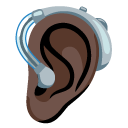


Appearance varies by platform and device. Google Noto, Twemoji, and OpenMoji are open-source.