🈵
The Emoji
Japanese “no Vacancy” Button
U+1F235 · :japanese_no_vacancy_button:
Trend 32
Meaning layers
- interpretation
- Used ironically to signal that someone's emotional capacity, patience, or social bandwidth is completely maxed out — 'I am full, no more room for drama.'
- tiktok usage
- Appears in 'I'm at capacity' videos where creators list all the things draining them, ending with 🈵 to signal they're done accepting more.
- irony level
- 7 / 10
Platform meanings
- meaning
- Signals being completely full — emotionally, socially, or schedule-wise. Used as a punchline or commentary on being overwhelmed.
- trend usage
- Featured in 'at capacity' trend videos, mental health commentary skits, and 'no vacancy in my life for X' formats.
- hashtags
- #AtCapacity#NoVacancy#FullUp#BoundaryCheck#EmotionallyFull
- virality score
- 38 / 100
Cultural meanings
🇺🇸
Western / Gen-Z
Adopted ironically as a boundary-setting symbol — 'emotionally no vacancy' — and loved for its obscure, aesthetically interesting look.
🇵🇰
Pakistan & India
Mostly unfamiliar to general users; tech-savvy or Japan-interested youth may use it correctly or in its ironic 'full/no space' sense.
🌍
Middle East
Rarely used; when encountered, it may be mistaken for a game button or decorative element rather than a meaningful sign.
🌐
Global Neutral
Universally interpretable as 'full' or 'no vacancy' in contexts where Japanese signage is explained, but largely niche otherwise.
🇧🇩
Bangladesh
Uncommon usage; occasionally appears in Japanese pop culture fan communities with its original or ironic meaning intact.
🇱🇰
Sri Lanka
Niche usage mostly limited to anime and Japanese culture enthusiasts who understand the kanji meaning.
🇨🇳
China
The character 満 is recognizable to Chinese speakers as meaning 'full/satisfied,' giving it a more intuitive meaning than in Western contexts.
🇯🇵
Japan
Immediately and correctly understood as a 'no vacancy/full' sign — seen on hotel and parking lot displays daily, carrying purely practical meaning.
🇰🇷
South Korea
Recognized by many as a Japanese signage character; used in travel contexts and occasionally in ironic 'I'm full/overloaded' humor.
🇹🇼
Taiwan
Traditional Chinese speakers recognize 滿 (full) in the character, making its meaning more intuitive; used practically and humorously.
🇭🇰
Hong Kong
Similar to Taiwan — the character's meaning is accessible to Cantonese/Chinese readers; used in travel and ironic contexts.
🇵🇭
Philippines
Used mostly by anime fans and Japanese culture enthusiasts; the ironic 'no vacancy for drama' usage has small but growing traction.
🇮🇩
Indonesia
Limited to Japanese culture fans and travelers; occasionally used ironically in youth social media to signal 'I'm full/done.'
🇹🇭
Thailand
Found in Japanese travel content and among K/J-pop culture fans; the red aesthetic also resonates with Thai cultural comfort with red signage.
🇻🇳
Vietnam
Niche usage in Japanese-interest communities; the bold red-and-white design is visually striking and occasionally used for aesthetic purposes.
🇲🇾
Malaysia
Used by Japanese culture fans and travelers; the multilingual environment means some Chinese-reading Malaysians also grasp the meaning.
🇸🇦
Saudi Arabia
Very niche; primarily encountered by those who have traveled to Japan or follow Japanese content creators.
🇦🇪
UAE
More exposure due to tourism and cosmopolitan demographics; Japanese restaurant and hotel contexts make it slightly more recognizable.
🇪🇬
Egypt
Almost entirely niche; seen as an exotic or foreign button by most users unfamiliar with Japanese writing.
🇹🇷
Turkey
Limited to anime/manga fan communities; the 'full/no vacancy' meaning has found some ironic use among youth online.
🇮🇷
Iran
Used primarily in anime fan communities; the red button aesthetic is visually interesting and sometimes repurposed for 'full/stop' signaling.
🇳🇬
Nigeria
Very niche; anime community members may use it correctly, while mainstream users see it as a decorative or game-related symbol.
🇿🇦
South Africa
Rare usage outside Japanese culture enthusiast circles; occasionally used in ironic 'at capacity' social media posts.
🇬🇧
UK & Ireland
Used ironically by Gen Z for 'emotionally full' or 'no space for this' — also recognized by Japan travelers in its original context.
🇫🇷
France
Niche but present in Japanese culture communities (France has a strong manga/anime following); ironic usage mirrors English-speaking Gen Z patterns.
🇩🇪
Germany
Occasionally used in Japan travel communities and by anime fans; the practical 'no vacancy/full' meaning resonates in orderly German communication culture.
🇪🇸
Spain & Italy
Found in anime fan communities; ironic usage for 'full/no more' has some traction among younger social media users.
🇧🇷
Brazil
Brazil's large anime community means this emoji has moderate recognition; used both correctly and ironically in 'cheio' (full) contexts.
🇲🇽
Mexico
Used by anime fans and Japan-culture enthusiasts; the ironic 'no hay lugar' (no space) usage appears in Gen Z social media.
🌎
Latin America
Across Latin America, anime culture provides the primary context for recognizing this emoji; ironic 'full/done' usage is emerging.
🇦🇺
Australia & NZ
Used similarly to UK/US Gen Z — ironic 'emotionally full' usage alongside correct Japan-travel context recognition.
How its meaning shifted
- 2010
Primarily used by Japanese speakers and early smartphone adopters to represent 'no vacancy' or 'full' in travel or logistical contexts — very literal and functional.
- 2015
Still largely functional, but anime and Japanese pop culture growth expanded its user base slightly; recognized by more non-Japanese users as a Japan-related symbol.
- 2020
Began appearing in ironic and Gen Z 'at capacity' meme formats; the pandemic era of overwhelm made 'no vacancy' metaphors culturally resonant.
- 2026
Firmly established in Gen Z emoji vocabulary as a boundary-setting and overwhelm symbol; used across platforms for ironic 'I'm full/done' communication alongside its original meaning.
See it on every platform
Adjacent emojis
- Often confused with
- japanese bargain buttonjapanese passing grade buttonred circle
- Can replace
- no entryprohibitedred circle
Share & embed
Frequently asked
01What does the 🈵 Japanese “no Vacancy” Button emoji mean?
The 🈵 emoji represents the Japanese character 満 (man), meaning 'full' or 'no vacancy.' It is used on signs in Japan to indicate that a hotel, parking lot, or venue has no available space.
02What does 🈵 mean on TikTok?
Signals being completely full — emotionally, socially, or schedule-wise. Used as a punchline or commentary on being overwhelmed.
03What does 🈵 mean on WhatsApp?
Sent to indicate unavailability — 'I'm full right now, can't take more on.'
04What does 🈵 mean in Gen-Z slang?
Used ironically to signal that someone's emotional capacity, patience, or social bandwidth is completely maxed out — 'I am full, no more room for drama.'
05Is the 🈵 emoji safe to use?
Universally safe — communicates 'full,' 'no vacancy,' or personal capacity limits in a non-offensive way.
06What does 🈵 mean in texting?
Psychologically mirrors the concept of emotional saturation — the individual communicates they've reached their limit for input, interaction, or responsibility, often as a self-protective boundary signal.
07What is the shortcode for 🈵?
The shortcode for Japanese “no Vacancy” Button is :japanese_no_vacancy_button:
08What does 🈵 mean in dating?
Rarely used flirtatiously; when it is, it signals 'my heart is already taken' or 'not available for new connections.'
Safety & usage
- Safe meaning
- Universally safe — communicates 'full,' 'no vacancy,' or personal capacity limits in a non-offensive way.
- Caution
- Could be used dismissively to shut down communication or signal rejection to someone reaching out, which may feel cold.
No significant safety concerns. Extremely low risk of misuse. Not associated with hate speech, NSFW content, or coded harmful language.
How it looks across platforms
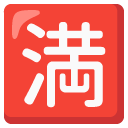


Appearance varies by platform and device. Google Noto, Twemoji, and OpenMoji are open-source.