👷🏾♂️
The Emoji
Man Construction Worker: Medium-dark Skin Tone
U+1F477 U+1F3FE U+200D U+2642 U+FE0F · :man_construction_worker_mediumdark_skin_tone:
Trend 45
Meaning layers
- interpretation
- Used to represent hard work, blue-collar pride, the construction bro aesthetic, or ironically to describe someone doing the bare minimum. Also used in 'building' metaphors — 'building myself up,' 'under construction' vibes.
- tiktok usage
- Appears in POV skits about construction workers, work grind content, self-improvement arcs described as being 'under construction,' and blue-collar appreciation posts.
- irony level
- 5 / 10
Platform meanings
- meaning
- Represents construction culture, trade pride, DIY grind content, or metaphorical 'building' of one's life or physique.
- trend usage
- Used in #tradestok, #bluecollar, and self-improvement transformation videos. POV videos of construction workers showing their day are a growing micro-trend.
- hashtags
- #tradestok#bluecollar#constructionlife#underconstructionera#buildingmyself
- virality score
- 52 / 100
Cultural meanings
🇺🇸
Western / Gen-Z
Used both literally for trade pride and ironically in 'under construction' self-improvement metaphors. Blue-collar appreciation is a growing counter-culture trend among Gen Z.
🇵🇰
Pakistan & India
Represents the large construction and infrastructure workforce central to urban development. Used respectfully to denote laborers and engineers, though class distinctions may affect connotation.
🌍
Middle East
Highly relevant given the massive construction sector in the Gulf region. Represents migrant labor forces that built iconic skylines, carrying both dignity and complex socioeconomic undertones.
🌐
Global Neutral
Universally understood as a construction or building worker. Carries no inherently negative or positive charge across global contexts.
🇧🇩
Bangladesh
Strongly tied to the large labor export and domestic construction workforce. Used to represent migrant construction workers, a major part of national identity and remittance economy.
🇱🇰
Sri Lanka
Associated with infrastructure development projects and overseas construction workers sending remittances home. Seen as a symbol of economic contribution.
🇨🇳
China
Linked to China's massive infrastructure boom and Belt and Road Initiative. Construction workers are celebrated in state media as heroes of development.
🇯🇵
Japan
Represents skilled craftsmen and construction professionals, a respected trade in Japanese culture. Associated with precision and quality workmanship.
🇰🇷
South Korea
Used in contexts of infrastructure pride and the globally renowned Korean construction conglomerates. Younger Koreans also use it in hustle culture and self-building metaphors.
🇹🇼
Taiwan
Associated with skilled labor and construction industry growth. Used straightforwardly in professional and trade contexts.
🇭🇰
Hong Kong
Carries connotations of the dense urban construction environment. Sometimes used symbolically in discussions about the city's rapid development and changing skyline.
🇵🇭
Philippines
Deeply tied to OFW (Overseas Filipino Worker) culture, many of whom work in construction abroad. The emoji evokes family sacrifice and hard-earned remittances.
🇮🇩
Indonesia
Represents the booming domestic construction sector and infrastructure projects under national development programs. Used with pride in labor contexts.
🇹🇭
Thailand
Connected to urban development and a large construction migrant labor community. Used practically to denote construction-related conversations.
🇻🇳
Vietnam
Symbolizes rapid urbanization and the construction boom transforming Vietnamese cities. Used in contexts of national development pride.
🇲🇾
Malaysia
Tied to the large construction workforce including migrant workers. Used in practical trade contexts and infrastructure discussions.
🇸🇦
Saudi Arabia
Extremely relevant given Vision 2030 mega-projects. Represents both the massive foreign workforce and the national development ambition driving construction activity.
🇦🇪
UAE
Iconic in the context of Dubai and Abu Dhabi's transformation. The emoji carries both pride in architectural achievement and awareness of labor dynamics.
🇪🇬
Egypt
Associated with large-scale government infrastructure projects including the New Administrative Capital. Used to represent a sector central to economic development plans.
🇹🇷
Turkey
Linked to Turkey's strong construction sector and its global contracting presence. Used in professional and national development contexts.
🇮🇷
Iran
Represents domestic infrastructure workers and construction projects. Used straightforwardly in labor and development discussions.
🇳🇬
Nigeria
Connected to urban development, real estate boom, and infrastructure gaps. Used in discussions about construction business and the building trade as an entrepreneurial sector.
🇿🇦
South Africa
Represents the construction and trades sector with BBBEE employment implications. Used in both practical trade contexts and discussions about labor equity.
🇬🇧
UK & Ireland
Used in banter about builders and tradies — a cultural archetype with tea break jokes. Also carries genuine blue-collar pride and increasing trade skill shortage awareness.
🇫🇷
France
Associated with skilled ouvriers (workers) and construction unions. Used in labor rights contexts and celebration of artisan craftsmanship.
🇩🇪
Germany
Represents the highly respected Handwerk (craft) tradition. Germans use this emoji with genuine professional pride — trades are prestigious and well-compensated careers.
🇪🇸
Spain & Italy
Tied to construction industries historically central to economic booms and busts. Used with cultural appreciation for craftsmen and building artisans.
🇧🇷
Brazil
Strongly associated with the large peão de obra workforce central to Brazilian urban growth. Used practically and also in humor about construction delays and informal building practices.
🇲🇽
Mexico
Represents the large construction labor force and skilled tradespeople central to Mexican urban life. Also appears in diaspora contexts among construction workers in the US.
🌎
Latin America
Broadly represents construction workers across Latin America's expanding urban centers. Used with dignity in labor-positive contexts and occasionally in political discussions about worker rights.
🇦🇺
Australia & NZ
The 'tradie' is a beloved cultural archetype. This emoji represents a respected, often well-paid professional. Used with pride, humor, and genuine cultural affection for trade workers.
How its meaning shifted
- 2010
Emoji skin tone modifiers didn't exist yet in 2010. General construction worker emoji was used as a simple literal representation of builders and laborers without cultural nuance.
- 2015
Skin tone variants introduced in Unicode 8.0 (2015). The medium-dark variant emerged as part of diversity initiatives. Primarily used literally to represent construction workers.
- 2020
Gained traction in blue-collar pride movements, essential worker appreciation during COVID-19, and increasingly in metaphorical 'building myself' self-improvement content.
- 2026
Used broadly across literal trade representation, Gen Z hustle culture metaphors, trades vs. college discourse, and as part of diverse professional emoji vocabulary. Skin tone specificity now normalized.
See it on every platform
Compare with
Adjacent emojis
- Often confused with
- person wearing turbanconstruction signpolice officer
- Can replace
- hammerbuilding constructionmuscle
Share & embed
Frequently asked
01What does the 👷🏾♂️ Man Construction Worker: Medium-dark Skin Tone emoji mean?
A male construction worker with medium-dark skin tone, wearing a hard hat and typically associated with building, labor, and infrastructure work.
02What does 👷🏾♂️ mean on TikTok?
Represents construction culture, trade pride, DIY grind content, or metaphorical 'building' of one's life or physique.
03What does 👷🏾♂️ mean on WhatsApp?
Sent to indicate someone is working a hard job, doing home renovations, or literally at a construction site. Also used to say 'I'm busy working.'
04What does 👷🏾♂️ mean in Gen-Z slang?
Used to represent hard work, blue-collar pride, the construction bro aesthetic, or ironically to describe someone doing the bare minimum. Also used in 'building' metaphors — 'building myself up,' 'under construction' vibes.
05Is the 👷🏾♂️ emoji safe to use?
Represents construction workers, builders, tradespeople, labor pride, and infrastructure — entirely safe and positive in standard use.
06What does 👷🏾♂️ mean in texting?
Evokes a sense of blue-collar identity pride and physical labor dignity. Can trigger feelings of respect for hard work or nostalgia for manual craftsmanship in an increasingly digital world.
07What is the shortcode for 👷🏾♂️?
The shortcode for Man Construction Worker: Medium-dark Skin Tone is :man_construction_worker_mediumdark_skin_tone:
08What does 👷🏾♂️ mean in dating?
Occasionally used by someone signaling they're a hands-on, practical, hardworking partner — 'I build things, I fix things.' Can also be used flirtatiously in the context of 'let me build something with you.'
Safety & usage
- Safe meaning
- Represents construction workers, builders, tradespeople, labor pride, and infrastructure — entirely safe and positive in standard use.
- Caution
- Rarely used in toxic ways. Could theoretically appear in derogatory class-based comments belittling manual labor, though this is uncommon.
The skin tone modifier makes it important to avoid using it in racially stereotyping contexts implying only certain ethnicities do manual labor. Use thoughtfully in diverse representations.
How it looks across platforms
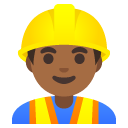
Appearance varies by platform and device. Google Noto, Twemoji, and OpenMoji are open-source.