👨🏿🦱
The Emoji
Man: Dark Skin Tone, Curly Hair
U+1F468 U+1F3FF U+200D U+1F9B1 · :man_dark_skin_tone_curly_hair:
Trend 58
Meaning layers
- interpretation
- Used to represent Black men, mixed-race men with curly hair, or as self-representation by dark-skinned curly-haired individuals. Often deployed in conversations about natural hair, Black identity, and cultural pride.
- tiktok usage
- Appears in Black creator content, natural hair tutorials, and representation discourse. Used in comment sections to tag or celebrate Black men being featured.
- irony level
- 2 / 10
Platform meanings
- meaning
- Represents Black or dark-skinned curly-haired men in video descriptions, comment hype, and identity expression. Used in natural hair and melanin-positive content.
- trend usage
- Appears in 'representation matters' trends, natural hair transformation videos, and Black excellence content. Frequently used alongside affirmations.
- hashtags
- #BlackExcellence#NaturalHair#MelaninPoppin#BlackMen#RepresentationMatters
- virality score
- 62 / 100
Cultural meanings
🇺🇸
Western / Gen-Z
Strongly associated with Black pride, natural hair acceptance, and diversity representation; widely used for self-identification and cultural affirmation by Black Gen Z men in the US, Canada, and Western Europe.
🇵🇰
Pakistan & India
Less commonly used for self-representation due to differing dominant skin tone and hair type norms, but may appear in conversations about African or Afro-Indian communities and diversity discussions.
🌍
Middle East
Used among Afro-Arab communities in the Gulf and Levant; also appears in diversity and multicultural content, though representation of dark skin remains a sensitive social topic in some areas.
🌐
Global Neutral
Universally recognized as representing a dark-skinned man with curly hair; interpreted as a symbol of human diversity and inclusivity across global digital communication.
🇧🇩
Bangladesh
Rarely used for self-representation; may appear in academic or social discourse about diversity, or in conversations about the African diaspora.
🇱🇰
Sri Lanka
Seldom used in everyday messaging; may appear in international or diaspora contexts, and occasionally in social media discussions about diversity and global culture.
🇨🇳
China
Typically used to represent an African or Black man in descriptive contexts; increasing awareness through social media about global diversity has slightly expanded its use.
🇯🇵
Japan
Used in contexts discussing global diversity or international culture; Japanese users may use it to represent African or mixed-heritage characters in creative or storytelling contexts.
🇰🇷
South Korea
Appears mainly in K-pop fan communities discussing Black artists' influence, and in diversity or anti-racism content shared by progressive youth.
🇹🇼
Taiwan
Used in international and multicultural discussions, as well as in content celebrating global diversity and Afro-descendant representation.
🇭🇰
Hong Kong
More commonly seen in international business and cosmopolitan social circles; used in diversity content and to represent Black colleagues or public figures.
🇵🇭
Philippines
Used in OFW communities abroad to describe Black colleagues or neighbors, and in Filipino social media discussions celebrating diversity and representation.
🇮🇩
Indonesia
Appears in diversity-themed content and discussions about global culture; Indonesian youth may use it in international social media contexts.
🇹🇭
Thailand
Used in content about Black culture, African tourism, and international diversity; Thai social media users apply it in globally-facing conversations.
🇻🇳
Vietnam
Relatively uncommon in everyday messaging; seen in discussions about international diversity, African students in Vietnam, and global cultural exchange.
🇲🇾
Malaysia
Used among Malaysia's diverse communities to represent Afro-descendant individuals, and in multicultural content that celebrates ethnic diversity.
🇸🇦
Saudi Arabia
Seen in conversations about African communities in the Kingdom and in content about the hajj and the broader Islamic ummah's diversity.
🇦🇪
UAE
Frequently used in Dubai's cosmopolitan social media scene to represent the large Afro-Arab and African expatriate community; embraced in diversity-positive content.
🇪🇬
Egypt
Used to describe or reference Black African communities in cultural discussions; also appears in Pan-African and Afro-Egyptian identity conversations online.
🇹🇷
Turkey
Appears in content about Black African students and diaspora communities in Turkey, and in social media discussions on diversity and anti-racism.
🇮🇷
Iran
Rarely used; may appear in conversations about African students, the Afro-Iranian community in southern Iran, or international diversity topics.
🇳🇬
Nigeria
Widely embraced as a direct self-representation emoji by Nigerian men; used proudly in social media content, especially in urban digital culture and Afrobeats communities.
🇿🇦
South Africa
Strongly resonant for Black South African men; used in everyday social media, celebration of Afro identity, and natural hair positivity content.
🇬🇧
UK & Ireland
Commonly used by British and Irish Black communities for self-expression; prominent in discussions about Black British identity, diversity in media, and cultural pride.
🇫🇷
France
Used by Afro-French communities to represent Black identity in a country where public discussion of ethnicity is complex; popular in anti-racism and diversity advocacy.
🇩🇪
Germany
Appears in Afro-German community spaces and diversity discussions; increasingly used by Black German youth on social platforms to assert visibility.
🇪🇸
Spain & Italy
Used by Afro-Spanish and Afro-Italian communities, as well as by Sub-Saharan African migrants; seen in diversity advocacy and cultural celebration content.
🇧🇷
Brazil
Highly resonant given Brazil's large Afro-descendant population; used in Afro-Brazilian pride content, natural hair movements, and cultural celebrations like Black Consciousness Day.
🇲🇽
Mexico
Used in Afro-Mexican community advocacy and by those celebrating indigenous African heritage in Mexico, particularly in Guerrero and Oaxacan coastal regions.
🌎
Latin America
Embraced across the Afro-Latino diaspora in Colombia, Venezuela, Cuba, and beyond for self-representation and cultural pride in Black Latin identity.
🇦🇺
Australia & NZ
Used by Aboriginal and Pacific Islander communities as a close but imperfect representation, and by Black African diaspora communities in Australia and New Zealand for self-identification.
How its meaning shifted
- 2010
This specific emoji did not exist in 2010; skin tone modifiers and hair component sequences were not part of Unicode, so generic yellow-skinned emojis were the only option, leaving dark-skinned individuals without representation.
- 2015
Skin tone modifiers were introduced in Unicode 8.0 in 2015, allowing for darker skin tones, but hair-specific variants like curly hair were not yet available; the base man emoji with dark skin tone served as a rough representation.
- 2020
By 2020 this emoji was well-established following its 2019 introduction; widely adopted by Black communities for representation, gaining cultural traction on TikTok and Instagram during the heightened social justice discourse of the year.
- 2026
In 2026 this emoji is a normalized part of everyday digital communication; used fluidly for identity, storytelling, and cultural celebration, with increasing appearance in corporate diversity content and mainstream media contexts.
See it on every platform
Compare with
Adjacent emojis
Share & embed
Frequently asked
01What does the 👨🏿🦱 Man: Dark Skin Tone, Curly Hair emoji mean?
A man with dark skin tone and curly hair, represented as a ZWJ sequence combining the man emoji, dark skin tone modifier, and curly hair component.
02What does 👨🏿🦱 mean on TikTok?
Represents Black or dark-skinned curly-haired men in video descriptions, comment hype, and identity expression. Used in natural hair and melanin-positive content.
03What does 👨🏿🦱 mean on WhatsApp?
Used to describe or represent a dark-skinned curly-haired man in a conversation, often referring to a specific person being discussed.
04What does 👨🏿🦱 mean in Gen-Z slang?
Used to represent Black men, mixed-race men with curly hair, or as self-representation by dark-skinned curly-haired individuals. Often deployed in conversations about natural hair, Black identity, and cultural pride.
05Is the 👨🏿🦱 emoji safe to use?
A positive representation emoji used for identity, diversity, and cultural pride among dark-skinned curly-haired men and their communities.
06What does 👨🏿🦱 mean in texting?
Carries strong identity-affirmation weight, particularly for communities historically underrepresented in digital media. Seeing oneself reflected in an emoji can reinforce positive self-image and cultural belonging.
07What is the shortcode for 👨🏿🦱?
The shortcode for Man: Dark Skin Tone, Curly Hair is :man_dark_skin_tone_curly_hair:
08What does 👨🏿🦱 mean in dating?
Used by people attracted to dark-skinned curly-haired men to express interest or appreciation. Can be dropped in DMs as a subtle compliment about someone's appearance.
Safety & usage
- Safe meaning
- A positive representation emoji used for identity, diversity, and cultural pride among dark-skinned curly-haired men and their communities.
- Caution
- Can be misused in racially charged contexts, tokenistic corporate diversity signaling, or in mockery threads, though such misuse is not the primary usage.
While generally positive and safe, context matters greatly. Using this emoji in combination with stereotyping language or in tokenistic ways can be perceived as offensive or reductive. Users should be mindful of cultural sensitivity.
How it looks across platforms
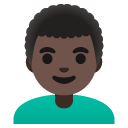


Appearance varies by platform and device. Google Noto, Twemoji, and OpenMoji are open-source.