💆🏻♂️
The Emoji
Man Getting Massage: Light Skin Tone
U+1F486 U+1F3FB U+200D U+2642 U+FE0F · :man_getting_massage_light_skin_tone:
Trend 52
Meaning layers
- interpretation
- Used to express needing a mental break, emotional exhaustion, or the blissful state of not thinking about anything. Often deployed humorously when someone is overwhelmed or choosing to mentally check out.
- tiktok usage
- Appears in self-care content, 'treating myself' videos, and 'unbothered' aesthetics. Sometimes used sarcastically when describing coping with stress by doing nothing productive.
- irony level
- 5 / 10
Platform meanings
- meaning
- Symbol of self-care, mental rest, and chosen ignorance of stress. Used in videos about boundaries, relaxation, and escaping responsibility.
- trend usage
- Appears in 'soft life' trends, 'that girl' morning routine aesthetics, and POV videos about ignoring toxic situations.
- hashtags
- #selfcare#softlife#unbothered#mentalhealth#treatyourself
- virality score
- 55 / 100
Cultural meanings
🇺🇸
Western / Gen-Z
Widely used ironically and sincerely to represent mental health breaks, self-care culture, and the 'soft life' trend. Men using self-care emojis is increasingly normalized and celebrated.
🇵🇰
Pakistan & India
Used in urban, social-media-savvy circles to signal spa culture or wellness aspirations. Less common in rural or older demographics; associated with modern, cosmopolitan lifestyle branding.
🌍
Middle East
Used in Gulf countries particularly among younger, affluent users who frequent luxury spas. Represents pampering and high-end leisure culture that is increasingly popular among men.
🌐
Global Neutral
Universally understood as representing relaxation, massage, and self-care. Safe and inoffensive across most global contexts with consistent interpretation.
🇧🇩
Bangladesh
Primarily understood literally as a massage or spa reference. Self-care culture for men is growing in urban centers like Dhaka, where this emoji aligns with emerging wellness trends.
🇱🇰
Sri Lanka
Associated with Ayurvedic and traditional massage culture, making the emoji relatable in wellness contexts. Urban youth also use it in the ironic 'I need a break' sense.
🇨🇳
China
Used on platforms like WeChat and Weibo to signal relaxation, spa trips, or 'lying flat' (躺平) culture — the popular anti-hustle philosophy resonates with this emoji's energy.
🇯🇵
Japan
Strongly associated with the rich spa and onsen culture. The emoji is used earnestly to represent relaxation rituals, with less ironic usage compared to Western contexts.
🇰🇷
South Korea
Aligned with Korea's booming wellness and skincare culture. The emoji is popular among men engaging with 'grooming' content and the growing men's self-care market.
🇹🇼
Taiwan
Used in lifestyle and wellness contexts with a mix of sincere self-care signaling and light humor about needing a break from busy work culture.
🇭🇰
Hong Kong
Used to signal escape from the notoriously high-stress work environment. Carries both aspirational (spa day) and ironic (I need to escape this city) meanings.
🇵🇭
Philippines
Popular among OFW content creators and urban youth to express needing rest or pampering after hard work. Fits into the 'self-reward' cultural narrative.
🇮🇩
Indonesia
Used in lifestyle and wellness content on Instagram and TikTok. Associated with spa culture common in Bali and major cities, and increasingly with mental health awareness.
🇹🇭
Thailand
Closely associated with Thailand's globally famous massage and spa industry. Both locals and tourism-context content use this emoji to reference traditional Thai massage culture.
🇻🇳
Vietnam
Used by younger urban Vietnamese to signal self-care and escape from work stress. Growing wellness culture in cities like Ho Chi Minh City makes this emoji increasingly relevant.
🇲🇾
Malaysia
Used in self-care and wellness posts across social media. Resonates with the multicultural urban demographic as wellness culture grows, especially in Kuala Lumpur.
🇸🇦
Saudi Arabia
Used among younger Saudi men in the context of luxury spa culture and self-care, which is growing significantly in the Kingdom alongside Vision 2030 lifestyle shifts.
🇦🇪
UAE
Very popular in Dubai and Abu Dhabi contexts where luxury spa culture is a prominent part of lifestyle branding. Used by influencers and everyday users to signal high-end wellness.
🇪🇬
Egypt
Used primarily in urban, social-media-active communities in Cairo. Represents relaxation and self-care; sometimes used humorously to cope with Egypt's busy and chaotic daily life.
🇹🇷
Turkey
Associated with hammam (Turkish bath) culture, making the emoji particularly resonant. Used both to reference traditional bathing rituals and modern spa experiences.
🇮🇷
Iran
Used mainly in younger, urban social media communities to express relaxation and self-care desires. Wellness content is growing among Iranian youth on platforms like Instagram.
🇳🇬
Nigeria
Used in the growing Lagos wellness and self-care community. Often signals aspiration toward luxury lifestyle or is used humorously to say 'I deserve better treatment than I'm getting.'
🇿🇦
South Africa
Popular in urban wellness communities and among lifestyle content creators. Carries both aspirational spa day connotations and the ironic 'I need a mental break' usage.
🇬🇧
UK & Ireland
Commonly used with dry British humor — 'me after reading the news 💆🏻♂️' is a classic deployment. Also used sincerely in growing men's mental health conversations.
🇫🇷
France
Fits naturally into French self-care and bien-être (wellbeing) culture. Used sincerely to signal spa visits, grooming rituals, and the French appreciation for rest and leisure.
🇩🇪
Germany
Used more literally in wellness and health contexts. German social media culture tends toward sincerity with this emoji — representing actual rest and recovery rather than irony.
🇪🇸
Spain & Italy
Used to signal dolce far niente (the sweetness of doing nothing) energy. Fits Mediterranean cultures' celebration of leisure, rest, and sensory pleasure.
🇧🇷
Brazil
Used in the context of salon and spa culture that is extremely mainstream in Brazil. Men visiting spas and salons is normalized, making this emoji both aspirational and relatable.
🇲🇽
Mexico
Used to signal self-care days and relaxation, increasingly common among younger Mexicans embracing wellness culture. Also used humorously to cope with stress and daily chaos.
🌎
Latin America
Across Latin America, used in self-care content with a warm, community-oriented spin. Often shared in the spirit of encouraging friends to rest and take care of themselves.
🇦🇺
Australia & NZ
Used casually in the context of beach culture, wellness, and 'taking a sickie' energy. Often ironic in nature — 'can't deal today, need this 💆🏻♂️' — with a laid-back Australian twist.
How its meaning shifted
- 2010
Emoji did not exist yet. Massage and relaxation concepts were conveyed through text descriptions or basic spa-related symbols if available.
- 2015
Introduced around this era as part of expanded Unicode emoji sets. Used almost exclusively literally to reference massages, spa days, and physical relaxation.
- 2020
Usage expanded significantly with the global focus on mental health during the pandemic. Began to take on metaphorical meaning around mental exhaustion, self-care culture, and stress relief.
- 2026
Fully integrated into digital communication as a versatile emoji representing everything from genuine spa trips to ironic 'mentally checked out' commentary. Anchored in men's self-care normalization discourse and the anti-hustle cultural movement.
See it on every platform
Compare with
Adjacent emojis
Share & embed
Frequently asked
01What does the 💆🏻♂️ Man Getting Massage: Light Skin Tone emoji mean?
A man receiving a head or face massage, depicted with light skin tone. The figure typically has hands pressed to the temples or head area, eyes closed, suggesting relaxation or relief.
02What does 💆🏻♂️ mean on TikTok?
Symbol of self-care, mental rest, and chosen ignorance of stress. Used in videos about boundaries, relaxation, and escaping responsibility.
03What does 💆🏻♂️ mean on WhatsApp?
Signals that the person is tired, needs a break, or is actively relaxing and not to be disturbed. Casual shorthand for 'I need a moment.'
04What does 💆🏻♂️ mean in Gen-Z slang?
Used to express needing a mental break, emotional exhaustion, or the blissful state of not thinking about anything. Often deployed humorously when someone is overwhelmed or choosing to mentally check out.
05Is the 💆🏻♂️ emoji safe to use?
A man receiving a relaxing head massage. Represents wellness, self-care, spa treatments, and mental or physical decompression.
06What does 💆🏻♂️ mean in texting?
Psychologically signals a desire for decompression and sensory relief. Often used when someone is at peak stress and fantasizing about or actively practicing self-care and escape from mental load.
07What is the shortcode for 💆🏻♂️?
The shortcode for Man Getting Massage: Light Skin Tone is :man_getting_massage_light_skin_tone:
08What does 💆🏻♂️ mean in dating?
Can be used playfully to hint at wanting physical touch or pampering from a partner. 'Someone give me this treatment 💆🏻♂️' can be a subtle flirty invitation.
Safety & usage
- Safe meaning
- A man receiving a relaxing head massage. Represents wellness, self-care, spa treatments, and mental or physical decompression.
- Caution
- Rarely used in harmful contexts. Occasionally deployed dismissively to tell someone to 'relax' in a condescending way during disagreements.
Generally very safe emoji with minimal risk of misuse. In rare cases could be used to dismiss someone's valid concerns by suggesting they need to 'chill out.' No significant NSFW associations.
How it looks across platforms
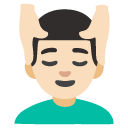
Appearance varies by platform and device. Google Noto, Twemoji, and OpenMoji are open-source.