👨🏿🦼➡️
The Emoji
Man In Motorized Wheelchair Facing Right: Dark Skin Tone
U+1F468 U+1F3FF U+200D U+1F9BC U+200D U+27A1 U+FE0F · :man_in_motorized_wheelchair_facing_right_dark_skin_tone:
Trend 22
Meaning layers
- interpretation
- Used to signal movement, independence, and unstoppable energy. Sometimes deployed ironically to say 'I'm out of here' or 'moving on without you.' Also used genuinely in disability pride and accessibility advocacy contexts.
- tiktok usage
- Appears in videos about disability representation, mobility tech, or as a 'moving forward' metaphor. Sometimes used in 'POV: I'm leaving this situation' content.
- irony level
- 3 / 10
Platform meanings
- meaning
- Used in disability awareness content, mobility tech showcases, and occasionally as a symbol of decisive forward movement or exit.
- trend usage
- Appears under disability pride hashtags, accessibility reviews, and 'moving on' narrative videos. Creators in the disability community use it as a signature identifier.
- hashtags
- #DisabilityPride#WheelchairLife#AccessibilityMatters#MobilityFreedom#DisabledAndProud
- virality score
- 28 / 100
Cultural meanings
🇺🇸
Western / Gen-Z
Embraced as a symbol of disability pride and inclusive representation; used freely in advocacy and identity expression online.
🇵🇰
Pakistan & India
Primarily interpreted literally as depicting a person with a physical disability; increasingly used in urban disability awareness campaigns but carries some stigma in traditional contexts.
🌍
Middle East
Used mainly in healthcare and charitable giving contexts; disability representation is growing but cultural stigma can affect how freely the emoji is deployed.
🌐
Global Neutral
Universally recognized as representing a motorized wheelchair user; broadly accepted as an accessibility and inclusion symbol.
🇧🇩
Bangladesh
Interpreted literally in the context of disability; used in NGO and development sector communications around disability rights and inclusive education.
🇱🇰
Sri Lanka
Used in disability welfare and healthcare social media content; representation of dark-skinned wheelchair users resonates with local demographics.
🇨🇳
China
Seen as a neutral disability representation emoji; used in medical, social welfare, and Paralympic content rather than casual messaging.
🇯🇵
Japan
Used carefully and respectfully; Japanese culture places importance on proper context for disability-related imagery, often seen in healthcare or social welfare posts.
🇰🇷
South Korea
Appears in inclusive design and accessibility technology discussions; K-pop fan communities may use it in supportive contexts for disabled artists.
🇹🇼
Taiwan
Used in disability rights advocacy and accessible design content; Taiwan's strong civil society means the emoji sees genuine advocacy use.
🇭🇰
Hong Kong
Deployed in social welfare and accessibility discussions; the directional facing adds a nuance of 'moving forward' appreciated in local discourse.
🇵🇭
Philippines
Used in disability awareness campaigns and healthcare content; the dark skin tone is particularly representative of Filipino complexions, adding cultural resonance.
🇮🇩
Indonesia
Primarily used in disability welfare, healthcare, and inclusive education content; growing disability rights movement increases its advocacy usage.
🇹🇭
Thailand
Seen in healthcare and social support contexts; used by disability organizations and in content about accessible tourism.
🇻🇳
Vietnam
Used in disability support and social welfare communications; increasing visibility in urban digital spaces as disability rights awareness grows.
🇲🇾
Malaysia
Appears in accessibility advocacy and healthcare social media; the diverse Malaysian population finds the dark skin tone inclusive and representative.
🇸🇦
Saudi Arabia
Used in healthcare and disability support contexts, often tied to government accessibility initiatives and charitable organizations.
🇦🇪
UAE
Common in accessibility and smart city content; UAE's push for inclusive infrastructure sees this emoji in governmental and NGO communications.
🇪🇬
Egypt
Used in disability advocacy and social welfare content; cultural attitudes toward disability are evolving and the emoji reflects growing awareness.
🇹🇷
Turkey
Appears in social welfare, healthcare, and disability rights content; used by NGOs and advocacy groups promoting accessible public spaces.
🇮🇷
Iran
Used in healthcare and disability support contexts; social media usage is more limited but appears in disability awareness content.
🇳🇬
Nigeria
Used in disability rights advocacy and health content; the dark skin tone is particularly resonant for Nigerian users, making it feel culturally authentic.
🇿🇦
South Africa
Strongly embraced due to the dark skin tone representation; used in disability rights content, community health posts, and inclusive development discussions.
🇬🇧
UK & Ireland
Used in disability rights advocacy, NHS/HSE accessibility content, and inclusive representation discussions; the right-facing direction aligns with left-to-right reading culture symbolism of progress.
🇫🇷
France
Used in disability inclusion and accessibility content; France's strong disability rights legislation context means it appears in civic and political discussions.
🇩🇪
Germany
Featured in barrier-free (barrierefreiheit) and inclusion content; used professionally in discussions about accessible infrastructure and disability rights.
🇪🇸
Spain & Italy
Used in disability support, healthcare, and inclusive design content; increasing presence in social media accessibility campaigns.
🇧🇷
Brazil
Used in disability rights, social welfare, and inclusive design content; the dark skin tone resonates in Brazil's diverse population and adds representational value.
🇲🇽
Mexico
Appears in healthcare, disability support, and social inclusion content; used by advocacy groups and inclusive organizations.
🌎
Latin America
Broadly used across Latin America in disability awareness, healthcare, and social welfare content; the dark skin tone supports broader representation across the region.
🇦🇺
Australia & NZ
Used in NDIS (National Disability Insurance Scheme) related content, disability advocacy, and inclusive representation discussions; widely accepted in professional and casual contexts.
How its meaning shifted
- 2010
This specific emoji did not exist in 2010; motorized wheelchair emojis and directional ZWJ sequences had not yet been created. General disability representation was minimal in emoji sets.
- 2015
Still not yet available; basic wheelchair emoji was not yet standard. Disability representation in emoji was a growing advocacy topic during this period.
- 2020
Motorized wheelchair emojis with skin tone variants were introduced around this era following Unicode and Emojipedia advocacy for disability representation; initial usage was primarily in disability communities and healthcare contexts.
- 2026
Widely recognized as a disability pride and accessibility symbol; used across advocacy, healthcare, gaming accessibility, and DEI professional contexts with growing mainstream awareness.
See it on every platform
Compare with
Adjacent emojis
Share & embed
Frequently asked
01What does the 👨🏿🦼➡️ Man In Motorized Wheelchair Facing Right: Dark Skin Tone emoji mean?
A man using a motorized wheelchair, depicted with dark skin tone, facing right. This is a ZWJ sequence combining the man emoji, dark skin tone modifier, motorized wheelchair emoji, and right-facing arrow.
02What does 👨🏿🦼➡️ mean on TikTok?
Used in disability awareness content, mobility tech showcases, and occasionally as a symbol of decisive forward movement or exit.
03What does 👨🏿🦼➡️ mean on WhatsApp?
Used to indicate someone is leaving or moving on, or as a representation of a wheelchair-using friend or family member.
04What does 👨🏿🦼➡️ mean in Gen-Z slang?
Used to signal movement, independence, and unstoppable energy. Sometimes deployed ironically to say 'I'm out of here' or 'moving on without you.' Also used genuinely in disability pride and accessibility advocacy contexts.
05Is the 👨🏿🦼➡️ emoji safe to use?
Represents a dark-skinned man using a motorized wheelchair; used in disability advocacy, accessibility discussions, and inclusive representation content.
06What does 👨🏿🦼➡️ mean in texting?
This emoji carries strong connotations of autonomy and self-determination. For many users with disabilities, it represents pride and visibility. For others, it evokes empathy and awareness around accessibility needs.
07What is the shortcode for 👨🏿🦼➡️?
The shortcode for Man In Motorized Wheelchair Facing Right: Dark Skin Tone is :man_in_motorized_wheelchair_facing_right_dark_skin_tone:
08What does 👨🏿🦼➡️ mean in dating?
Rarely used in flirting contexts; not a common romantic signal. Could theoretically appear in disability-positive dating spaces as an identity marker.
Safety & usage
- Safe meaning
- Represents a dark-skinned man using a motorized wheelchair; used in disability advocacy, accessibility discussions, and inclusive representation content.
- Caution
- Could theoretically be used mockingly to demean someone's mobility or disability, though this is uncommon. May be used insensitively by non-disabled users appropriating disability identity.
Should be used respectfully and authentically. Non-disabled users should be mindful of context when using disability-related emojis, especially in ironic or meme contexts that could trivialize disability experiences.
How it looks across platforms
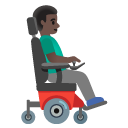
Appearance varies by platform and device. Google Noto, Twemoji, and OpenMoji are open-source.