🧎🏾♂️➡️
The Emoji
Man Kneeling Facing Right: Medium-dark Skin Tone
U+1F9CE U+1F3FE U+200D U+2642 U+FE0F U+200D U+27A1 U+FE0F · :man_kneeling_facing_right_mediumdark_skin_tone:
Trend 47
Meaning layers
- interpretation
- Used to convey deep respect, reverence, or a dramatic 'bowing down' to someone or something. Also used ironically to mock someone being excessively devoted or simp-like toward another person.
- tiktok usage
- Appears in comment sections to praise creators, signal that someone is 'knighting' another user, or mock obsessive fans of a celebrity.
- irony level
- 6 / 10
Platform meanings
- meaning
- Represents bowing down in admiration, being humbled by talent, or sarcastically calling out a simp. Also used in 'pledge of allegiance to the fandom' type comments.
- trend usage
- Used in fan comment storms under celebrity videos to show devotion. Also used in self-deprecating humor about simp behavior.
- hashtags
- #kneeling#notworthy#simp#respectemoji#bowdown
- virality score
- 52 / 100
Cultural meanings
🇺🇸
Western / Gen-Z
Used heavily in ironic meme culture to denote 'simping' or over-the-top worship, but also sincerely to hype up creators and friends on social media.
🇵🇰
Pakistan & India
Interpreted as a gesture of deep respect or religious humility; may be associated with bowing before elders or a deity in cultural contexts.
🌍
Middle East
Often linked to religious postures of prayer or submission before God; culturally carries significant spiritual weight and is used earnestly.
🌐
Global Neutral
Universally understood as a gesture of respect, submission, or reverence, making it a culturally transferable expression of admiration.
🇧🇩
Bangladesh
Associated with acts of religious devotion or respectful submission; used in spiritual conversation contexts or when showing deference to authority.
🇱🇰
Sri Lanka
Linked to Buddhist prostration practices and respectful gestures; carries a tone of spiritual humility and devotion in digital communication.
🇨🇳
China
May be used to indicate extreme respect for an idol or senior figure, though kneeling carries historically complex connotations of subjugation in some contexts.
🇯🇵
Japan
Evokes the concept of dogeza (deep bow/kneel) — the highest form of apology or respect. Used earnestly in fan culture to praise idols or creators.
🇰🇷
South Korea
Connected to idol culture where fans pledge extreme devotion; used in K-pop fan communities to express being overwhelmed by a bias's perfection.
🇹🇼
Taiwan
Used in gaming and fandom communities to show respect for a skilled player or beloved creator, borrowing heavily from Japanese otaku culture conventions.
🇭🇰
Hong Kong
Used in online communities to react to impressive feats or moments of unexpected excellence, often in sports and entertainment contexts.
🇵🇭
Philippines
Carries religious overtones due to strong Catholic culture; also used in pop culture to worship local celebrities or K-pop artists passionately.
🇮🇩
Indonesia
Associated with respect for elders and religious humility; in digital contexts also used in fandom communities to express devotion to a celebrity.
🇹🇭
Thailand
Evokes the act of paying respects in Buddhist tradition; used in modern digital communication to signal deep admiration or reverence.
🇻🇳
Vietnam
Used to express deep respect for elders or authority figures in traditional context; in youth culture it signals ironic or earnest devotion to an idol.
🇲🇾
Malaysia
Carries both religious and respectful connotations; used in fan groups to express admiration for a celebrity or impressive online moment.
🇸🇦
Saudi Arabia
Strongly associated with religious submission before Allah in Islamic tradition; used carefully in digital spaces with awareness of its spiritual gravity.
🇦🇪
UAE
Used in social media to express admiration for luxury, achievement, or powerful figures; the skin tone representation makes it more personally relatable.
🇪🇬
Egypt
Used to express dramatic reverence, sometimes ironically in meme culture; in sincere usage it signals respect for a wise or highly accomplished person.
🇹🇷
Turkey
Used in fan communities and gaming spaces to show respect for a talented player or beloved public figure; also used in ironic contexts similar to western meme culture.
🇮🇷
Iran
Used cautiously in digital spaces; when used, it tends to convey deep respect for a spiritual leader, elder, or someone who has done something genuinely remarkable.
🇳🇬
Nigeria
Used in social media to hype someone up massively — 'I bow for you' energy is common in Nigerian internet culture when someone achieves something impressive.
🇿🇦
South Africa
Used to acknowledge excellence, especially in sports or music; carries the spirit of 'you have earned this respect' in local digital slang culture.
🇬🇧
UK & Ireland
Used with heavy irony and dry humor to sarcastically 'bow' before someone being annoying or overly self-important; also used sincerely for sports legends.
🇫🇷
France
Used in ironic or theatrical social media posts to mock excessive reverence; also appears in fan communities devoted to art, cinema, or haute couture icons.
🇩🇪
Germany
Relatively straightforward usage to signal respect or admiration; less meme-heavy than Anglo internet culture, more likely used in gaming or sports contexts.
🇪🇸
Spain & Italy
Used dramatically and passionately in fan culture — football fans especially use it to worship legendary players or celebrate historic match moments.
🇧🇷
Brazil
Heavily used in football fan culture to bow before iconic players like Ronaldinho; also used in funk and trap music communities to hype artists.
🇲🇽
Mexico
Used in fan communities and gaming groups to show reverence for skill or talent; in meme culture it appears in jokes about being 'ruled by' something one loves.
🌎
Latin America
Broadly used across Latin American digital spaces to signal either sincere respect for a cultural icon or ironic devotion to a beloved meme or food item.
🇦🇺
Australia & NZ
Used with typical Australian irony and humor — either genuinely hyping up a mate for something impressive or sarcastically mocking someone's ego.
How its meaning shifted
- 2010
Emoji combining sequences like this did not exist in 2010; kneeling gestures were represented through text emoticons or not at all in digital communication.
- 2015
Basic kneeling emoji was not yet standardized; users expressed reverence through 🙏 or creative text-based expressions like '/bow'.
- 2020
With the introduction of direction-facing and gender-specific emoji ZWJ sequences, this emoji became part of a wave of diversity-focused updates; usage was still niche.
- 2026
Established as a staple in fandom, gaming, and meme culture across platforms; the medium-dark skin tone variant sees increased natural use as diverse emoji representation becomes more normalized.
See it on every platform
Adjacent emojis
- Often confused with
- person in lotus positionperson doing cartwheelperson climbing
- Can replace
- folded handsbow and arrowred heart
Share & embed
Frequently asked
01What does the 🧎🏾♂️➡️ Man Kneeling Facing Right: Medium-dark Skin Tone emoji mean?
A man with medium-dark skin tone kneeling on one knee and facing to the right, often representing submission, prayer, proposal, or physical exercise such as a lunge.
02What does 🧎🏾♂️➡️ mean on TikTok?
Represents bowing down in admiration, being humbled by talent, or sarcastically calling out a simp. Also used in 'pledge of allegiance to the fandom' type comments.
03What does 🧎🏾♂️➡️ mean on WhatsApp?
Sent to show extreme respect or admiration for something someone did or said in the chat.
04What does 🧎🏾♂️➡️ mean in Gen-Z slang?
Used to convey deep respect, reverence, or a dramatic 'bowing down' to someone or something. Also used ironically to mock someone being excessively devoted or simp-like toward another person.
05Is the 🧎🏾♂️➡️ emoji safe to use?
Represents humility, respect, prayer, proposal, or admiration. Used to honor someone or something in both sincere and playful contexts.
06What does 🧎🏾♂️➡️ mean in texting?
The act of kneeling is a deeply ingrained human gesture of submission and respect, rooted in feudal and religious traditions. Its directional facing adds a sense of purposeful movement or journey toward something worthy.
07What is the shortcode for 🧎🏾♂️➡️?
The shortcode for Man Kneeling Facing Right: Medium-dark Skin Tone is :man_kneeling_facing_right_mediumdark_skin_tone:
08What does 🧎🏾♂️➡️ mean in dating?
Used playfully to indicate someone is 'on their knees' for a crush, signaling extreme attraction or willingness to do anything for them — often used in a flirty, exaggerated way.
Safety & usage
- Safe meaning
- Represents humility, respect, prayer, proposal, or admiration. Used to honor someone or something in both sincere and playful contexts.
- Caution
- Can be used in harassment contexts to mock someone by sarcastically 'kneeling' in fake reverence, or to demean someone by suggesting they should kneel in submission.
In some political contexts, the kneeling gesture has been associated with protest movements (e.g., taking a knee). Use with awareness of potential political interpretations in sensitive discussions.
How it looks across platforms
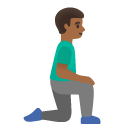
Appearance varies by platform and device. Google Noto, Twemoji, and OpenMoji are open-source.