🧗
The Emoji
Person Climbing
U+1F9D7 · :person_climbing:
Trend 55
Meaning layers
- interpretation
- Used to symbolize grinding, hustling, leveling up, or pushing through obstacles — both literally and metaphorically. Also used to say 'I'm on my way up' in life or career.
- tiktok usage
- Appears in motivational content, gym progress videos, and 'era' transitions — 'entering my climbing era 🧗'.
- irony level
- 3 / 10
Platform meanings
- meaning
- Symbolizes grinding, overcoming obstacles, or literally climbing — popular in fitness, adventure, and motivational niches.
- trend usage
- Used in 'entering my ___ era' trends, gym transformation videos, and mountain hiking content.
- hashtags
- #ClimbingEra#GrindMode#RockClimbing#LevelUp#ClimbEveryMountain
- virality score
- 58 / 100
Cultural meanings
🇺🇸
Western / Gen-Z
Used heavily as a metaphor for leveling up in life, entering a new 'era,' or grinding toward goals — part of the broader hustle and self-improvement aesthetic.
🇵🇰
Pakistan & India
Associated with hard work and social climbing — used in motivational posts and among youth discussing career ambition or academic grind.
🌍
Middle East
Tied to themes of perseverance and striving — resonates in contexts of ambition, spiritual struggle, and overcoming adversity.
🌐
Global Neutral
Universally understood as representing effort, physical challenge, and the desire to reach higher — minimal cultural misinterpretation risk.
🇧🇩
Bangladesh
Used among urban youth to signal ambition and the struggle to rise above difficult circumstances, especially in academic or professional contexts.
🇱🇰
Sri Lanka
Appears in outdoor adventure content and motivational social media — climbing is a growing sport with some local niche community use.
🇨🇳
China
Associated with ambition and 'involution' (内卷) culture — can ironically represent the exhausting climb up competitive academic and career ladders.
🇯🇵
Japan
Resonates with the concept of ganbaru (頑張る) — persisting and doing one's best; used in motivational and sports contexts without much irony.
🇰🇷
South Korea
Tied to the intense 'climbing the ladder' pressure in education and career culture (수저 계급론); both sincere and ironic use is common.
🇹🇼
Taiwan
Used in outdoor and adventure contexts given Taiwan's popularity for hiking and climbing; also used motivationally among younger generations.
🇭🇰
Hong Kong
Carries weight in hustle-culture conversations, especially in the context of overcoming adversity and social mobility challenges.
🇵🇭
Philippines
Used in motivational content and among OFW communities as a symbol of striving and sacrifice to reach higher in life.
🇮🇩
Indonesia
Associated with the growing adventure and outdoor tourism culture; also used metaphorically for career and social climbing among youth.
🇹🇭
Thailand
Used in fitness and outdoor recreation content; metaphorically applies to the aspirational content popular among Thai social media users.
🇻🇳
Vietnam
Common in motivational content and youth entrepreneurship discourse — represents the 'climbing out of difficulty' narrative popular on Vietnamese social platforms.
🇲🇾
Malaysia
Used in outdoor adventure content and motivational posts; younger Malaysians use it in the same hustle-culture context as global Gen Z.
🇸🇦
Saudi Arabia
Used in sports and fitness contexts with the growing Vision 2030 push toward active lifestyles; motivational use is also common among youth.
🇦🇪
UAE
Appears in adventure tourism content (given UAE's growing outdoor scene) and ambition-driven business/motivational posts from expat and local communities.
🇪🇬
Egypt
Used symbolically for perseverance and ambition — resonates in a culture where striving against odds is a valued cultural narrative.
🇹🇷
Turkey
Common in outdoor adventure content (Turkey has rich climbing geography) and motivational discourse among younger, digitally active populations.
🇮🇷
Iran
Used in rock climbing communities and among youth to signal determination and ambition in the face of daily challenges.
🇳🇬
Nigeria
Strongly resonates with hustle culture — 'climbing' is a powerful metaphor for rising from difficult circumstances, especially popular in motivational content.
🇿🇦
South Africa
Used in outdoor and adventure sports content, and also as a metaphor for social and economic climbing in a country with stark inequality narratives.
🇬🇧
UK & Ireland
Used in climbing gym culture and outdoor adventure content; also deployed with dry British irony when describing difficult or tedious tasks.
🇫🇷
France
France has a strong rock climbing tradition — used authentically in outdoor sports content and metaphorically in discussions of ambition and les grandes écoles-style achievement.
🇩🇪
Germany
Used in outdoor and Alpinist contexts (Germany has strong alpine culture) and straightforwardly in motivational or fitness content.
🇪🇸
Spain & Italy
Tied to outdoor adventure culture in mountain regions (Pyrenees, Dolomites); also used metaphorically for climbing social or professional ladders.
🇧🇷
Brazil
Used in the growing Brazilian climbing scene and in motivational content — resonates with themes of perseverance and rising above adversity in social media.
🇲🇽
Mexico
Used in outdoor adventure contexts and motivationally — 'seguir subiendo 🧗' (keep climbing) is a common motivational phrase pairing.
🌎
Latin America
Broadly used across Latin America in motivational and fitness content; the metaphor of climbing as social/economic mobility resonates deeply across the region.
🇦🇺
Australia & NZ
Very literally used in outdoor adventure and rock climbing content — both countries have active climbing communities and active lifestyle social media culture.
How its meaning shifted
- 2010
Did not exist yet — rock climbing or outdoor activity was represented by generic symbols or mountain emojis.
- 2015
Still pre-release; fitness and outdoor adventure communities were beginning to popularize emoji use but had no specific climbing representation.
- 2020
Became prominent with the Tokyo Olympics including sport climbing as an official event — saw a spike in literal sports usage and early adoption in motivational content.
- 2026
Firmly established in the motivational, hustle-culture, and self-improvement lexicon — used both sincerely and ironically across Gen Z content, fitness TikTok, and career-growth narratives.
See it on every platform
Compare with
Emoji combinations
Adjacent emojis
- Often confused with
- person cartwheelingperson swimmingperson golfing
- Can replace
- flexed bicepsmountainfire
Share & embed
Frequently asked
01What does the 🧗 Person Climbing emoji mean?
A person climbing a rock wall or cliff face, depicted in a climbing harness and using hands and feet to scale a vertical surface.
02What does 🧗 mean on TikTok?
Symbolizes grinding, overcoming obstacles, or literally climbing — popular in fitness, adventure, and motivational niches.
03What does 🧗 mean on WhatsApp?
Tells friends you're doing something physically active, outdoorsy, or working hard on a goal.
04What does 🧗 mean in Gen-Z slang?
Used to symbolize grinding, hustling, leveling up, or pushing through obstacles — both literally and metaphorically. Also used to say 'I'm on my way up' in life or career.
05Is the 🧗 emoji safe to use?
Represents physical activity, ambition, perseverance, and outdoor adventure — entirely wholesome.
06What does 🧗 mean in texting?
Psychologically linked to the concept of striving and upward mobility — taps into achievement motivation and the human drive to conquer challenges.
07What is the shortcode for 🧗?
The shortcode for Person Climbing is :person_climbing:
08What does 🧗 mean in dating?
Rarely flirtatious on its own, but could be used playfully to say 'I'm working my way up to you' or 'I'm climbing the ranks of your heart.'
Safety & usage
- Safe meaning
- Represents physical activity, ambition, perseverance, and outdoor adventure — entirely wholesome.
- Caution
- Occasionally used sarcastically in hustle-culture critiques or to mock someone overexerting themselves for social approval.
No significant toxic or NSFW associations. Minimal risk of misinterpretation across most platforms and cultures.
How it looks across platforms
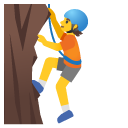


Appearance varies by platform and device. Google Noto, Twemoji, and OpenMoji are open-source.