🦸🏻♂️
The Emoji
Man Superhero: Light Skin Tone
U+1F9B8 U+1F3FB U+200D U+2642 U+FE0F · :man_superhero_light_skin_tone:
Trend 68
Meaning layers
- interpretation
- Used to hype up someone doing something impressive or stepping up in a clutch moment; can also be used ironically for mundane 'heroic' acts like buying snacks for the group.
- tiktok usage
- Appears in captions praising someone's glow-up, calling out a friend who saved the day, or sarcastically celebrating basic adulting tasks.
- irony level
- 6 / 10
Platform meanings
- meaning
- Hype emoji for praising a clutch moment, glow-up reveal, or someone standing up for others in a viral video.
- trend usage
- Used in duets and stitch videos where someone 'rescues' a situation; also in fitness and motivation content.
- hashtags
- #superhero#heromove#notallheroeswearcapes#glowup#clutch
- virality score
- 72 / 100
Cultural meanings
🇺🇸
Western / Gen-Z
Widely used ironically and sincerely to hype friends, celebrate small wins, and participate in 'not all heroes wear capes' meme culture.
🇵🇰
Pakistan & India
Used to celebrate cricket heroes, Bollywood stars in action roles, or to hype friends who do something brave or helpful; also common in motivational WhatsApp forwards.
🌍
Middle East
Used to honor acts of generosity, community leadership, and strength; appears in sports content and motivational social media posts celebrating local heroes.
🌐
Global Neutral
Universally understood as praise for heroic or impressive behavior, making it one of the safer emojis to use across cultural contexts.
🇧🇩
Bangladesh
Common in motivational content and used to celebrate national heroes, sports achievements, or local acts of kindness shared on Facebook and WhatsApp.
🇱🇰
Sri Lanka
Used on social media to celebrate national athletes, humanitarian workers, and community leaders; often sincere rather than ironic.
🇨🇳
China
Popular in gaming and esports communities to celebrate top players; also used on Weibo to hype national athletes and frontline workers.
🇯🇵
Japan
Frequently used in anime and manga fan communities to reference superhero archetypes; also appears in motivational content on Twitter/X-Japan.
🇰🇷
South Korea
Heavily used in K-pop fan communities to praise idols who overcome hardship; also appears in gaming and esports hype content.
🇹🇼
Taiwan
Used in gaming, pop culture, and sports contexts to celebrate clutch moments; carries a lighthearted, positive energy.
🇭🇰
Hong Kong
Used to praise courageous public figures, community helpers, or sports athletes; can carry deeper resonance in social justice contexts.
🇵🇭
Philippines
Very popular as sincere praise for everyday heroes — nurses, teachers, OFWs (Overseas Filipino Workers) — and also used in gaming content.
🇮🇩
Indonesia
Common on Instagram and TikTok to celebrate local influencers, athletes, and people who help their communities; used earnestly.
🇹🇭
Thailand
Used to hype Muay Thai fighters, gaming streamers, and social media personalities doing impressive things; mostly positive and sincere.
🇻🇳
Vietnam
Popular in gaming communities and youth social media to celebrate achievements; also used to honor national athletes and community figures.
🇲🇾
Malaysia
Used to celebrate multicultural community heroes, sports figures, and everyday acts of kindness; common on Twitter and TikTok.
🇸🇦
Saudi Arabia
Appears in sports and gaming content to celebrate national athletes; also used to honor acts of generosity or religious charity.
🇦🇪
UAE
Used in cosmopolitan social media contexts to celebrate innovators, entrepreneurs, and sports heroes; popular in both English and Arabic posts.
🇪🇬
Egypt
Common in social media to celebrate football players, musicians, and acts of everyday heroism; carries strong positive connotations.
🇹🇷
Turkey
Used to hype athletes, especially football players, and to praise people who stand up for others; appears in both sincere and ironic contexts.
🇮🇷
Iran
Used primarily in sports and gaming communities to celebrate achievements; also appears in motivational content shared on Instagram.
🇳🇬
Nigeria
Widely used to celebrate Afrobeats artists, athletes, and community leaders; 'not all heroes wear capes' format is popular for praising everyday people.
🇿🇦
South Africa
Used to honor community helpers, sports heroes, and activists; carries both sincere and ironic usage across platforms.
🇬🇧
UK & Ireland
Used with British dry humor — often ironic for mundane heroism like putting the kettle on; also genuinely used to hype sports moments.
🇫🇷
France
Used to celebrate athletes, humanitarian workers, and cultural figures; carries a slightly more formal tone of admiration than in English-speaking cultures.
🇩🇪
Germany
Used sincerely to praise efficiency, problem-solving, and leadership; less ironic usage than in Anglo-American contexts.
🇪🇸
Spain & Italy
Used passionately to celebrate football players, local heroes, and community figures; very expressive and sincere in praise contexts.
🇧🇷
Brazil
Hugely popular for praising football heroes, carnival performers, and everyday community helpers; often combined with fire emojis for extra hype.
🇲🇽
Mexico
Used to celebrate athletes, musicians like Luis Miguel, and everyday community heroes; very warm and enthusiastic in application.
🌎
Latin America
Broadly used across Latin America to celebrate cultural heroes, sports stars, and people who stand up for their communities with passion.
🇦🇺
Australia & NZ
Used with relaxed humor — often ironic for mundane tasks — but also sincerely to celebrate sports achievements and everyday kindness.
How its meaning shifted
- 2010
This specific emoji did not exist yet; superhero concepts online were expressed through text like ':superhero:' or generic strong-arm emojis.
- 2015
Base superhero emoji variants began appearing; usage was primarily literal, referencing comic book characters and Halloween costumes.
- 2020
Gained significant traction during COVID-19 to honor frontline workers as 'everyday superheroes'; skin tone variants became more deliberately chosen as representation discourse grew.
- 2026
Widely used across ironic, sincere, and meme contexts; the light skin tone variant is consciously selected for personal identification; strong in fitness, gaming, and motivational content.
See it on every platform
Adjacent emojis
- Often confused with
- man guardman police officerman in tuxedo
- Can replace
- flexed bicepstrophyfire
Share & embed
Frequently asked
01What does the 🦸🏻♂️ Man Superhero: Light Skin Tone emoji mean?
A male superhero with light skin tone, depicted wearing a superhero costume, often with a cape, representing heroism, strength, and extraordinary ability.
02What does 🦸🏻♂️ mean on TikTok?
Hype emoji for praising a clutch moment, glow-up reveal, or someone standing up for others in a viral video.
03What does 🦸🏻♂️ mean on WhatsApp?
Sent to praise a friend who helped out or solved a problem in the group.
04What does 🦸🏻♂️ mean in Gen-Z slang?
Used to hype up someone doing something impressive or stepping up in a clutch moment; can also be used ironically for mundane 'heroic' acts like buying snacks for the group.
05Is the 🦸🏻♂️ emoji safe to use?
Represents heroism, strength, admiration, and empowerment; used to celebrate people who go above and beyond.
06What does 🦸🏻♂️ mean in texting?
Taps into the human desire for recognition and the archetypal hero narrative; using this emoji signals both self-efficacy and the impulse to celebrate others who rise to challenges.
07What is the shortcode for 🦸🏻♂️?
The shortcode for Man Superhero: Light Skin Tone is :man_superhero_light_skin_tone:
08What does 🦸🏻♂️ mean in dating?
Sent to someone after they do something sweet or protective, like 'you're my hero 🦸🏻♂️'; can be a playful compliment on someone's confidence.
Safety & usage
- Safe meaning
- Represents heroism, strength, admiration, and empowerment; used to celebrate people who go above and beyond.
- Caution
- Rarely weaponized, but can be used sarcastically to mock someone who overestimates their importance or plays the savior complex.
Generally very safe; minimal risk of misuse. The skin tone specificity (light) can occasionally be noted in diversity discussions but is not inherently problematic.
How it looks across platforms
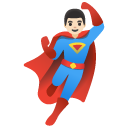
Appearance varies by platform and device. Google Noto, Twemoji, and OpenMoji are open-source.