🚶🏿♂️➡️
The Emoji
Man Walking Facing Right: Dark Skin Tone
U+1F6B6 U+1F3FF U+200D U+2642 U+FE0F U+200D U+27A1 U+FE0F · :man_walking_facing_right_dark_skin_tone:
Trend 52
Meaning layers
- interpretation
- Used to represent moving forward, leaving something or someone behind, or simply walking away without looking back. Often deployed when someone is done with a situation, person, or drama and is quite literally 'walking.'
- tiktok usage
- Appears in 'walking away' POV videos, transition clips, and 'leaving toxic situations' content. Frequently paired with a dramatic music cue or a mic-drop caption.
- irony level
- 4 / 10
Platform meanings
- meaning
- Represents physically walking away, transitioning, or moving forward in life. Used heavily in POV and transition content.
- trend usage
- Featured in 'glow-up walk' trends, 'leaving 2024 behind' compilations, and cinematic walking-away video edits with voiceovers.
- hashtags
- #walkingaway#movingforward#glowupwalk#leftthatchapter#emojirepresentation
- virality score
- 58 / 100
Cultural meanings
🇺🇸
Western / Gen-Z
Heavily used as a 'leaving' or 'unbothered' emoji in English-speaking Western Gen Z spaces, especially on TikTok and Twitter/X. The dark skin tone is specifically appreciated for its representation value in diverse online communities.
🇵🇰
Pakistan & India
Used to indicate physically heading somewhere or being on the move in WhatsApp chats. In Hindustani digital culture, it can also carry a dismissive 'I'm out of this drama' connotation.
🌍
Middle East
Interpreted primarily as a literal movement emoji — someone walking or traveling. Used in group chats to signal departure or arrival, with less ironic usage than in Western contexts.
🌐
Global Neutral
Universally understood as a person walking to the right, used across contexts to represent movement, departure, or forward progress without strong cultural loading.
🇧🇩
Bangladesh
Used in casual messaging to indicate being on the move or leaving a place. WhatsApp-dominant usage means it appears frequently in personal and family group chats.
🇱🇰
Sri Lanka
Primarily used in its literal sense to show someone is walking or on their way. Less ironic usage; more practical communication shorthand.
🇨🇳
China
On platforms like WeChat, used to indicate being busy or heading out. The directional aspect is appreciated for clarity in communication.
🇯🇵
Japan
Used with appreciation for its specificity — directional emojis are valued in Japanese digital communication for their precision. May appear in work contexts to signal 'I'm heading there now.'
🇰🇷
South Korea
Popular on KakaoTalk and Twitter for indicating movement or a casual exit from a conversation. K-drama fan communities may use it dramatically during plot reactions.
🇹🇼
Taiwan
Used casually to indicate being on the move. In Taiwanese internet culture, may pair with humor about busy city life or commuting.
🇭🇰
Hong Kong
Used in the context of fast-paced city life to indicate being in transit or heading somewhere quickly. Cantonese-speaking users may pair it with shorthand slang.
🇵🇭
Philippines
Widely used on Facebook Messenger to indicate leaving or being on the move. The Filipino internet culture embraces emojis expressively and the dark skin tone resonates with local representation.
🇮🇩
Indonesia
Used across WhatsApp and Instagram to signal departure or movement. Indonesian users often combine it with casual language to say 'I'm heading out.'
🇹🇭
Thailand
Used to indicate movement or leaving, fitting into Thai digital communication's emoji-heavy style. May also appear in fitness and walking challenge content.
🇻🇳
Vietnam
Practical usage to indicate someone is on their way or leaving. Vietnamese Zalo and Facebook users use it as a quick departure signal in group chats.
🇲🇾
Malaysia
Used across multicultural Malaysian chat groups to signal movement. The dark skin tone can resonate with Malay and Indian-Malaysian communities for representation.
🇸🇦
Saudi Arabia
Used to indicate physical movement or departure. In group chats, used politely to signal one is heading out, respecting communication etiquette.
🇦🇪
UAE
Popular in diverse UAE group chats among expatriate communities for its inclusive skin tone options. Used to indicate commuting, travel, or departure.
🇪🇬
Egypt
Used in Egyptian WhatsApp groups to say 'I'm leaving' or 'heading somewhere.' The emoji culture in Egypt is expressive and this fits naturally into casual exit messaging.
🇹🇷
Turkey
Used casually to indicate being on the move or leaving a conversation. Turkish internet users may employ it with humorous captions about avoiding drama.
🇮🇷
Iran
Used on platforms like Telegram and Instagram to indicate movement or departure. The literal walking meaning is the dominant interpretation.
🇳🇬
Nigeria
Widely embraced for its dark skin tone representation. In Nigerian Twitter (now X) and WhatsApp culture, it's used with flair to signal unbothered exits and powerful departures.
🇿🇦
South Africa
The dark skin tone version carries specific representation significance. Used across South African social media to signal leaving a situation with dignity and confidence.
🇬🇧
UK & Ireland
Used in British and Irish digital spaces with dry humor — often dropped at the end of a sarcastic comment or used to signal leaving a chaotic online conversation.
🇫🇷
France
Used practically to indicate being in motion or leaving. French users may pair it with philosophical captions about 'moving on' in an understated way.
🇩🇪
Germany
Deployed in its most literal sense — indicating a person walking or being on the move. German digital communication tends to use emojis more functionally than ironically.
🇪🇸
Spain & Italy
Used expressively to signal heading out, especially in social contexts. Mediterranean digital culture embraces this emoji for its energy and movement.
🇧🇷
Brazil
Used dynamically in Brazilian WhatsApp and TikTok to signal departures, exits from drama, and 'moving forward' narratives. Brazilians pair it energetically with caps-lock captions.
🇲🇽
Mexico
Used in Mexican digital spaces to indicate movement or walking away from situations. Social media usage is vibrant and often paired with humorous context.
🌎
Latin America
Broadly used across Latin America to signal departure or movement. The emoji fits into the expressive, emoji-heavy communication style prevalent in the region.
🇦🇺
Australia & NZ
Used with casual irreverence to signal walking away from drama or being on the move. Australian internet culture applies it with dry wit and humor.
How its meaning shifted
- 2010
This specific emoji did not exist in 2010. Basic walking figure emojis were just beginning to appear in early emoji sets, without skin tone modifiers or directional variants.
- 2015
Walking emojis with skin tone modifiers began appearing following Unicode 8.0 in 2015, but directional variants were not yet available. The standard walking man emoji was used generically.
- 2020
Directional walking emojis were added, but adoption was gradual. The dark skin tone walking right emoji began appearing in diversity-conscious social media posts and representation discussions.
- 2026
Fully integrated into mainstream emoji vocabulary across platforms. Used fluidly for both literal and metaphorical 'walking away' contexts, with the dark skin tone variant specifically embraced in representation conversations and by users who identify with it.
See it on every platform
Compare with
Adjacent emojis
- Often confused with
- man walking facing leftperson walkingman running
- Can replace
- man walkingperson walkingrunning man
Share & embed
Frequently asked
01What does the 🚶🏿♂️➡️ Man Walking Facing Right: Dark Skin Tone emoji mean?
A man walking and facing to the right, rendered with a dark skin tone. This emoji combines the man walking emoji with a dark skin tone modifier and a directional arrow indicating rightward movement.
02What does 🚶🏿♂️➡️ mean on TikTok?
Represents physically walking away, transitioning, or moving forward in life. Used heavily in POV and transition content.
03What does 🚶🏿♂️➡️ mean on WhatsApp?
Signals that someone is heading out, on their way, or done with a conversation. Casual shorthand for 'I'm leaving' or 'I'm on the move.'
04What does 🚶🏿♂️➡️ mean in Gen-Z slang?
Used to represent moving forward, leaving something or someone behind, or simply walking away without looking back. Often deployed when someone is done with a situation, person, or drama and is quite literally 'walking.'
05Is the 🚶🏿♂️➡️ emoji safe to use?
A man with dark skin tone walking to the right — universally safe for general use representing movement, departure, progress, and forward motion.
06What does 🚶🏿♂️➡️ mean in texting?
The act of walking away is psychologically associated with autonomy, boundary-setting, and self-preservation. The rightward direction in many cultures implies forward progress or a positive future direction, reinforcing themes of moving on and personal agency.
07What is the shortcode for 🚶🏿♂️➡️?
The shortcode for Man Walking Facing Right: Dark Skin Tone is :man_walking_facing_right_dark_skin_tone:
08What does 🚶🏿♂️➡️ mean in dating?
Rarely used for flirting directly, but can be used playfully to imply 'I'm coming your way' or 'walking into your DMs.'
Safety & usage
- Safe meaning
- A man with dark skin tone walking to the right — universally safe for general use representing movement, departure, progress, and forward motion.
- Caution
- In rare hostile contexts, could be used dismissively toward someone to tell them to 'walk away' or 'leave,' but this is uncommon and context-dependent.
Generally very safe. The dark skin tone modifier is important for representation and should be respected rather than used mockingly. No significant toxic usage patterns identified.
How it looks across platforms
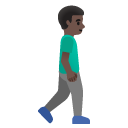
Appearance varies by platform and device. Google Noto, Twemoji, and OpenMoji are open-source.