🚶♀️➡️
The Emoji
Woman Walking Facing Right
U+1F6B6 U+200D U+2640 U+FE0F U+200D U+27A1 U+FE0F · :woman_walking_facing_right:
Trend 58
Meaning layers
- interpretation
- Used to signal leaving, moving on, walking away from drama, toxicity, or a bad situation. Often paired with other emojis to narrate a departure sequence.
- tiktok usage
- Appears in 'walking away from ___' trend videos, comment sections under callout posts, and transition edits where someone dramatically leaves a scene.
- irony level
- 4 / 10
Platform meanings
- meaning
- Signals a dramatic or unbothered exit, often used in comment wars or video captions about leaving something negative behind.
- trend usage
- Appears in POV videos, 'walking away from my situationship' audios, and transition content where creators physically walk away from the camera.
- hashtags
- #walkingaway#unbothered#girlswalking#movingon#exitera
- virality score
- 62 / 100
Cultural meanings
🇺🇸
Western / Gen-Z
Quintessential 'main character walking away' emoji — used constantly in irony, breakup content, and empowerment posts. Carries strong connotations of unbothered feminine energy.
🇵🇰
Pakistan & India
Used in the context of women asserting independence or leaving toxic situations, which carries social weight. Also used literally in fitness and walking group chats.
🌍
Middle East
More commonly interpreted as a literal walking figure. In progressive online communities it can signal female independence and personal agency, which holds cultural significance.
🌐
Global Neutral
Universally readable as a woman walking to the right, interpreted as movement, progress, or departure depending on context.
🇧🇩
Bangladesh
Primarily used in a literal sense — walking, going somewhere, or fitness-related conversation. Metaphorical use of 'walking away' is emerging among younger urban users.
🇱🇰
Sri Lanka
Used in casual conversation to indicate someone is on their way or heading out. Emotional subtexts are less common but growing in younger digital communities.
🇨🇳
China
Used literally in messaging apps. May appear in fitness challenges and step-counting groups. The female-specific emoji may be used to represent working women on the move.
🇯🇵
Japan
Interpreted matter-of-factly as a woman in motion. Used in travel, commute, and fitness contexts. The directional specificity aligns with Japan's precise emoji culture.
🇰🇷
South Korea
Popular in fitness and wellness content. Also used in K-drama fan communities to describe a character's dramatic exit from a scene.
🇹🇼
Taiwan
Used similarly to mainland China but with slightly more ironic potential among younger Taiwanese internet users familiar with Western meme culture.
🇭🇰
Hong Kong
Bilingual internet culture means it gets used both literally and in Western-style meme contexts, particularly in protest or social commentary scenarios symbolizing walking away.
🇵🇭
Philippines
Commonly used in 'hugot' (emotional punchline) culture to represent walking away from heartbreak or unrequited love. Often used with OPM song references.
🇮🇩
Indonesia
Used in casual texting to show someone is leaving or on the move. Among Gen Z it also carries the 'unbothered' departure energy from Western internet culture.
🇹🇭
Thailand
Seen in fitness content and daily life updates. Also used in Thai meme culture to represent a dramatic exit from conflict or awkward situations.
🇻🇳
Vietnam
Primarily literal — indicating movement or departure. Used in group chats when someone is heading out. Western meme usage is slowly being adopted.
🇲🇾
Malaysia
Used in both English and Malay-language chats to signal someone leaving. The 'walking away from drama' usage is popular on Malaysian Twitter and TikTok.
🇸🇦
Saudi Arabia
Used in fitness and wellness contexts which are culturally growing. Among younger women it can symbolize freedom of movement and independence — a quietly powerful statement.
🇦🇪
UAE
In the cosmopolitan UAE context it is used both literally and metaphorically, with expat communities adopting Western meme interpretations alongside local usage.
🇪🇬
Egypt
Commonly used in casual chat to mean someone is leaving or going somewhere. Among younger Egyptians on TikTok it has started representing the 'I'm done with this' attitude.
🇹🇷
Turkey
Used in everyday messaging to indicate physical departure. Among Turkish Gen Z it is also used in the context of 'leaving the drama' similar to Western usage.
🇮🇷
Iran
Used in private messaging apps to represent movement and departure. Among younger Iranians it can carry symbolic weight as women assert independence in digital spaces.
🇳🇬
Nigeria
Used in everyday chat and Naija Twitter to signal an unbothered exit. Nigerian women online use it as a power move when leaving conversations or bad situations.
🇿🇦
South Africa
Used across racial and cultural communities to signal moving on or departing. Common in youth-oriented social media posts about growth and leaving negativity.
🇬🇧
UK & Ireland
Used with classic British understatement — often dropped after a sarcastic comment or used to punctuate leaving a cringe conversation. 'I'm off 🚶♀️➡️' energy.
🇫🇷
France
Used in French social media to signal a stylish, unbothered exit. French Gen Z uses it with ironic flair — the woman walking away as a symbol of effortless cool.
🇩🇪
Germany
Primarily interpreted literally and practically. Used in fitness groups and daily schedule chats. Less meme-irony attached compared to Anglophone cultures.
🇪🇸
Spain & Italy
Used expressively in chat — often paired with hand gesture emojis for a full dramatic departure. Mediterranean expressiveness makes the exit emoji particularly theatrical.
🇧🇷
Brazil
Hugely popular in Brazilian meme culture. Used in the context of walking away from exes, cringe, and chaotic situations. Frequently appears in reels and TikTok comments.
🇲🇽
Mexico
Common in Mexican Gen Z internet culture to signal leaving drama or a situation. Used in feminist spaces to represent women walking away from oppressive norms.
🌎
Latin America
Across Latin America it carries the dual meaning of literal movement and emotional departure. Used heavily in breakup content, feminist discourse, and motivational posts.
🇦🇺
Australia & NZ
Used casually and with dry humor — 'going for a walk 🚶♀️➡️' is both literal (Australians love walking) and ironic shorthand for removing oneself from a situation.
How its meaning shifted
- 2010
This specific directional variant did not exist in 2010. The base walking emoji was gender-neutral and non-directional, used almost entirely for literal walking references.
- 2015
Gendered emoji variants began emerging but directional walking emojis were not yet available. Women online were beginning to use walking emojis metaphorically for 'moving on.'
- 2020
The directional walking variants were introduced and quickly adopted. Used in pandemic-era content about 'going for walks' as mental health coping and beginning to gain metaphorical traction.
- 2026
Firmly established as the 'unbothered exit' emoji for women. Deeply embedded in meme culture, breakup content, and empowerment discourse. A staple of Gen Z feminine digital expression.
See it on every platform
Compare with
Adjacent emojis
Share & embed
Frequently asked
01What does the 🚶♀️➡️ Woman Walking Facing Right emoji mean?
A woman walking and facing to the right, depicted as a female pedestrian in motion moving rightward.
02What does 🚶♀️➡️ mean on TikTok?
Signals a dramatic or unbothered exit, often used in comment wars or video captions about leaving something negative behind.
03What does 🚶♀️➡️ mean on WhatsApp?
Sent when ending a conversation abruptly or when someone is literally going for a walk and signing off.
04What does 🚶♀️➡️ mean in Gen-Z slang?
Used to signal leaving, moving on, walking away from drama, toxicity, or a bad situation. Often paired with other emojis to narrate a departure sequence.
05Is the 🚶♀️➡️ emoji safe to use?
A woman walking to the right — used to represent movement, departure, progress, independence, and self-care walks.
06What does 🚶♀️➡️ mean in texting?
The rightward direction is culturally associated with forward progress and the future. Using a woman-specific emoji adds identity ownership — 'I am the one choosing to walk away.' Often signals quiet confidence over loud confrontation.
07What is the shortcode for 🚶♀️➡️?
The shortcode for Woman Walking Facing Right is :woman_walking_facing_right:
08What does 🚶♀️➡️ mean in dating?
Low flirt value; more often used to end conversations or signal disinterest. 'K 🚶♀️➡️' is a classic cold-shoulder text.
Safety & usage
- Safe meaning
- A woman walking to the right — used to represent movement, departure, progress, independence, and self-care walks.
- Caution
- Occasionally used passive-aggressively to shut down conversations or dismiss someone without engagement. Low toxicity potential overall.
No significant safety concerns. In rare online harassment contexts it could be used to tell someone to 'leave,' but this is uncommon. Generally a positive or neutral emoji.
How it looks across platforms
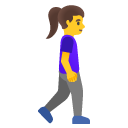
Appearance varies by platform and device. Google Noto, Twemoji, and OpenMoji are open-source.