🚶🏾♂️➡️
The Emoji
Man Walking Facing Right: Medium-dark Skin Tone
U+1F6B6 U+1F3FE U+200D U+2642 U+FE0F U+200D U+27A1 U+FE0F · :man_walking_facing_right_mediumdark_skin_tone:
Trend 55
Meaning layers
- interpretation
- Used to signal moving on, leaving a situation behind, or literally walking away from drama, toxicity, or bad energy. Often paired with dismissive or unbothered captions.
- tiktok usage
- Appears in 'leaving that behind' or 'walking away from my problems' trend videos, often as a dramatic or humorous exit symbol at the end of a rant.
- irony level
- 5 / 10
Platform meanings
- meaning
- Represents walking away, unbothered energy, moving to the next phase, or literal travel/commute content
- trend usage
- Used in POV videos where the creator 'walks away' from a toxic situation, job, or relationship; also used in fitness walking content
- hashtags
- #walkingaway#unbothered#newchapter#movingon#walkingman
- virality score
- 58 / 100
Cultural meanings
🇺🇸
Western / Gen-Z
Primarily used ironically to signal walking away from problems, toxic energy, or awkward situations — quintessential unbothered Gen Z energy.
🇵🇰
Pakistan & India
Used to indicate someone is leaving or on the move; in urban youth culture it also carries the 'moving on from drama' connotation similar to Western Gen Z usage.
🌍
Middle East
Commonly used literally to indicate travel or walking; in youth circles it can also represent leaving a situation or starting a new chapter.
🌐
Global Neutral
Universally understood as a person walking to the right — direction of movement and forward progress; skin tone adds personal identity representation.
🇧🇩
Bangladesh
Used mainly in a literal sense — someone is on the way or heading out; less ironic usage compared to Western contexts.
🇱🇰
Sri Lanka
Interpreted literally as commuting or walking; younger users may adopt the 'moving on' cultural meaning influenced by global social media trends.
🇨🇳
China
Used on platforms like WeChat or Weibo to indicate someone is stepping out or heading somewhere; less culturally loaded with irony.
🇯🇵
Japan
Interpreted as polite notification of departure or movement; aligns with Japanese etiquette of informing others when leaving.
🇰🇷
South Korea
Used in messaging apps to say you're leaving or heading out; K-content creators use it to represent a 'glow-up walk' or confidence narrative.
🇹🇼
Taiwan
Similar to broader East Asian usage — a casual way to say you're on the move or heading somewhere, with some youth adoption of the 'moving on' meaning.
🇭🇰
Hong Kong
Used frequently in fast-paced urban communication to quickly signal being in transit or commuting across the city.
🇵🇭
Philippines
Casual indicator of heading out or being on the go; in youth culture, it mirrors the global 'walking away from drama' trope seen on TikTok.
🇮🇩
Indonesia
Used in daily messaging to say someone is en route; Gen Z Indonesians on TikTok adopt its 'moving on' meaning enthusiastically.
🇹🇭
Thailand
Interpreted as being on the move or leaving; in youth content it resonates with themes of independence and self-discovery.
🇻🇳
Vietnam
Primarily literal — used to indicate departure or commuting; younger digital-native users may adopt ironic walking-away meme culture.
🇲🇾
Malaysia
Used casually to indicate being out and about; the skin tone representation resonates with the diverse Malaysian user base seeking inclusive emoji options.
🇸🇦
Saudi Arabia
Used to communicate being on the way or heading to a destination; in youth circles it can subtly represent ambition and forward movement.
🇦🇪
UAE
In the cosmopolitan UAE context, used across diverse communities to indicate travel, commuting, or moving toward new opportunities.
🇪🇬
Egypt
Commonly used to indicate someone is heading out; among Egyptian youth it can carry the dramatic 'I'm done, walking away' tone from meme culture.
🇹🇷
Turkey
Used literally for being on the move; Turkish social media users sometimes adopt it in the context of 'leaving behind old habits' for motivational posts.
🇮🇷
Iran
Used primarily to indicate movement or departure in messaging; among younger Iranians on Instagram it aligns with themes of resilience and forward progress.
🇳🇬
Nigeria
Widely used to signal someone is on the move or heading out; Nigerian Twitter/X culture has adopted it as a 'walking away from nonsense' power statement.
🇿🇦
South Africa
Used across cultures to indicate movement or commuting; in township and urban youth culture it can signal confidence and independence.
🇬🇧
UK & Ireland
Used with dry British humor to indicate leaving a conversation or situation; fits perfectly in understated 'I'm off then' cultural communication style.
🇫🇷
France
Used casually to say someone is heading out; French users may incorporate it in posts about urban walks, flânerie culture, or stylish city life.
🇩🇪
Germany
Interpreted practically — used to signal being in transit or leaving; Germans appreciate its directional specificity as a clear communication tool.
🇪🇸
Spain & Italy
Used to indicate heading out or taking a walk; in Mediterranean culture it aligns with the social ritual of the evening passeggiata or paseo.
🇧🇷
Brazil
Used energetically to indicate being on the move; Brazilian youth on TikTok and Instagram use it in the 'walking into my era' empowerment context.
🇲🇽
Mexico
Commonly signals being on the way somewhere; Mexican social media users also use it humorously to indicate walking away from drama or bad vibes.
🌎
Latin America
Broadly used across Latin America for literal movement and figuratively for walking toward new opportunities or away from negative situations.
🇦🇺
Australia & NZ
Used casually to say you're heading out or going for a walk; Australians may use it humorously in the context of 'going for a walkabout' or escaping a situation.
How its meaning shifted
- 2010
This specific emoji combination did not exist in 2010; basic walking emoji variants were just beginning to be standardized under Unicode without skin tone or directional modifiers.
- 2015
Skin tone modifiers were introduced in Unicode 8.0 (2015), but directional walking variants were not yet available; users would use the generic walking emoji with skin tone only.
- 2020
Directional and gendered walking variants began gaining traction; used primarily for literal movement, commuting contexts, and early 'walking away' meme formats on TikTok.
- 2026
Widely recognized shorthand for unbothered confidence, moving on, and forward momentum; the medium-dark skin tone version gains appreciation for representation, used heavily across short-form video platforms and messaging apps.
See it on every platform
Compare with
Adjacent emojis
Share & embed
Frequently asked
01What does the 🚶🏾♂️➡️ Man Walking Facing Right: Medium-dark Skin Tone emoji mean?
A man walking and facing toward the right side, depicted with medium-dark skin tone. The emoji combines the walking person base with a rightward direction modifier and male gender sign.
02What does 🚶🏾♂️➡️ mean on TikTok?
Represents walking away, unbothered energy, moving to the next phase, or literal travel/commute content
03What does 🚶🏾♂️➡️ mean on WhatsApp?
Signals someone is heading out, leaving the house, or done with a conversation
04What does 🚶🏾♂️➡️ mean in Gen-Z slang?
Used to signal moving on, leaving a situation behind, or literally walking away from drama, toxicity, or bad energy. Often paired with dismissive or unbothered captions.
05Is the 🚶🏾♂️➡️ emoji safe to use?
A neutral and inclusive representation of a man walking to the right, used for communication about movement, travel, commuting, and forward progress.
06What does 🚶🏾♂️➡️ mean in texting?
The act of walking forward (rightward) psychologically connotes progress and forward momentum. Medium-dark skin tone adds identity affirmation, making it a symbol of confident self-ownership for users of similar complexion.
07What is the shortcode for 🚶🏾♂️➡️?
The shortcode for Man Walking Facing Right: Medium-dark Skin Tone is :man_walking_facing_right_mediumdark_skin_tone:
08What does 🚶🏾♂️➡️ mean in dating?
Rarely used flirtatiously; when used it implies 'I'm moving on unless you give me a reason to stay' — a subtle power move in texting dynamics.
Safety & usage
- Safe meaning
- A neutral and inclusive representation of a man walking to the right, used for communication about movement, travel, commuting, and forward progress.
- Caution
- Extremely rarely used toxically; in some contexts could be used to tell someone to 'walk away' in a dismissive or hostile manner.
No significant warning flags. The emoji is safe for all audiences and contexts. Skin tone representation is a positive inclusivity feature.
How it looks across platforms
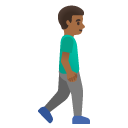
Appearance varies by platform and device. Google Noto, Twemoji, and OpenMoji are open-source.