🎑
The Emoji
Moon Viewing Ceremony
U+1F391 · :moon_viewing_ceremony:
Trend 22
Meaning layers
- interpretation
- Gen Z largely treats this as an aesthetic autumn or moon emoji, rarely associating it with its actual Japanese cultural origin. It gets used as a moody, ethereal symbol for night vibes, fall aesthetics, or quiet introspection.
- tiktok usage
- Used in cottagecore, dark academia, and autumn aesthetic videos. Often paired with lo-fi music TikToks or 'soft life' content about slowing down and appreciating simple moments.
- irony level
- 2 / 10
Platform meanings
- meaning
- Represents autumn aesthetic, moon-watching vibes, and introspective nighttime content
- trend usage
- Used in cottagecore, dark academia, lo-fi study, and Japan travel TikToks. Often in captions for slow-living or mindfulness content
- hashtags
- #autumnaesthetic#moonvibes#tsukimi#japanesecultural#cottagecorefall
- virality score
- 28 / 100
Cultural meanings
🇺🇸
Western / Gen-Z
Primarily seen as a generic 'aesthetic moon' emoji with Japanese cultural associations vaguely understood. Appreciated for its autumnal, lo-fi, and cottagecore vibe.
🇵🇰
Pakistan & India
Rarely used with cultural context; may be confused with Eid moon imagery or simply treated as a decorative night/nature emoji.
🌍
Middle East
Largely unfamiliar with the Tsukimi origin; may be interpreted as a moon and nature scene, sometimes confused with crescent moon symbolism but distinctly different.
🌐
Global Neutral
Recognized as a Japanese cultural emoji by Unicode; globally treated as an autumn or moon-related symbol without specific cultural weight outside East Asia.
🇧🇩
Bangladesh
Uncommon usage; if used, it is typically as a scenic or decorative emoji representing nighttime or a peaceful outdoor scene.
🇱🇰
Sri Lanka
Minimal cultural resonance; occasionally used in content about full moon days (Poya) due to the moon element, though the cultural origin differs.
🇨🇳
China
Has some cultural resonance with harvest moon traditions (Mid-Autumn Festival), though the specific imagery is distinctly Japanese. Used sometimes as a broader harvest moon symbol.
🇯🇵
Japan
Holds deep authentic cultural significance — used proudly during Tsukimi season (September/October) in social media posts, restaurant promotions, and cultural content.
🇰🇷
South Korea
Somewhat familiar due to shared East Asian harvest moon traditions (Chuseok); appreciated aesthetically but recognized as specifically Japanese in origin.
🇹🇼
Taiwan
Recognized as Japanese cultural content; used by people who appreciate Japanese aesthetics or are sharing Tsukimi-related experiences.
🇭🇰
Hong Kong
Familiar through Japanese cultural exports; used in content about Japanese culture, autumn, or moon festivals with some appreciation for the shared East Asian heritage.
🇵🇭
Philippines
Primarily aesthetic use; appreciated in Japan-fan communities and used decoratively in autumn or nighttime content without deep cultural knowledge.
🇮🇩
Indonesia
Used in anime and Japanese culture fan communities; associated with Japan aesthetics and occasionally appearing in autumn/night-themed content.
🇹🇭
Thailand
Popular in Japanese culture fan communities; used in K-J-pop crossover aesthetics and moon-themed content, appreciated for its visual elegance.
🇻🇳
Vietnam
Used among Japanese culture enthusiasts and anime fans; also occasionally connected to Vietnamese harvest moon celebrations (Tết Trung Thu) due to thematic overlap.
🇲🇾
Malaysia
Appears in Japanese culture communities and among young people who follow J-aesthetics; rare in mainstream usage outside those circles.
🇸🇦
Saudi Arabia
Rarely used with cultural context; the moon element might loosely connect to Islamic moon symbolism but is generally understood as Japanese cultural content.
🇦🇪
UAE
Appears in cosmopolitan social media content from Japan enthusiasts or expats; treated as an exotic, aesthetically pleasing emoji.
🇪🇬
Egypt
Limited use; occasionally appears in posts about Japanese culture among youth communities interested in anime and Japan-related content.
🇹🇷
Turkey
Used in anime fan communities and among Japanese culture enthusiasts; appreciated aesthetically as an autumn or moon symbol.
🇮🇷
Iran
Appears in anime fan circles and Japanese culture appreciation content; the moon element resonates given Persian poetic moon traditions but is understood as culturally Japanese.
🇳🇬
Nigeria
Primarily used by anime fans and Japanese culture enthusiasts; otherwise rarely encountered in mainstream Nigerian social media usage.
🇿🇦
South Africa
Niche usage among anime and Japanese culture communities; occasionally used as a general aesthetic autumn or moon emoji.
🇬🇧
UK & Ireland
Used in aesthetic and Japan-appreciation communities; some usage in autumn content given the seasonal fit with UK/Irish weather narratives.
🇫🇷
France
Appreciated in Japanophile communities (which are large in France); used in content about Japanese culture, anime, and autumn aesthetics.
🇩🇪
Germany
Found in Japan fan communities and used in clean, minimalist aesthetic content that aligns with German appreciation for Japanese design philosophy.
🇪🇸
Spain & Italy
Appears in Japanese culture fan communities and used for aesthetic autumn content; limited mainstream recognition of the specific cultural meaning.
🇧🇷
Brazil
Brazil has one of the largest Japanese diaspora communities globally, giving this emoji more authentic cultural resonance than in most non-Asian countries. Used in Tsukimi posts and Japanese cultural events.
🇲🇽
Mexico
Used by anime fans and those with exposure to Japanese culture; occasionally appears in aesthetic content mixing autumn and Japanese visual styles.
🌎
Latin America
Across Latin America, primarily appears in anime fan communities and Japanese cultural interest groups with general aesthetic appreciation.
🇦🇺
Australia & NZ
Used in Japanese culture communities and autumn aesthetic content; New Zealand and Australian users sometimes deploy it during their own autumn season.
How its meaning shifted
- 2010
Extremely niche usage, primarily by Japanese users on early social platforms for literal Tsukimi celebration posts. Almost completely unknown internationally.
- 2015
Slowly gaining visibility with the rise of anime fandom globally; still primarily used by Japan-focused communities. Occasional appearance in emoji curiosity posts.
- 2020
Absorbed into the broader aesthetic and cottagecore wave on TikTok and Instagram; began appearing in lo-fi and autumn aesthetic content detached from its original cultural meaning.
- 2026
Used as a dual-purpose emoji — authentic cultural symbol in Japanese and Japan-adjacent communities, and a general aesthetic autumn/moon emoji in broader Gen Z digital culture.
See it on every platform
Compare with
Emoji combinations
Adjacent emojis
- Often confused with
- new moon facefirst quarter moonmosque
- Can replace
- full moonfallen leafcherry blossom
Share & embed
Frequently asked
01What does the 🎑 Moon Viewing Ceremony emoji mean?
The 🎑 emoji depicts a traditional Japanese moon-viewing ceremony called Tsukimi, showing pampas grass and a full moon against a dark sky. It represents the autumn harvest moon festival celebrated in Japan.
02What does 🎑 mean on TikTok?
Represents autumn aesthetic, moon-watching vibes, and introspective nighttime content
03What does 🎑 mean on WhatsApp?
Sent to indicate a calm, peaceful evening or to share appreciation of a moonlit night
04What does 🎑 mean in Gen-Z slang?
Gen Z largely treats this as an aesthetic autumn or moon emoji, rarely associating it with its actual Japanese cultural origin. It gets used as a moody, ethereal symbol for night vibes, fall aesthetics, or quiet introspection.
05Is the 🎑 emoji safe to use?
A culturally respectful symbol of Japanese harvest moon tradition, autumn appreciation, and peaceful night contemplation. Entirely safe in all standard contexts.
06What does 🎑 mean in texting?
The imagery of moon-gazing evokes a contemplative emotional state tied to impermanence, which connects psychologically to mono no aware — the Japanese sensitivity to transience. It can signal a need for quiet reflection or emotional grounding.
07What is the shortcode for 🎑?
The shortcode for Moon Viewing Ceremony is :moon_viewing_ceremony:
08What does 🎑 mean in dating?
Rarely used as a direct flirt tool, but could be sent to invite someone to a late-night hangout or a romantic autumn evening. 'Let's 🎑 tonight' has subtle poetic charm.
Safety & usage
- Safe meaning
- A culturally respectful symbol of Japanese harvest moon tradition, autumn appreciation, and peaceful night contemplation. Entirely safe in all standard contexts.
- Caution
- No known toxic, coded, or harmful meanings associated with this emoji in any community.
The only concern is cultural appropriation when used carelessly or mockingly in reference to Japanese culture without understanding. Otherwise no safety issues.
How it looks across platforms
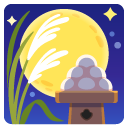


Appearance varies by platform and device. Google Noto, Twemoji, and OpenMoji are open-source.