🧑🦱
The Emoji
Person: Curly Hair
U+1F9D1 U+200D U+1F9B1 · :person_curly_hair:
Trend 52
Meaning layers
- interpretation
- Used to represent oneself or others with curly hair, often as a self-identifier in bios or captions. Also used ironically to signal 'chaotic curly-haired energy' or the relatable struggle of curly hair maintenance.
- tiktok usage
- Appears in 'curly hair routine' videos, POV content about curly hair struggles, and as a self-tag in creator bios to signal curly-haired identity.
- irony level
- 3 / 10
Platform meanings
- meaning
- Self-identifier for curly-haired creators; used in hair tutorials, curly hair product reviews, and natural hair journey content.
- trend usage
- Frequently appears in #curlyhair and #naturalhair trending sounds where creators show transformations; also in POV skits about curly hair problems.
- hashtags
- #CurlyHair#NaturalHair#CurlyGirl#WashDay#HairRoutine
- virality score
- 55 / 100
Cultural meanings
🇺🇸
Western / Gen-Z
Used as a casual self-identifier by curly-haired Gen Z users across the US, Canada, and Western Europe; carries pride in natural hair texture and is often part of the 'curly girl method' community online.
🇵🇰
Pakistan & India
Used to describe people with naturally wavy or curly South Asian hair; may carry a sense of relatability or humor around managing thick, curly hair in humid climates.
🌍
Middle East
Represents individuals with naturally curly or wavy hair common in the region; used straightforwardly to identify or describe someone's appearance without significant deeper connotation.
🌐
Global Neutral
Universally understood as a person with curly hair; used neutrally across cultures as a descriptive emoji with minimal culture-specific layering.
🇧🇩
Bangladesh
Used descriptively to represent people with curly or wavy hair; casual use in chats to describe friends or oneself without significant cultural weight.
🇱🇰
Sri Lanka
Reflects naturally wavy to curly hair common in South Asian populations; used conversationally to describe appearance or to represent oneself.
🇨🇳
China
Less culturally resonant as curly hair is less common; may be used to describe a foreign-looking or 'Western' character, or to represent someone with a perm.
🇯🇵
Japan
Often associated with permed or styled curly hair, which has been a recurring fashion trend; used to describe someone with a stylish curly look or a permed hairstyle.
🇰🇷
South Korea
Connected to K-beauty curly or wavy hair trends; used by those with naturally curly hair or those who have gotten a wave perm, a popular salon treatment.
🇹🇼
Taiwan
Similar to South Korean usage — associated with wavy perms and hair aesthetics; used in beauty and fashion contexts to represent trendy hair.
🇭🇰
Hong Kong
Used in fashion and lifestyle contexts; curly hair is often associated with styled or permed looks popular in Hong Kong's beauty scene.
🇵🇭
Philippines
Represents Filipinos with naturally wavy or curly hair; used with humor or pride as many Filipinos have naturally textured hair.
🇮🇩
Indonesia
Used to represent naturally curly or wavy hair common across the archipelago; often used with positive connotation in casual conversation.
🇹🇭
Thailand
Curly hair is less common and sometimes perceived as exotic; emoji may be used to describe someone with a perm or naturally textured hair.
🇻🇳
Vietnam
Used to describe people with wavy or permed hair; Vietnamese beauty trends include wave perms, so this emoji aligns with certain salon aesthetics.
🇲🇾
Malaysia
Used across the diverse Malaysian population to represent naturally curly or wavy hair; straightforward descriptive use in chats.
🇸🇦
Saudi Arabia
Used to describe someone with curly hair, which is common; hair emojis carry less loaded cultural meaning due to hair often being covered in public contexts for women.
🇦🇪
UAE
Used in multicultural digital spaces to represent the wide variety of hair textures present in the UAE's diverse population.
🇪🇬
Egypt
Naturally curly and wavy hair is very common in Egypt; this emoji is used with relatability and sometimes pride to represent natural hair.
🇹🇷
Turkey
Used to represent the naturally wavy to curly hair common among Turkish people; casual and descriptive use without strong cultural subtext.
🇮🇷
Iran
Used to describe curly or wavy hair, which is common; straightforward descriptive use, sometimes with humor about managing thick, curly hair.
🇳🇬
Nigeria
Strongly resonant — used with pride in natural hair communities, connecting to the global natural hair movement and Afrocentric identity celebration.
🇿🇦
South Africa
Carries significance in natural hair and afro communities; used with pride particularly in the context of embracing natural African hair textures.
🇬🇧
UK & Ireland
Used casually by curly-haired users; ties into the UK's active curly girl method community and increasing natural hair representation in media.
🇫🇷
France
Used by individuals with curly hair, often in the context of France's growing natural hair movement, particularly within Afro-French communities.
🇩🇪
Germany
Used straightforwardly to describe curly hair; the emoji has gained some traction in diversity and inclusion conversations in German digital spaces.
🇪🇸
Spain & Italy
Highly relatable in Southern Europe where naturally curly and wavy Mediterranean hair is common; used with humor and pride about managing 'Mediterranean curls'.
🇧🇷
Brazil
Extremely resonant — Brazil's massive natural hair movement ('cabelo crespo') gives this emoji cultural weight; used with strong pride and community identity.
🇲🇽
Mexico
Used to represent wavy to curly hair common in Mexico; casual descriptive use with growing connection to natural hair pride movements.
🌎
Latin America
Broadly used across Latin America where wavy and curly hair textures are very common; associated with natural beauty movements and Afro-Latino identity in many countries.
🇦🇺
Australia & NZ
Used casually by curly-haired Australians and New Zealanders; gains particular meaning in Indigenous and Polynesian communities where natural hair texture is celebrated.
How its meaning shifted
- 2010
This emoji did not exist in 2010; hair component emojis had not yet been introduced to Unicode.
- 2015
Still not available; the Unicode hair component system was still years away from being proposed or standardized.
- 2020
Newly introduced (Unicode 12.1, 2019); early adopters used it primarily as a literal self-identifier in bios and captions, with the natural hair community quickly embracing it.
- 2026
Widely used across all major platforms as a standard self-identifier for curly-haired individuals; deeply embedded in natural hair communities, curly hair content creator culture, and DIY hair care communities online.
See it on every platform
Adjacent emojis
- Often confused with
- person red hairperson blond hairbust in silhouette
- Can replace
- woman curly hairman curly hairhaircut
Share & embed
Frequently asked
01What does the 🧑🦱 Person: Curly Hair emoji mean?
A gender-neutral person with curly hair, part of the Unicode hair component system introduced to represent diverse hair types.
02What does 🧑🦱 mean on TikTok?
Self-identifier for curly-haired creators; used in hair tutorials, curly hair product reviews, and natural hair journey content.
03What does 🧑🦱 mean on WhatsApp?
Used to refer to a curly-haired friend or oneself in conversation, e.g., 'That's literally you 🧑🦱'.
04What does 🧑🦱 mean in Gen-Z slang?
Used to represent oneself or others with curly hair, often as a self-identifier in bios or captions. Also used ironically to signal 'chaotic curly-haired energy' or the relatable struggle of curly hair maintenance.
05Is the 🧑🦱 emoji safe to use?
A completely safe, inclusive emoji representing a person with curly hair; used for self-expression, identity, and hair-related content.
06What does 🧑🦱 mean in texting?
For many users, especially those with natural or curly hair, this emoji carries a sense of validation and representation — seeing one's hair texture reflected in digital communication can reinforce positive self-image.
07What is the shortcode for 🧑🦱?
The shortcode for Person: Curly Hair is :person_curly_hair:
08What does 🧑🦱 mean in dating?
Sometimes used to describe or flirt with a curly-haired person: 'You looked cute today 🧑🦱' as a soft, non-threatening compliment.
Safety & usage
- Safe meaning
- A completely safe, inclusive emoji representing a person with curly hair; used for self-expression, identity, and hair-related content.
- Caution
- Extremely rare, but could theoretically be used in hair-based mockery or stereotyping — e.g., pairing with dismissive text to demean someone's natural appearance.
No significant safety concerns. The emoji is overwhelmingly used positively. Minimal risk of misuse compared to most other emojis.
How it looks across platforms
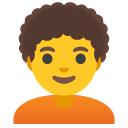


Appearance varies by platform and device. Google Noto, Twemoji, and OpenMoji are open-source.