👩🦱
The Emoji
Woman: Curly Hair
U+1F469 U+200D U+1F9B1 · :woman_curly_hair:
Trend 55
Meaning layers
- interpretation
- Used as a self-identifier by people with curly hair, or as a shorthand for 'curly hair girl' energy — spontaneous, bold, and unapologetically natural.
- tiktok usage
- Placed in bios and captions by curly-haired creators to signal their hair type community; also used in 'curly hair routine' and 'curly girl method' content.
- irony level
- 2 / 10
Platform meanings
- meaning
- A marker of curly hair identity, used by creators to signal their hair community membership and attract niche audiences.
- trend usage
- Heavily used in 'curly girl method' tutorials, curl type comparisons, and natural hair transformation videos.
- hashtags
- #curlygirlmethod#curlyhair#naturalhair#curlytok#haircare
- virality score
- 62 / 100
Cultural meanings
🇺🇸
Western / Gen-Z
A strong identity emoji used by curly-haired Gen Z users to represent their hair type and signal membership in the natural hair or curly girl method communities.
🇵🇰
Pakistan & India
Used to represent women with naturally curly or wavy hair; carries connotations of beauty diversity, though straight hair is still more dominant in mainstream beauty ideals.
🌍
Middle East
Used to represent women with natural curly or wavy hair; in contexts where hair is discussed openly, it signals authenticity and natural beauty.
🌐
Global Neutral
Universally understood as a woman with curly hair; used across cultures to represent this physical trait without strong additional cultural weight.
🇧🇩
Bangladesh
Generally interpreted literally as a woman with curly hair; not heavily loaded with cultural meaning beyond basic physical representation.
🇱🇰
Sri Lanka
Used to represent women with curly or wavy hair, which is common in the region; carries a neutral to positive connotation of natural beauty.
🇨🇳
China
Interpreted primarily as a foreign or non-Chinese woman due to the relative rarity of naturally curly hair; used in contexts discussing Western beauty or hair trends.
🇯🇵
Japan
Associated with a distinctive, trendy look — curly perms are popular in Japanese beauty culture, so this emoji can represent a fashionable or stylish woman.
🇰🇷
South Korea
Curly hair is often associated with perms, which are trendy in K-beauty; this emoji can represent a stylish woman with a perm or natural curls.
🇹🇼
Taiwan
Similar to South Korea, curly perms are fashionable; the emoji is used to represent a woman with a trendy or distinctive hairstyle.
🇭🇰
Hong Kong
Used to represent women with curly hair in a straightforward way; may carry associations with Western or Southeast Asian beauty styles.
🇵🇭
Philippines
Curly hair is common among Filipinos; this emoji is used positively to represent natural hair and is embraced in beauty and lifestyle content.
🇮🇩
Indonesia
Naturally wavy and curly hair is common; the emoji is used casually to represent women with these hair types and is normalized in beauty discussions.
🇹🇭
Thailand
Used to represent women with curly or wavy hair, which may be associated with a bold, fashionable, or artistic aesthetic in Thai digital culture.
🇻🇳
Vietnam
Curly hair is less common naturally; the emoji may be associated with women who have permed their hair, a popular beauty treatment in Vietnam.
🇲🇾
Malaysia
With diverse ethnic communities, curly hair is common among Malay and Indian Malaysians; the emoji is used positively to represent natural hair diversity.
🇸🇦
Saudi Arabia
In contexts where women discuss hair openly (e.g., among female friends), this emoji is used to represent curly-haired women and celebrate natural beauty.
🇦🇪
UAE
Used in cosmopolitan digital spaces to represent diverse beauty standards; curly hair is common among South Asian and African expatriate communities in the UAE.
🇪🇬
Egypt
Curly and wavy hair is very common in Egypt; this emoji is used positively to represent natural hair and is embraced in everyday digital conversation.
🇹🇷
Turkey
Wavy and curly hair is common among Turkish women; the emoji is used casually to represent this hair type and fits naturally into beauty conversations.
🇮🇷
Iran
Used among women in private or digital spaces to represent natural curly hair; beauty and hair discussions are popular in Iranian social media communities.
🇳🇬
Nigeria
Strongly resonates in Nigeria where natural and curly/coily hair is celebrated; often used in the context of the natural hair movement and Afrocentric beauty.
🇿🇦
South Africa
Embraced by the diverse South African community, particularly in the context of the 'natural hair movement' among Black South African women celebrating their curls and coils.
🇬🇧
UK & Ireland
Used casually by curly-haired individuals to represent themselves; fits into the growing UK natural hair movement and is seen positively in inclusive beauty discourse.
🇫🇷
France
Used to represent women with curly hair; in France, natural curly hair has gained more cultural acceptance and celebration, particularly influenced by Afro-French beauty movements.
🇩🇪
Germany
Interpreted straightforwardly as a woman with curly hair; used in lifestyle and beauty contexts without significant cultural baggage.
🇪🇸
Spain & Italy
Curly and wavy hair is common and celebrated in Southern European cultures; this emoji is used proudly to represent natural Mediterranean hair textures.
🇧🇷
Brazil
Highly resonant in Brazil where curly and coily hair is extremely common and increasingly celebrated; tied to the 'cabelo crespo' (curly hair) movement and natural beauty advocacy.
🇲🇽
Mexico
Used to represent women with curly or wavy hair; natural hair acceptance is growing and this emoji fits into conversations about embracing indigenous and mestizo beauty standards.
🌎
Latin America
Widely relatable across Latin America where curly and wavy hair is prevalent; used in natural hair and beauty communities to celebrate diverse hair textures.
🇦🇺
Australia & NZ
Used casually by curly-haired individuals to self-represent; fits into broader conversations about diverse beauty standards and natural hair acceptance in multicultural Australian and New Zealand society.
How its meaning shifted
- 2010
This emoji did not yet exist; hair modifier emojis were not introduced until 2018, so representation was limited to the generic woman emoji.
- 2015
Still nonexistent; users had to rely on basic person emojis without hair type customization, leading to a lack of representation for curly-haired individuals.
- 2020
Newly introduced and gaining traction; embraced by the curly girl community, natural hair advocates, and diversity advocates. Heavily adopted in Instagram and TikTok bios.
- 2026
Widely recognized and normalized as a representation emoji; integrated into the visual language of hair care communities, beauty influencers, and identity expression across all major platforms.
See it on every platform
Adjacent emojis
- Often confused with
- woman red hairwoman wavy hairperson curly hair
- Can replace
- womancurly loopsparkles
Share & embed
Frequently asked
01What does the 👩🦱 Woman: Curly Hair emoji mean?
A woman emoji with curly hair, introduced as part of the hair style modifier system to represent diversity in appearance.
02What does 👩🦱 mean on TikTok?
A marker of curly hair identity, used by creators to signal their hair community membership and attract niche audiences.
03What does 👩🦱 mean on WhatsApp?
Casually used to represent oneself or a friend with curly hair in conversation.
04What does 👩🦱 mean in Gen-Z slang?
Used as a self-identifier by people with curly hair, or as a shorthand for 'curly hair girl' energy — spontaneous, bold, and unapologetically natural.
05Is the 👩🦱 emoji safe to use?
A neutral, positive representation of a woman with curly hair used for identity expression, self-representation, and community signaling.
06What does 👩🦱 mean in texting?
For many users, this emoji carries a strong sense of identity and cultural pride, especially among communities where curly or coily hair has historically been stigmatized. Using it signals self-acceptance and community belonging.
07What is the shortcode for 👩🦱?
The shortcode for Woman: Curly Hair is :woman_curly_hair:
08What does 👩🦱 mean in dating?
Used to say 'this is me' when describing oneself in a flirty context, or to point out a partner's curly-haired look. Low-key flirty when sent to imply 'I look like this today.'
Safety & usage
- Safe meaning
- A neutral, positive representation of a woman with curly hair used for identity expression, self-representation, and community signaling.
- Caution
- Could theoretically be used in a derogatory context when combined with negative text targeting curly-haired or Black women, but this is uncommon and context-dependent.
No inherent toxicity. In rare cases, may be used in racially charged commentary targeting women of color whose hair is naturally curly or coily. Always evaluate surrounding text for context.
How it looks across platforms
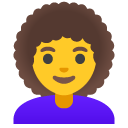

Appearance varies by platform and device. Google Noto, Twemoji, and OpenMoji are open-source.