🧑🏾🦱
The Emoji
Person: Medium-dark Skin Tone, Curly Hair
U+1F9D1 U+1F3FE U+200D U+1F9B1 · :person_mediumdark_skin_tone_curly_hair:
Trend 58
Meaning layers
- interpretation
- Used as a self-identifier by people who match this description, often paired with aesthetic captions or used in relatable content about curly hair struggles and wins.
- tiktok usage
- Appears in 'this is me' videos, curly hair tutorials, and representation celebration content; commonly used by creators embracing their natural hair journey.
- irony level
- 2 / 10
Platform meanings
- meaning
- Self-representation emoji used by creators with medium-dark skin and curly hair; signals authenticity and natural beauty content.
- trend usage
- Appears in curly hair tutorials, melanin appreciation videos, and 'day in my life' content from creators matching this description.
- hashtags
- #curlyhair#melaninpoppin#naturalhair#brownskin#curlygirl
- virality score
- 62 / 100
Cultural meanings
🇺🇸
Western / Gen-Z
Widely used as a self-identifier among young people with medium-dark skin and curly hair; strongly associated with natural hair movements and melanin beauty culture.
🇵🇰
Pakistan & India
Used to represent people with naturally wavy or curly hair common in South Asian communities; appreciated as a closer match to South Asian features than lighter-toned alternatives.
🌍
Middle East
Resonates with users who have darker complexions and curly or wavy hair common across the Levant and North Africa; used casually for self-representation.
🌐
Global Neutral
Recognized universally as a gender-neutral person with a specific appearance; used broadly for self-identification without deep cultural baggage.
🇧🇩
Bangladesh
Used by users who feel this emoji better represents their skin tone and hair texture compared to lighter alternatives; growing use among younger digital natives.
🇱🇰
Sri Lanka
Appreciated for its closer resemblance to many Sri Lankan complexions and hair types; used in casual digital conversations for self-expression.
🇨🇳
China
Less commonly used for self-identification due to different beauty standards; may be used to represent foreign characters in storytelling or meme contexts.
🇯🇵
Japan
Used primarily for representation of non-Japanese characters or in diverse storytelling; appreciated in international fan communities.
🇰🇷
South Korea
Appears in K-pop fan communities when referencing international artists or in diversity-themed content; not commonly used for self-identification.
🇹🇼
Taiwan
Used in diverse and international online communities; appreciated in conversations about global representation.
🇭🇰
Hong Kong
Used in multicultural digital spaces and in contexts discussing global diversity and representation.
🇵🇭
Philippines
Resonates with Filipino users who have medium-dark complexions and wavy or curly hair; used in natural beauty and self-love content.
🇮🇩
Indonesia
Appreciated by Indonesian users with darker skin tones seeking more representative emoji options; used in casual and beauty-focused content.
🇹🇭
Thailand
Less commonly used for self-identification due to different local skin tone ideals; may appear in international or diversity-themed content.
🇻🇳
Vietnam
Used in contexts celebrating diverse beauty; occasionally used by Vietnamese users with wavy or curly hair as the closest match available.
🇲🇾
Malaysia
Resonates with Malaysian users from various ethnic backgrounds with medium-dark skin; used in multicultural digital communities.
🇸🇦
Saudi Arabia
Used by users who identify with the skin tone and hair texture; appreciated in a country with diverse ethnic backgrounds including those from African and South Asian heritage.
🇦🇪
UAE
Highly relevant in the UAE's multicultural population; used by expats and locals with medium-dark skin and curly hair for self-representation.
🇪🇬
Egypt
Used by Egyptians with darker complexions and naturally curly hair, particularly those from Upper Egypt or Nubian heritage.
🇹🇷
Turkey
Used by Turkish users with darker skin tones and curly hair; occasionally used in Afro-Turk or diversity-celebrating communities.
🇮🇷
Iran
Used by Iranians with darker complexions and curly hair seeking more representative digital options; less common but growing in use.
🇳🇬
Nigeria
Highly resonant and widely used in Nigeria where medium-dark skin and curly or coily hair are common; strongly associated with pride in natural African features.
🇿🇦
South Africa
Popular across South Africa's diverse population; used in natural hair communities and melanin appreciation spaces.
🇬🇧
UK & Ireland
Used in the British and Irish diaspora communities by people of African, Caribbean, and South Asian heritage for self-representation.
🇫🇷
France
Used in multicultural French communities, particularly among Afro-French and Caribbean-French users celebrating natural beauty.
🇩🇪
Germany
Used in diversity-focused spaces and by people of African or Middle Eastern heritage living in Germany; gaining relevance in multicultural online communities.
🇪🇸
Spain & Italy
Used by users of North African, Latin American, and Sub-Saharan African heritage living in Southern Europe; associated with natural beauty and diverse identities.
🇧🇷
Brazil
Widely relevant in Brazil's diverse population; used by Afro-Brazilian and mixed-heritage users in natural hair (cabelo natural) and melanin pride movements.
🇲🇽
Mexico
Used by Mexican users with darker skin tones and curly or wavy hair; resonates in Afro-Mexican and Indigenous communities celebrating natural features.
🌎
Latin America
Broadly appreciated across Latin America where medium-dark skin and curly hair are common; used in afrolatino communities and natural hair movements.
🇦🇺
Australia & NZ
Used by Indigenous Australians, Maori, Pacific Islander, and diaspora communities who identify with this skin tone and hair type.
How its meaning shifted
- 2010
This specific emoji did not exist; representation was limited to a single generic yellow person emoji with no skin tone or hair type options.
- 2015
Skin tone modifiers had just been introduced but hair type combinations were not yet available; users made do with basic skin-toned person emojis.
- 2020
Newly introduced as part of Unicode 12.1 hair component update; early adopters used it enthusiastically for self-representation, especially in natural hair and melanin communities.
- 2026
Widely adopted across all major platforms; commonly seen in bios, natural hair content, and diversity-celebrating spaces; normalized as a standard self-identifier.
See it on every platform
Compare with
Adjacent emojis
Share & embed
Frequently asked
01What does the 🧑🏾🦱 Person: Medium-dark Skin Tone, Curly Hair emoji mean?
A gender-neutral person with medium-dark skin tone and curly hair, representing diversity and inclusion in human representation.
02What does 🧑🏾🦱 mean on TikTok?
Self-representation emoji used by creators with medium-dark skin and curly hair; signals authenticity and natural beauty content.
03What does 🧑🏾🦱 mean on WhatsApp?
Used as a stand-in for oneself or a friend who matches the description; casual self-reference in group chats.
04What does 🧑🏾🦱 mean in Gen-Z slang?
Used as a self-identifier by people who match this description, often paired with aesthetic captions or used in relatable content about curly hair struggles and wins.
05Is the 🧑🏾🦱 emoji safe to use?
A positive, inclusive emoji representing a person with medium-dark skin tone and curly hair; used for self-identification, representation, and celebrating natural beauty.
06What does 🧑🏾🦱 mean in texting?
Represents a strong sense of identity affirmation; seeing oneself reflected in an emoji can provide genuine psychological validation and a sense of belonging, especially for underrepresented groups.
07What is the shortcode for 🧑🏾🦱?
The shortcode for Person: Medium-dark Skin Tone, Curly Hair is :person_mediumdark_skin_tone_curly_hair:
08What does 🧑🏾🦱 mean in dating?
Sometimes used flirtatiously by someone describing or referring to themselves, as in 'this is me waiting for your text 🧑🏾🦱'.
Safety & usage
- Safe meaning
- A positive, inclusive emoji representing a person with medium-dark skin tone and curly hair; used for self-identification, representation, and celebrating natural beauty.
- Caution
- In rare cases could be used in racially targeted harassment to mock or stereotype individuals; however, this is uncommon and context-dependent.
Generally very safe to use; as with all skin-toned emojis, context matters — avoid using it to mock or stereotype. Misuse in racist contexts should be reported.
How it looks across platforms
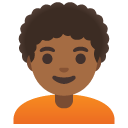


Appearance varies by platform and device. Google Noto, Twemoji, and OpenMoji are open-source.