🚵🏿
The Emoji
Person Mountain Biking: Dark Skin Tone
U+1F6B5 U+1F3FF · :person_mountain_biking_dark_skin_tone:
Trend 55
Meaning layers
- interpretation
- Used to signal an active, outdoorsy lifestyle or to hype up someone grinding through obstacles — metaphorically and literally. Also used to represent hustle culture with a chill outdoor twist.
- tiktok usage
- Appears in fitness, trail riding, and Black outdoor community content. Used in captions like 'finally touched grass 🚵🏿' or to celebrate Black athletes in cycling and extreme sports.
- irony level
- 3 / 10
Platform meanings
- meaning
- Signals outdoor adventure, Black fitness culture, or someone doing the absolute most physically. Also used as shorthand for the Black Outdoors movement.
- trend usage
- Popular in #BlackOutdoors, trail running, and mountain biking content. Used by creators documenting outdoor adventures and breaking stereotypes about who belongs in nature sports.
- hashtags
- #BlackOutdoors#MountainBiking#OutdoorLife#TrailRiding#BlackAthletes
- virality score
- 58 / 100
Cultural meanings
🇺🇸
Western / Gen-Z
Embraced as a symbol of Black outdoor visibility and athletic freedom. Common in social media content challenging the narrative that outdoor sports aren't for everyone.
🇵🇰
Pakistan & India
Primarily interpreted as a generic sports or cycling emoji. Mountain biking as a leisure sport is growing in urban areas, so it signals modern athleticism.
🌍
Middle East
Seen as a representation of outdoor sports and fitness. Mountain biking communities are growing in countries like Saudi Arabia and UAE, giving this emoji increasing relevance.
🌐
Global Neutral
Universally understood as representing cycling or mountain biking. The dark skin tone is recognized as a diversity modifier without additional cultural loading in neutral contexts.
🇧🇩
Bangladesh
Interpreted straightforwardly as cycling, a common mode of transport and sport. The athletic context may signal fitness culture or youth sporting activity.
🇱🇰
Sri Lanka
Associated with cycling as both sport and transport. Mountain biking as recreation is niche but growing, so this emoji may signal modern outdoor hobbies.
🇨🇳
China
Seen as a sports and fitness emoji. Mountain biking has a growing following in China, and this emoji might be used in outdoor sports communities without strong cultural connotation beyond sport.
🇯🇵
Japan
Interpreted as an outdoor sports symbol. Japan has an active cycling culture, and the emoji fits naturally in outdoor and sports-related content without significant additional cultural weight.
🇰🇷
South Korea
Used in fitness and outdoor lifestyle contexts. South Korea's growing outdoor recreation culture makes this relevant for trail biking communities and athletic content creators.
🇹🇼
Taiwan
Associated with outdoor adventure and cycling — Taiwan has a strong cycling culture, making this emoji particularly resonant for trail riding communities.
🇭🇰
Hong Kong
Used in outdoor sports and fitness contexts. The dark skin tone modifier is recognized for diversity representation, respected within Hong Kong's internationally aware digital culture.
🇵🇭
Philippines
Seen primarily as a sports or outdoor activity emoji. Mountain biking is popular in rural and adventure tourism contexts, giving this emoji genuine sporting relevance.
🇮🇩
Indonesia
Interpreted as an outdoor sports symbol, with mountain biking being increasingly popular. The dark skin tone resonates with Indonesian users due to representation alignment.
🇹🇭
Thailand
Used in outdoor adventure and sports content. Thailand's growing mountain biking tourism scene makes this emoji relevant for trail communities and adventure tourism posts.
🇻🇳
Vietnam
Associated with cycling culture broadly, with the mountain biking variant signaling modern sport and outdoor recreation. Used in active lifestyle and sports communities.
🇲🇾
Malaysia
Resonates naturally as Malaysia has a growing mountain biking community. The dark skin tone is appreciated for diversity, and this emoji is used freely in sports contexts.
🇸🇦
Saudi Arabia
With Saudi Arabia's growing interest in outdoor sports and entertainment, this emoji is gaining traction in sports communities. Represents modern youth fitness culture.
🇦🇪
UAE
Used in fitness and outdoor sports contexts, which are popular in the UAE's active lifestyle culture. Mountain biking in desert terrain is an actual growing sport, adding authenticity.
🇪🇬
Egypt
Interpreted as a sports and fitness emoji. Cycling communities in Egypt would recognize this in sporting contexts, while the dark skin tone may resonate with local color representation.
🇹🇷
Turkey
Associated with outdoor sports and adventure, which are popular across Turkey's varied terrain. Used in cycling communities and outdoor adventure content without strong cultural loading.
🇮🇷
Iran
Seen as a fitness and sports emoji. Cycling is popular in Iran, and this emoji is used in sporting and outdoor recreation contexts among active youth communities.
🇳🇬
Nigeria
Carries strong resonance as both a sports emoji and a representation symbol. Nigeria's growing cycling communities and pride in seeing dark-skinned representation in international emoji sets make this particularly meaningful.
🇿🇦
South Africa
Deeply meaningful given South Africa's active mountain biking culture and conversations about racial representation in outdoor sports. Used proudly in Black South African outdoor and cycling communities.
🇬🇧
UK & Ireland
Used in cycling and outdoor sports contexts. The dark skin tone is appreciated in the context of UK diversity conversations and is used in Black British outdoor communities.
🇫🇷
France
Interpreted in cycling contexts with France's strong cycling culture (Tour de France heritage). The dark skin tone adds representation value celebrated by French multicultural communities.
🇩🇪
Germany
Seen as an outdoor sports emoji in Germany's active cycling culture. Used in trail biking communities and diversity-in-sports advocacy content.
🇪🇸
Spain & Italy
Associated with outdoor sports and adventure. Used in cycling communities and mountain recreation contexts across these outdoor-activity-loving cultures.
🇧🇷
Brazil
Resonates strongly given Brazil's vibrant mountain biking culture and the visibility of Afro-Brazilian athletes. Used with pride in sports and representation contexts.
🇲🇽
Mexico
Used in outdoor sports and fitness contexts. Mexico's growing mountain biking scene and indigenous outdoor culture give this emoji authentic sporting relevance.
🌎
Latin America
Broadly used in cycling and outdoor sports communities across Latin America, with the dark skin tone celebrated as representation for Afro-Latino communities.
🇦🇺
Australia & NZ
Highly relevant given Australia and New Zealand's strong outdoor sports cultures and active mountain biking communities. The diversity aspect is positively received.
How its meaning shifted
- 2010
Mountain biking emoji did not yet exist — the concept was represented through combinations of bike emojis and terrain descriptions in text.
- 2015
Early adoption after emoji introduction. Used primarily in literal cycling contexts with minimal cultural layering. Skin tone modifiers were newly introduced and seen as progressive.
- 2020
Gained significant traction alongside the Black Outdoors movement and broader conversations about racial representation in nature and sports. Became a symbol of visibility beyond just literal biking.
- 2026
Established as a multi-layered emoji representing athletic empowerment, Black outdoor culture, and the broader 'grind through any terrain' metaphor. Regular fixture in fitness, representation, and lifestyle content.
See it on every platform
Adjacent emojis
- Often confused with
- person bikingkick scooterperson running
- Can replace
- person bikingbicyclemountain
Share & embed
Frequently asked
01What does the 🚵🏿 Person Mountain Biking: Dark Skin Tone emoji mean?
A person riding a mountain bike, depicted with dark skin tone. The figure is shown in an active cycling pose, often on rough terrain.
02What does 🚵🏿 mean on TikTok?
Signals outdoor adventure, Black fitness culture, or someone doing the absolute most physically. Also used as shorthand for the Black Outdoors movement.
03What does 🚵🏿 mean on WhatsApp?
Sharing excitement about a bike ride, outdoor plans, or fitness goals. Common in family and friend group chats when organizing outdoor activities.
04What does 🚵🏿 mean in Gen-Z slang?
Used to signal an active, outdoorsy lifestyle or to hype up someone grinding through obstacles — metaphorically and literally. Also used to represent hustle culture with a chill outdoor twist.
05Is the 🚵🏿 emoji safe to use?
Represents outdoor sports, cycling, fitness, physical activity, and cultural representation in athletics. Entirely safe and positive in standard use.
06What does 🚵🏿 mean in texting?
Evokes feelings of physical liberation and mastery over challenging terrain. The dark skin tone modifier adds a layer of cultural pride and visibility, resonating deeply within communities historically underrepresented in outdoor sports.
07What is the shortcode for 🚵🏿?
The shortcode for Person Mountain Biking: Dark Skin Tone is :person_mountain_biking_dark_skin_tone:
08What does 🚵🏿 mean in dating?
Sent to signal an active, adventurous personality — a subtle flex that says 'I'm fit and fun, let's do something outdoors together.'
Safety & usage
- Safe meaning
- Represents outdoor sports, cycling, fitness, physical activity, and cultural representation in athletics. Entirely safe and positive in standard use.
- Caution
- Extremely rare toxic usage — could theoretically be used in racially dismissive contexts, but this is highly uncommon and not a documented pattern.
No significant toxic usage patterns documented. The dark skin tone modifier is intended for and received as positive representation. Safe for all audiences.
How it looks across platforms
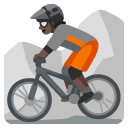


Appearance varies by platform and device. Google Noto, Twemoji, and OpenMoji are open-source.