🤽🏻
The Emoji
Person Playing Water Polo: Light Skin Tone
U+1F93D U+1F3FB · :person_playing_water_polo_light_skin_tone:
Trend 18
Meaning layers
- interpretation
- Used to signal athletic identity, summer pool vibes, or niche sports pride. Sometimes deployed humorously to describe chaotic multitasking — treading water while doing something else simultaneously.
- tiktok usage
- Appears in sports highlight reels, gym motivation content, and ironically in 'nobody asked but here's my obscure sport' trends.
- irony level
- 4 / 10
Platform meanings
- meaning
- Athletic identity marker, water sports enthusiasm, or ironic metaphor for chaotic survival
- trend usage
- Used in sports day TikToks, athlete POV content, and 'tell me you play water polo without telling me' trends
- hashtags
- #waterpolo#aquaticsports#poolvibes#athletelife#swimmersoftiktok
- virality score
- 22 / 100
Cultural meanings
🇺🇸
Western / Gen-Z
Used primarily by actual water polo players or as an ironic metaphor for frantically keeping up with life; niche and sincere in sports communities.
🇵🇰
Pakistan & India
Rarely used as water polo has limited mainstream presence; may be used by elite club sport participants or during Olympics coverage discussions.
🌍
Middle East
Uncommon in everyday chat; may appear during Olympic Games commentary or among youth athletes in UAE/Qatar where aquatic sports are growing.
🌐
Global Neutral
Universally understood as a water sport emoji; used sincerely for sports communication across all platforms globally.
🇧🇩
Bangladesh
Very niche usage; water polo is not widely played and the emoji would be understood through sports broadcasts rather than personal use.
🇱🇰
Sri Lanka
Seldom used domestically; may be seen in conversations about international sports or among Sri Lankan athletes abroad.
🇨🇳
China
Used during Olympic coverage discussions, particularly as China has a competitive national water polo team; associated with national athletic pride.
🇯🇵
Japan
Used around the Summer Olympics when Japan fields water polo teams; also found in sports school club communications.
🇰🇷
South Korea
Niche usage; appears in sports community chats and during Olympic Games as Korea participates in water polo at international levels.
🇹🇼
Taiwan
Used in Olympic season discussions and by university sports club members; relatively rare in everyday messaging.
🇭🇰
Hong Kong
More common in international school communities where aquatic sports are popular; used in sports team group chats.
🇵🇭
Philippines
Occasionally used among university athletic communities; water polo is gaining popularity in private school sports programs.
🇮🇩
Indonesia
Very niche; primarily used by elite sports community members or in discussions of multi-sport games like Asian Games.
🇹🇭
Thailand
Rare in everyday use; associated with Olympic sports news and elite athlete communities discussing international competitions.
🇻🇳
Vietnam
Limited usage; appears during Southeast Asian Games or international sports coverage discussions.
🇲🇾
Malaysia
Niche but present in inter-school sports community chats; Malaysia competes in water polo at regional games.
🇸🇦
Saudi Arabia
Rare in casual messaging; may appear in discussions of Saudi Vision 2030 sports initiatives or Olympic participation.
🇦🇪
UAE
More common than in neighboring countries due to growing aquatic sports culture and international school communities.
🇪🇬
Egypt
Occasionally used during Olympic season; Egypt has a national water polo tradition and the emoji appears in sports fan discussions.
🇹🇷
Turkey
Used among sports enthusiasts and during Olympic periods; Turkey has a developing water polo scene.
🇮🇷
Iran
Seen during international sports discussions; Iran participates in water polo at Asian Games, giving the emoji some recognition.
🇳🇬
Nigeria
Very rare; water polo has minimal cultural presence but the emoji may appear during Olympic broadcasts or among diaspora communities.
🇿🇦
South Africa
Used in aquatic sports communities, particularly in Cape Town and Johannesburg where water polo has school and club presence.
🇬🇧
UK & Ireland
Used in school sports communities where water polo has a stronger presence, particularly in private schools and university clubs.
🇫🇷
France
France has a strong water polo tradition; the emoji is used genuinely by athletes and fans, especially during European Championships.
🇩🇪
Germany
Used in sports club communities and Olympic discussion groups; Germany has an active water polo league.
🇪🇸
Spain & Italy
Very commonly used in southern Europe where water polo is a mainstream sport, especially in Spain (strong national team) and Italy (world-class program).
🇧🇷
Brazil
Used in sports community chats; Brazil participates in water polo at Pan American Games and the emoji appears in sports fan content.
🇲🇽
Mexico
Niche usage; appears in university sports communities and during Pan American Games coverage.
🌎
Latin America
Generally niche across Latin America; most visible during Pan American Games and Olympic cycles in sports media discussions.
🇦🇺
Australia & NZ
Relatively common in aquatic sports communities; Australia has a strong Olympic water polo program (especially women's) and the emoji appears in school and club sports contexts.
How its meaning shifted
- 2010
Emoji did not exist yet; water sports were represented by generic swimming emojis or text descriptions.
- 2015
Water polo emoji introduced (Unicode 8.0, 2015); initial usage was almost exclusively literal by athletes and sports fans.
- 2020
Skin tone variants gained traction for inclusive sports representation; saw uptick during Tokyo 2020 Olympics discussions; occasional metaphorical use emerging.
- 2026
Used sincerely in niche sports communities, metaphorically for 'keeping afloat' situations, and appears in AI-generated sports content; stable low-to-medium usage with spikes during Olympics.
See it on every platform
Adjacent emojis
- Often confused with
- person surfingperson rowing boatperson swimming
- Can replace
- swimming capwater wavetrophy
Share & embed
Frequently asked
01What does the 🤽🏻 Person Playing Water Polo: Light Skin Tone emoji mean?
A person playing water polo with light skin tone, depicted in a swimming pool raising one arm to throw or block a ball. The light skin tone modifier (🏻) applies a Fitzpatrick Type-1-2 skin tone to the base water polo emoji.
02What does 🤽🏻 mean on TikTok?
Athletic identity marker, water sports enthusiasm, or ironic metaphor for chaotic survival
03What does 🤽🏻 mean on WhatsApp?
Communicating that someone plays water polo, is at the pool, or is involved in aquatic sports
04What does 🤽🏻 mean in Gen-Z slang?
Used to signal athletic identity, summer pool vibes, or niche sports pride. Sometimes deployed humorously to describe chaotic multitasking — treading water while doing something else simultaneously.
05Is the 🤽🏻 emoji safe to use?
Straightforwardly represents the sport of water polo and athletic participation in aquatic sports.
06What does 🤽🏻 mean in texting?
Signals a sense of active engagement and physical identity. People who use this emoji often want to communicate sporting dedication or a love of water-based activity, sometimes as a niche identity marker.
07What is the shortcode for 🤽🏻?
The shortcode for Person Playing Water Polo: Light Skin Tone is :person_playing_water_polo_light_skin_tone:
08What does 🤽🏻 mean in dating?
Rare as a flirting tool; occasionally used to hint at a fit, active lifestyle or to invite someone to watch a sport. 'Come watch me play 🤽🏻' carries a casual flex.
Safety & usage
- Safe meaning
- Straightforwardly represents the sport of water polo and athletic participation in aquatic sports.
- Caution
- No widely documented toxic or coded meanings; extremely low risk of misuse.
No significant safety concerns. In extremely rare edge cases, skin-tone modifiers on any emoji can be used to make racially targeted commentary, but this is not specific to or common with this emoji.
How it looks across platforms
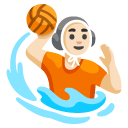


Appearance varies by platform and device. Google Noto, Twemoji, and OpenMoji are open-source.