🏃🏾➡️
The Emoji
Person Running Facing Right: Medium-dark Skin Tone
U+1F3C3 U+1F3FE U+200D U+27A1 U+FE0F · :person_running_facing_right_mediumdark_skin_tone:
Trend 65
Meaning layers
- interpretation
- Used to signal escaping a situation, running away from problems, clocking out fast, or hyping up physical activity. Often used humorously to indicate fleeing from responsibilities or awkward situations.
- tiktok usage
- Appears in 'running from my problems' content, gym motivation videos, and reaction clips where someone is literally or metaphorically sprinting away from drama or stress.
- irony level
- 7 / 10
Platform meanings
- meaning
- Escape, hype, urgency, or gym motivation. Used in voiceovers and text overlays when someone is figuratively or literally running.
- trend usage
- Appears in gym transformation TikToks, 'running from red flags' trend, and 'POV: me leaving that situation' formats. Also used in race or marathon recap content.
- hashtags
- #RunningFromMyProblems#GymTok#FitnessTikTok#RaceDay#EscapeMode
- virality score
- 68 / 100
Cultural meanings
🇺🇸
Western / Gen-Z
Primarily used ironically to signal fleeing from responsibilities, awkward situations, or emotional discomfort — a staple of self-deprecating humor. Also genuinely used for fitness motivation content.
🇵🇰
Pakistan & India
Used in everyday messaging to signal being in a rush or leaving quickly. Fitness culture adoption is growing, especially among urban youth using it in gym and running group contexts.
🌍
Middle East
Commonly used to signal urgency or being late in informal chats. Growing fitness culture in Gulf states means it's increasingly used in marathon and workout contexts.
🌐
Global Neutral
Universally understood as representing speed, urgency, physical movement, or running. The directional variant adds a sense of purposeful forward movement recognized across cultures.
🇧🇩
Bangladesh
Used casually in chats to indicate being in a hurry or leaving quickly. Fitness-related usage is emerging among younger, urban demographics.
🇱🇰
Sri Lanka
Predominantly used to convey being rushed or in motion in casual messaging. Athletic and marathon culture is growing, increasing its literal fitness usage.
🇨🇳
China
Used on platforms like WeChat and Weibo to signal being busy or in a rush. Fitness influencer culture has boosted its use in workout and running challenge content.
🇯🇵
Japan
Associated with diligence and physical effort — used in fitness communities, marathon culture (very popular in Japan), and as a symbol of working hard and pressing forward.
🇰🇷
South Korea
Tied to the strong running and fitness culture; used in workout apps, running club chats, and among K-pop fans to hype energetic performers 'running' the stage.
🇹🇼
Taiwan
Used in fitness contexts and to signal urgency in messaging. The directional aspect aligns with Taiwanese pop culture themes of chasing dreams and moving forward.
🇭🇰
Hong Kong
Used practically to mean rushing or being late, and in fitness contexts for the city's active running community which holds major marathons annually.
🇵🇭
Philippines
Used in casual chats to mean 'I'm out' or 'I'm rushing.' Also popular in fitness communities and among fans who use it to describe energetic idol performers.
🇮🇩
Indonesia
Commonly used to signal leaving or being busy in WhatsApp-heavy communication culture. Growing gym and running community uses it motivationally.
🇹🇭
Thailand
Used to indicate haste in everyday communication and embraced by the growing fitness and marathon running community in Bangkok and major cities.
🇻🇳
Vietnam
Primarily signals being in a rush in chat contexts. Fitness culture growth and urban marathon events have introduced more literal and motivational usage.
🇲🇾
Malaysia
Used in WhatsApp groups to signal rushing or exiting quickly. The active running culture in KL means it also appears genuinely in race and fitness content.
🇸🇦
Saudi Arabia
Increasingly used as fitness and wellness culture expands, particularly around Vision 2030-driven health initiatives. Used in run club and marathon content.
🇦🇪
UAE
Common in Dubai and Abu Dhabi running communities, which are very active. Also used casually to indicate urgency or leaving in messaging contexts.
🇪🇬
Egypt
Used to signal being in a rush or exiting a chat. Fitness culture is growing and the emoji appears in gym and running community content among youth.
🇹🇷
Turkey
Used in everyday messaging for urgency and in growing fitness communities. Istanbul Marathon culture gives it a genuine running context alongside casual rush usage.
🇮🇷
Iran
Used in messaging to indicate haste or departure. Fitness and running culture, particularly among youth, is growing and the emoji is used in those contexts.
🇳🇬
Nigeria
Used to signal 'I'm out' or leaving a situation quickly — carries strong connotations of escape or avoiding something problematic. Also used in fitness posts.
🇿🇦
South Africa
Used in both literal running contexts (Comrades Marathon culture is enormous) and humorously to signal fleeing a situation. Strong dual-use across demographics.
🇬🇧
UK & Ireland
Used both for genuine running/fitness content and for the very British/Irish humor of running away from awkward situations or miserable weather. High irony potential.
🇫🇷
France
Used in fitness contexts and to signal being in a rush. French humor culture gives it some ironic escape-from-life usage, though less meme-heavy than Anglo cultures.
🇩🇪
Germany
Used practically to indicate haste or fitness activity. Germany's strong running and marathon culture (Berlin Marathon) gives it genuine athletic relevance.
🇪🇸
Spain & Italy
Used to signal urgency in messaging and in the growing running and outdoor fitness culture. Also used humorously in the context of 'escaping' social obligations.
🇧🇷
Brazil
Used enthusiastically in fitness and running content — Brazil has a huge outdoor running culture. Also used humorously to signal escaping situations or difficult conversations.
🇲🇽
Mexico
Used to signal rushing or leaving quickly in casual chats and with growing ironic humor about running from problems. Fitness usage is increasing in urban areas.
🌎
Latin America
Broadly used across Latin America to signal urgency, movement, or escape from situations. Fitness culture adoption varies by country but is generally growing.
🇦🇺
Australia & NZ
Used for genuine running and outdoor fitness content (both countries have strong run cultures) and humorously in the very casual, ironic Aussie/Kiwi communication style.
How its meaning shifted
- 2010
The base running emoji barely existed in mainstream use; directional and skin tone variants did not exist yet. Running emojis were niche and used only literally.
- 2015
Running emoji usage grew with fitness culture and social media. Skin tone modifiers were introduced in 2015, making diverse representation possible. Usage was still primarily literal.
- 2020
The directional variant was introduced and quickly adopted. During COVID-19 lockdowns, it saw heavy ironic use — 'running from 2020' — alongside genuine fitness content as home workouts boomed.
- 2026
Firmly established in both literal fitness contexts and as a meme/irony staple for escape and avoidance humor. The medium-dark skin tone variant represents normalized diverse emoji representation in everyday communication.
See it on every platform
Adjacent emojis
- Often confused with
- person walking facing rightperson runningperson cartwheeling
- Can replace
- person runningdash symbolathletic shoe
Share & embed
Frequently asked
01What does the 🏃🏾➡️ Person Running Facing Right: Medium-dark Skin Tone emoji mean?
A person running and facing to the right, depicted with medium-dark skin tone. Introduced as a directional variant of the running person emoji to indicate movement toward the right side.
02What does 🏃🏾➡️ mean on TikTok?
Escape, hype, urgency, or gym motivation. Used in voiceovers and text overlays when someone is figuratively or literally running.
03What does 🏃🏾➡️ mean on WhatsApp?
Signals someone is in a rush, leaving quickly, or humorously fleeing a conversation. 'Gtg 🏃🏾➡️' is a common usage.
04What does 🏃🏾➡️ mean in Gen-Z slang?
Used to signal escaping a situation, running away from problems, clocking out fast, or hyping up physical activity. Often used humorously to indicate fleeing from responsibilities or awkward situations.
05Is the 🏃🏾➡️ emoji safe to use?
Represents physical running, exercise, urgency, movement, or humorous escape from situations. Universally benign in standard usage.
06What does 🏃🏾➡️ mean in texting?
The rightward direction subconsciously implies forward momentum and progress in left-to-right reading cultures, making this emoji feel more purposeful than escapist despite frequent ironic use.
07What is the shortcode for 🏃🏾➡️?
The shortcode for Person Running Facing Right: Medium-dark Skin Tone is :person_running_facing_right_mediumdark_skin_tone:
08What does 🏃🏾➡️ mean in dating?
Sometimes used playfully when someone is 'running toward' a date or running away from the situationship they're stuck in. Low flirt utility on its own.
Safety & usage
- Safe meaning
- Represents physical running, exercise, urgency, movement, or humorous escape from situations. Universally benign in standard usage.
- Caution
- Extremely rare toxic misuse — could theoretically be used to mock someone for 'running away' from a conflict, implying cowardice, but this is uncommon.
No significant safety concerns. Directional emoji are sometimes used in sequences that could imply chasing, so context matters in multi-emoji chains.
How it looks across platforms
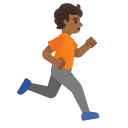
Appearance varies by platform and device. Google Noto, Twemoji, and OpenMoji are open-source.