🛀🏼
The Emoji
Person Taking Bath: Medium-light Skin Tone
U+1F6C0 U+1F3FC · :person_taking_bath_mediumlight_skin_tone:
Trend 48
Meaning layers
- interpretation
- Used to signal self-care rituals, 'me time,' emotional reset, or avoiding people. Also ironically used when someone is doing nothing productive or 'soaking in their thoughts.'
- tiktok usage
- Appears in 'soft life' and 'that girl' aesthetic content, bath bomb reviews, and self-care routine videos. Also used sarcastically when someone is 'cleansing' themselves of drama or toxic people.
- irony level
- 4 / 10
Platform meanings
- meaning
- Represents self-care routines, relaxation content, bath aesthetic, and 'unbothered' energy.
- trend usage
- Frequently used in 'that girl' morning/night routine videos, bath bomb ASMR, emotional reset vlogs, and 'soft life' content.
- hashtags
- #selfcare#bathtime#thatgirl#softlife#treatyourself
- virality score
- 55 / 100
Cultural meanings
🇺🇸
Western / Gen-Z
Widely used as a self-care and 'soft life' symbol; also deployed ironically in meme contexts to represent unbothered detachment from drama or stress.
🇵🇰
Pakistan & India
Used casually to indicate bathing time or unavailability in personal chats; less commonly used for self-care aesthetics, though urban youth are adopting it in that context.
🌍
Middle East
Understood literally as a hygiene or relaxation symbol; bathing culture (including hammam traditions) gives it a culturally resonant, positive connotation.
🌐
Global Neutral
Universally understood as representing bathing, relaxation, and personal hygiene — carries minimal cultural specificity in its core interpretation.
🇧🇩
Bangladesh
Used primarily in a literal sense to communicate being busy with a bath or unavailable; self-care aesthetic usage is growing among younger urban users.
🇱🇰
Sri Lanka
Understood as a hygiene indicator in casual messaging; occasionally used in wellness-related social media content by lifestyle influencers.
🇨🇳
China
Used on platforms like WeChat and Weibo to signal bathing routines or relaxation; associates with 'wellness aesthetics' (养生文化) among younger Chinese users.
🇯🇵
Japan
Bathing (ofuro) is a deeply cultural practice in Japan, making this emoji particularly resonant — it can evoke the meditative, ritualistic quality of Japanese bath culture beyond simple hygiene.
🇰🇷
South Korea
Connected to K-beauty self-care routines and 'healing' culture; used frequently in self-care content and skin care ritual documentation.
🇹🇼
Taiwan
Used casually to indicate bathing or unavailability, with growing usage in self-care and wellness content influenced by Korean and Japanese beauty culture.
🇭🇰
Hong Kong
Used to signal being busy or offline; in lifestyle content, it aligns with wellness trends popular among urban young professionals.
🇵🇭
Philippines
Used literally in casual chats; self-care usage is growing on TikTok and Instagram among Filipino lifestyle content creators.
🇮🇩
Indonesia
Understood as a hygiene symbol; in social media contexts, it's adopted in self-care and 'soft life' content influenced by Korean and Western trends.
🇹🇭
Thailand
Used in casual messaging for bathing/unavailability; also appears in spa and wellness tourism content given Thailand's strong spa culture.
🇻🇳
Vietnam
Primarily used in literal contexts for bathing; younger urban users are incorporating it into self-care aesthetic content on TikTok.
🇲🇾
Malaysia
Used in everyday messaging to indicate bathing; in lifestyle content, it aligns with self-care and wellness aesthetics popular among younger Malaysians.
🇸🇦
Saudi Arabia
Understood literally; hammam and bathing traditions give it cultural depth, and it appears in wellness and spa-related content.
🇦🇪
UAE
Used in wellness and luxury lifestyle content; the UAE's strong spa and luxury culture makes this emoji relevant in aspirational lifestyle posts.
🇪🇬
Egypt
Understood literally; hammam bathing culture gives it a culturally familiar resonance beyond simple modern hygiene.
🇹🇷
Turkey
Strongly resonates culturally due to the hamam (Turkish bath) tradition; used in both literal bathing contexts and wellness/tourism content.
🇮🇷
Iran
Used in casual messaging for bathing; cultural bathing traditions (garmabeh) give it a familiar and respected connotation.
🇳🇬
Nigeria
Used casually to indicate bathing or a break; in lifestyle and self-care content, it's gaining traction among urban youth on Instagram and TikTok.
🇿🇦
South Africa
Used in everyday messaging contexts; in lifestyle content, it appears in self-care and wellness posts influenced by global trends.
🇬🇧
UK & Ireland
Used in self-care and 'pamper night' contexts; British bath culture (long baths, bath bombs) makes this emoji very culturally familiar and warmly received.
🇫🇷
France
Associated with relaxation and personal hygiene rituals; used in lifestyle content and casual messaging, though the shower is more culturally dominant in France.
🇩🇪
Germany
Used primarily in practical, literal contexts; also appears in wellness and relaxation content as Germans value structured self-care and spa culture (Wellness).
🇪🇸
Spain & Italy
Used casually; in lifestyle content it connects to relaxation culture (siesta energy), spa aesthetics, and self-care routines popular on Instagram.
🇧🇷
Brazil
Used casually in messaging; in self-care and beauty content it's popular among Brazilian influencers promoting wellness and self-love culture.
🇲🇽
Mexico
Used in casual messaging; in lifestyle content it appears in self-care posts, particularly among younger urban users influenced by global wellness trends.
🌎
Latin America
Broadly used across Latin America for literal bathing contexts and increasingly in self-care aesthetic content influenced by global social media culture.
🇦🇺
Australia & NZ
Used in casual self-care and relaxation contexts; aligns with laid-back lifestyle culture and 'Sunday reset' aesthetics popular in Australian and NZ social media.
How its meaning shifted
- 2010
Emoji was not yet introduced in this period; bathing was represented by text emoticons or simple water symbols in early mobile messaging.
- 2015
Newly introduced, used almost exclusively in literal contexts — telling someone you're in the bath or mentioning hygiene routines in text messages.
- 2020
Adopted into self-care and wellness culture on Instagram and TikTok; began appearing in 'soft life' content and as a symbol of relaxation and intentional downtime.
- 2026
Firmly established in self-care aesthetic vocabulary; used ironically in meme culture for 'unbothered' energy, and sincerely in wellness, spa, and mental health content across all major platforms.
See it on every platform
Compare with
Adjacent emojis
- Often confused with
- hot tubswimming personwater wave
- Can replace
- shower emojisparklesrelieved face
Share & embed
Frequently asked
01What does the 🛀🏼 Person Taking Bath: Medium-light Skin Tone emoji mean?
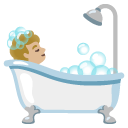
A person sitting in a bathtub taking a bath, depicted with medium-light skin tone. Represents bathing, hygiene, relaxation, and self-care.
02What does 🛀🏼 mean on TikTok?
Represents self-care routines, relaxation content, bath aesthetic, and 'unbothered' energy.
03What does 🛀🏼 mean on WhatsApp?
Typically signals the sender is taking a bath or about to — a common 'brb' shorthand in personal chats.
04What does 🛀🏼 mean in Gen-Z slang?
Used to signal self-care rituals, 'me time,' emotional reset, or avoiding people. Also ironically used when someone is doing nothing productive or 'soaking in their thoughts.'
05Is the 🛀🏼 emoji safe to use?
Represents bathing, personal hygiene, self-care, and relaxation — entirely benign in most contexts.
06What does 🛀🏼 mean in texting?
Bathing is psychologically linked to emotional cleansing and stress relief. Using this emoji often signals a need for solitude, decompression, or resetting one's mental state after a hard day.
07What is the shortcode for 🛀🏼?
The shortcode for Person Taking Bath: Medium-light Skin Tone is :person_taking_bath_mediumlight_skin_tone:
08What does 🛀🏼 mean in dating?
Can carry a mildly suggestive tone when sent late at night, implying intimacy or an invitation to imagine the sender in a vulnerable, relaxed state.
Safety & usage
- Safe meaning
- Represents bathing, personal hygiene, self-care, and relaxation — entirely benign in most contexts.
- Caution
- In rare cases, can be used to suggest sexual innuendo in flirtatious or explicit conversations, particularly in late-night direct messages.
Generally safe; context-dependent mild suggestiveness is possible in adult flirting scenarios. Not inherently NSFW but may carry subtle implications depending on conversation tone and relationship.
How it looks across platforms


Appearance varies by platform and device. Google Noto, Twemoji, and OpenMoji are open-source.