🚶🏿➡️
The Emoji
Person Walking Facing Right: Dark Skin Tone
U+1F6B6 U+1F3FF U+200D U+27A1 U+FE0F · :person_walking_facing_right_dark_skin_tone:
Trend 58
Meaning layers
- interpretation
- Used to signal leaving a situation, walking away from drama, moving on, or 'logging off' from a toxic environment. Often implies unbothered energy or a 'not my problem anymore' attitude.
- tiktok usage
- Appears in transition videos, 'leaving toxic situations' trend content, and as a visual metaphor for moving on from a bad era of life.
- irony level
- 4 / 10
Platform meanings
- meaning
- Symbolizes moving on, unbothered energy, or walking away from a past version of oneself. Used heavily in 'glow up' and 'leaving toxic situations' content.
- trend usage
- Used in 'POV: you finally left' videos, transition effects where the creator walks off screen, and in comment sections to signal agreement with someone leaving a bad situation.
- hashtags
- #walkingaway#unbothered#glowup#newera#leavingtoxicity
- virality score
- 62 / 100
Cultural meanings
🇺🇸
Western / Gen-Z
Widely understood as 'walking away from drama' or embodying unbothered energy; the dark skin tone is seen as inclusive representation and is used respectfully by those who identify with it.
🇵🇰
Pakistan & India
Used literally to indicate walking or going somewhere, and metaphorically to signal leaving a bad situation; the dark skin tone emoji is sometimes avoided due to colorism dynamics but is increasingly normalized among younger users.
🌍
Middle East
Primarily used in a literal sense for movement or commuting; the skin tone representation is noted and appreciated by darker-skinned Arab and South Asian communities in the region.
🌐
Global Neutral
Universally understood as a walking person; the rightward direction implies forward movement and progress across most global contexts.
🇧🇩
Bangladesh
Used mostly in a literal sense—someone going out or traveling; metaphorical 'walking away' usage is less common but growing among urban youth.
🇱🇰
Sri Lanka
Interpreted as someone walking or heading somewhere; increasingly used by younger Sri Lankans to signal independence or personal progress.
🇨🇳
China
Used for literal walking or indicating someone is on the move; the directional emoji is also sometimes used in navigation or exercise-related contexts on apps like WeChat.
🇯🇵
Japan
Often used literally for walks or exercise; in Japanese digital culture, directional precision is appreciated, making the rightward facing variant more meaningful than the generic version.
🇰🇷
South Korea
Used in fitness and wellness contexts given Korea's strong walking-culture content; also used metaphorically in K-drama discussion threads to signal a character 'walking out'.
🇹🇼
Taiwan
Practical usage for indicating movement or transit; younger users adopt the 'walking away' metaphor from Western meme culture.
🇭🇰
Hong Kong
Used in commuting and transit conversations; the 'walking away from drama' usage is popular among younger Cantonese-speaking users familiar with global meme culture.
🇵🇭
Philippines
Very commonly used—Filipinos embrace emoji expression broadly, and this one signals both literal movement and the 'unbothered' attitude popularized through TikTok trends.
🇮🇩
Indonesia
Used in casual chat to mean heading out or being on the move; metaphorical usage is growing among Indonesian Gen Z on TikTok and Instagram.
🇹🇭
Thailand
Practical use for indicating someone is walking or going somewhere; also appears in Thai wellness and exercise content.
🇻🇳
Vietnam
Primarily literal—used when chatting about going out or commuting; younger Vietnamese users are adopting the symbolic 'moving on' usage.
🇲🇾
Malaysia
Multi-community use across Malay, Chinese, and Indian Malaysian users; interpreted as walking or being on the go, with growing meme-based metaphorical usage.
🇸🇦
Saudi Arabia
Used in practical contexts for movement or travel indication; appreciated for skin tone diversity by darker-skinned residents and communities.
🇦🇪
UAE
Common in a multicultural digital landscape; used by South Asian, Arab, and African communities in the UAE who appreciate the dark skin tone representation.
🇪🇬
Egypt
Used for literal walking or travel; younger Egyptians use it in meme contexts to signal leaving a bad situation, especially on Twitter/X.
🇹🇷
Turkey
Employed in casual conversations about going out or walking; the 'walking away' meme usage is gaining traction among Turkish Gen Z.
🇮🇷
Iran
Used literally for movement or transit; metaphorical usage as 'leaving' or 'moving on' is emerging among Iranian youth on Instagram and Telegram.
🇳🇬
Nigeria
Heavily used—Nigerians are prolific emoji users and the dark skin tone carries strong cultural pride and identity resonance; used both literally and as bold 'I'm out' energy.
🇿🇦
South Africa
The dark skin tone is particularly meaningful in the South African context; used with pride by Black South Africans to represent themselves in digital conversations.
🇬🇧
UK & Ireland
Used in the British meme tradition of dry, understated exits from conversations; paired with phrases like 'right, I'm off' energy.
🇫🇷
France
Used casually for walking or leaving; in French social media culture, it carries a cool, unbothered 'je m'en vais' (I'm leaving) connotation.
🇩🇪
Germany
More practical usage—Germans tend to use it literally for walking, exercise, or indicating departure; less ironic or meme-heavy than Anglo contexts.
🇪🇸
Spain & Italy
Used expressively in the Mediterranean style—either literally or dramatically to signal 'I'm walking out of this conversation'; fits the expressive emoji culture of both countries.
🇧🇷
Brazil
Brazilians use this with flair—often to signal dramatic exits from arguments or as part of viral meme formats on Twitter and Instagram; the dark skin tone is embraced proudly by Afro-Brazilian users.
🇲🇽
Mexico
Used in casual chat for 'heading out' and in meme contexts for dramatic walkouts; the skin tone is appreciated by darker-skinned Mexican users as a form of representation.
🌎
Latin America
Broadly used across Latin America for movement and metaphorical exits; the dark skin tone resonates with Afro-Latino communities who value inclusive representation.
🇦🇺
Australia & NZ
Used casually and often ironically in the Australian/NZ meme culture; fits the 'not my problem, walking away' humor style common in these communities.
How its meaning shifted
- 2010
The emoji did not exist in this form; basic walking person emoji were just beginning to be standardized without skin tone modifiers or directional variants.
- 2015
Skin tone modifiers were introduced to Unicode; walking emojis began to gain diversity but directional variants were not yet widely available.
- 2020
Directional walking emojis with skin tones gained wider platform support; usage was primarily literal—indicating walks, exercise, or commuting during a period when COVID lockdowns made outdoor walks culturally significant.
- 2026
Fully integrated into Gen Z meme vocabulary as a symbol of walking away, moving on, and unbothered energy; dark skin tone variant is used with cultural pride and representation awareness; appears regularly in TikTok, Threads, and X discourse.
See it on every platform
Compare with
Adjacent emojis
- Often confused with
- person walkingperson running dark skin toneperson hiking
- Can replace
- person walkingfootprintsperson running
Share & embed
Frequently asked
01What does the 🚶🏿➡️ Person Walking Facing Right: Dark Skin Tone emoji mean?
A person walking and facing to the right, displayed with a dark skin tone modifier. The emoji depicts a human figure in mid-stride, oriented rightward.
02What does 🚶🏿➡️ mean on TikTok?
Symbolizes moving on, unbothered energy, or walking away from a past version of oneself. Used heavily in 'glow up' and 'leaving toxic situations' content.
03What does 🚶🏿➡️ mean on WhatsApp?
Signals that someone is done with a conversation, heading out, or metaphorically 'leaving the building'. Also used literally to say 'I'm going for a walk'.
04What does 🚶🏿➡️ mean in Gen-Z slang?
Used to signal leaving a situation, walking away from drama, moving on, or 'logging off' from a toxic environment. Often implies unbothered energy or a 'not my problem anymore' attitude.
05Is the 🚶🏿➡️ emoji safe to use?
A person walking to the right with dark skin tone—used to represent movement, travel, forward progress, personal growth, or leaving a situation behind.
06What does 🚶🏿➡️ mean in texting?
Walking away is a deeply symbolic act in human psychology—it conveys autonomy, self-preservation, and the decision to prioritize one's own wellbeing. The rightward direction subtly implies forward progress and future orientation.
07What is the shortcode for 🚶🏿➡️?
The shortcode for Person Walking Facing Right: Dark Skin Tone is :person_walking_facing_right_dark_skin_tone:
08What does 🚶🏿➡️ mean in dating?
Rarely flirtatious on its own; sometimes used playfully to say 'I'm walking away because you said something wild' in a teasing, low-stakes way.
Safety & usage
- Safe meaning
- A person walking to the right with dark skin tone—used to represent movement, travel, forward progress, personal growth, or leaving a situation behind.
- Caution
- Could be used to dismiss someone by 'walking away' from their concerns without engagement, which in some contexts reads as passive-aggressive or dismissive.
No significant safety concerns. The dark skin tone modifier should be used respectfully and ideally by those who identify with it, though there are no strict rules. Misuse of skin tone modifiers for mockery would be inappropriate.
How it looks across platforms
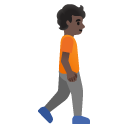
Appearance varies by platform and device. Google Noto, Twemoji, and OpenMoji are open-source.