🦹🏽
The Emoji
Supervillain: Medium Skin Tone
U+1F9B9 U+1F3FD · :supervillain_medium_skin_tone:
Trend 78
Meaning layers
- interpretation
- Used to describe someone who is unapologetically doing something chaotic, petty, or self-serving — often in a self-aware, playful way. The 'villain era' persona made popular by social media.
- tiktok usage
- Paired with 'villain era' content — people announcing they're done being nice, embracing chaos, or doing something mildly devious like eating the last slice of pizza.
- irony level
- 7 / 10
Platform meanings
- meaning
- Symbol of the 'villain era' — used when someone has decided to stop caring about others' opinions and act in their own interest.
- trend usage
- Appears in 'villain era' transition videos, 'POV: I'm the villain' skits, and self-empowerment content framed as villainy.
- hashtags
- #VillainEra#Supervillain#MainCharacter#ChaoticEnergy#VillainArc
- virality score
- 82 / 100
Cultural meanings
🇺🇸
Western / Gen-Z
The quintessential 'villain era' emoji — used constantly to signal personal transformation toward self-prioritization, pettiness, or chaos with full ironic self-awareness.
🇵🇰
Pakistan & India
Used in social media contexts by younger users to channel Bollywood villain energy or to describe someone behaving like a filmy antagonist in real life.
🌍
Middle East
Used among youth to describe a charismatic troublemaker or someone who is doing something bold and rule-breaking — often in gaming and pop culture contexts.
🌐
Global Neutral
Universally understood as representing a villain character — used for Halloween, fictional media discussion, or playful self-labeling across all cultures.
🇧🇩
Bangladesh
Appears in youth social media to describe someone acting dramatically petty or antagonistic — often referencing Bangladeshi drama series villains.
🇱🇰
Sri Lanka
Used in casual chat to label someone being dramatically difficult or mischievous — often paired with teasing messages about a friend's bad behavior.
🇨🇳
China
Used on platforms like Weibo and Douyin to represent the '反派 (villain)' archetype — popular in xianxia and wuxia fandom spaces for dramatic antagonist characters.
🇯🇵
Japan
Connected to 'ヴィラン (villain)' culture from anime and manga — used in fan communities and cosplay circles for dark or anti-hero characters.
🇰🇷
South Korea
Tied to K-drama villain aesthetics and idol 'dark concept' comebacks — used to express someone is giving villain/charismatic antagonist energy.
🇹🇼
Taiwan
Appears in gaming and anime fan communities — used when someone plays a villain role in a game or identifies with a dark-coded character.
🇭🇰
Hong Kong
Used in pop culture discussions about villain characters in local films and TVB dramas — also used playfully to describe someone being sneaky.
🇵🇭
Philippines
Heavily used to reference teleserye (soap opera) villains or to describe someone doing kontrabida (villain) behavior in real life drama.
🇮🇩
Indonesia
Used to describe someone being a 'penjahat' (villain) in a playful context — common in gaming communities and K-drama/anime fan spaces.
🇹🇭
Thailand
Associated with Thai drama villain tropes — used to describe someone acting manipulative or scheming, often in a half-joking tone.
🇻🇳
Vietnam
Appears in gaming and anime fandoms — used to label a 'phản diện' (antagonist) in a story or someone acting selfishly in a group.
🇲🇾
Malaysia
Used in mixed Malay-English internet slang to describe someone being 'jahat' (evil/naughty) in a playful or dramatic way.
🇸🇦
Saudi Arabia
Used among youth to describe charismatic antagonists in gaming, anime, or Western media — generally understood as fictional framing.
🇦🇪
UAE
Common in multicultural youth spaces to represent villain aesthetics from gaming, streaming media, and comic book culture.
🇪🇬
Egypt
Used to describe someone with 'sha'ra' (mischievous charisma) or referencing popular villain characters from Egyptian cinema and drama.
🇹🇷
Turkey
Associated with 'dizi' (Turkish drama) villain characters — used to describe someone acting scheming or dramatically antagonistic.
🇮🇷
Iran
Used in youth internet culture to reference villains from anime and foreign films — generally seen as a fictional or pop-culture reference.
🇳🇬
Nigeria
Used to describe someone with 'Nollywood villain energy' — dramatic, scheming, and unapologetic — a figure of charismatic badness.
🇿🇦
South Africa
Used across multiple language communities to describe someone acting selfishly or mischievously — often connected to local drama or 'tsotsi' (troublemaker) energy.
🇬🇧
UK & Ireland
Used with dry British humor to describe mildly villainous behavior — skipping queues, not sharing biscuits, or ghosting someone.
🇫🇷
France
Deployed with Gallic irony to describe someone being charismatically difficult — has a certain 'je ne sais quoi' of proud wrongdoing.
🇩🇪
Germany
Used more literally or in gaming contexts — the precise German internet culture uses it to label rule-breaking behavior or a game's antagonist.
🇪🇸
Spain & Italy
Used to describe dramatically passionate or theatrical bad behavior — a telenovela-style villain energy applied to everyday situations.
🇧🇷
Brazil
Associated with novela (soap opera) villain archetypes — used when someone is acting 'maldoso' (malicious/devious) in a dramatically entertaining way.
🇲🇽
Mexico
Used to describe someone acting like a 'villano' with swagger — referencing telenovela antagonists or charismatic troublemakers in everyday life.
🌎
Latin America
Broadly used across Latin America to reference dramatic antagonist energy from telenovelas, gaming, and anime — a mark of charismatic defiance.
🇦🇺
Australia & NZ
Used with larrikin humor to describe someone doing something cheeky or anti-establishment — the quintessential 'bit of a villain' energy.
How its meaning shifted
- 2010
This emoji did not exist yet — villain representation online was limited to text-based emoticons and basic smiley faces.
- 2015
Still pre-existing this emoji — villain concepts were represented by devil faces or skull emojis; no dedicated supervillain emoji was available.
- 2020
Newly introduced and gaining traction in fandom and gaming communities — early adoption in anime, comic, and superhero media discussions; 'villain era' concept beginning to emerge.
- 2026
Fully embedded in the 'villain era' cultural lexicon — one of the defining emojis of Gen Z self-expression, used across all platforms to signal defiant self-prioritization and chaotic energy.
See it on every platform
Adjacent emojis
- Often confused with
- ninjaperson in stealthsmiling face with horns
- Can replace
- smiling face with hornsskullfire
Share & embed
Frequently asked
01What does the 🦹🏽 Supervillain: Medium Skin Tone emoji mean?
A person with medium skin tone dressed as a supervillain, typically depicted wearing a mask or cape with a menacing expression.
02What does 🦹🏽 mean on TikTok?
Symbol of the 'villain era' — used when someone has decided to stop caring about others' opinions and act in their own interest.
03What does 🦹🏽 mean on WhatsApp?
Sent when someone is doing something mildly sneaky or mischievous — warning a friend they are 'being evil' today.
04What does 🦹🏽 mean in Gen-Z slang?
Used to describe someone who is unapologetically doing something chaotic, petty, or self-serving — often in a self-aware, playful way. The 'villain era' persona made popular by social media.
05Is the 🦹🏽 emoji safe to use?
Playful, comic-book-inspired expression of mischievousness, self-empowerment, or fictional villain appreciation — entirely safe in most contexts.
06What does 🦹🏽 mean in texting?
Taps into the psychological concept of 'shadow self' — the villainous emoji allows people to safely express rebellious, non-conformist, or anti-social feelings in a socially acceptable, humorous frame.
07What is the shortcode for 🦹🏽?
The shortcode for Supervillain: Medium Skin Tone is :supervillain_medium_skin_tone:
08What does 🦹🏽 mean in dating?
Used to signal someone is 'dangerously attractive' or is playfully warning their crush that they're trouble — a flirty power move.
Safety & usage
- Safe meaning
- Playful, comic-book-inspired expression of mischievousness, self-empowerment, or fictional villain appreciation — entirely safe in most contexts.
- Caution
- Could be used to celebrate genuinely harmful behavior under the guise of 'villain era' irony — normalizing cruelty, manipulation, or deliberate harm to others.
Occasionally used to glorify toxic relationship behavior like manipulation, emotional unavailability, or deliberate cruelty framed as 'being a villain.' Context-dependent — monitor in mental health spaces.
How it looks across platforms
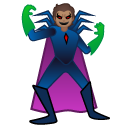


Appearance varies by platform and device. Google Noto, Twemoji, and OpenMoji are open-source.