⛹🏼♀️
The Emoji
Woman Bouncing Ball: Medium-light Skin Tone
U+26F9 U+1F3FC U+200D U+2640 U+FE0F · :woman_bouncing_ball_mediumlight_skin_tone:
Trend 38
Meaning layers
- interpretation
- Used to signal being active, sporty, or a 'that girl' energy — often paired with wellness aesthetics or used ironically to say 'I'm doing my thing and staying on my grind.'
- tiktok usage
- Appears in 'that girl' morning routine videos, sports highlight reacts, and ironically in captions like 'me bouncing back from everything ⛹🏼♀️'
- irony level
- 4 / 10
Platform meanings
- meaning
- Sporty girl aesthetic, 'that girl' energy, or literal basketball/sports content
- trend usage
- Used in 'bouncing back' trend captions, morning routine videos, and women's sports highlight reacts
- hashtags
- #thatgirl#womeninsports#basketballgirl#bounceback#activegirl
- virality score
- 42 / 100
Cultural meanings
🇺🇸
Western / Gen-Z
Widely used as part of the 'that girl' empowerment aesthetic and women's sports advocacy; appreciated for skin tone diversity representation.
🇵🇰
Pakistan & India
Used occasionally to represent women playing sports, often in the context of celebrating female athletes like basketball or cricket-adjacent female sports coverage.
🌍
Middle East
Used in the context of women's sports progress and empowerment narratives; increasingly common as women's sports participation grows in the region.
🌐
Global Neutral
Universally understood as a woman playing basketball or engaging in athletic activity, carrying positive connotations of health and empowerment.
🇧🇩
Bangladesh
Primarily used in literal sports contexts; women's sports representation through emoji is slowly gaining adoption among younger, urban users.
🇱🇰
Sri Lanka
Used in youth sports communities and fitness content; the specific skin tone detail is noted and appreciated for South Asian representation.
🇨🇳
China
Used in basketball content — particularly during NBA/CBA season — and women's sports posts; skin tone selection may vary based on personal preference.
🇯🇵
Japan
Used precisely in sports-related contexts; Japanese users tend to use it literally for basketball or physical activity rather than metaphorically.
🇰🇷
South Korea
Popular among K-sports fans and fitness influencers; sometimes used in idol fan content when athletes or fit celebrities are discussed.
🇹🇼
Taiwan
Used in sports and fitness communities, particularly in women's basketball discussions and general athletic lifestyle content.
🇭🇰
Hong Kong
Common in sports community posts and fitness culture content; often used by young women expressing active lifestyle identities.
🇵🇭
Philippines
Used to represent sporty women and basketball culture — basketball being hugely popular in the Philippines — with positive female athlete connotations.
🇮🇩
Indonesia
Appears in women's sports content and fitness communities; used to signal an active, healthy lifestyle among younger Indonesian women.
🇹🇭
Thailand
Used in sports and wellness contexts; Thai users may also associate it with competitive sports education and school sports events.
🇻🇳
Vietnam
Primarily literal usage in sports contexts; growing use among Vietnamese youth fitness communities and women's sports advocates.
🇲🇾
Malaysia
Used in sports content and fitness posts; the medium-light skin tone is noted as relatively relatable for some Southeast Asian users.
🇸🇦
Saudi Arabia
Increasingly used as women's sports participation has expanded post-2017 reforms; symbolizes progress in women's athletic rights and visibility.
🇦🇪
UAE
Used in cosmopolitan fitness and sports content; seen in expat communities and among Emirati women celebrating athletic achievements.
🇪🇬
Egypt
Used in women's sports contexts, often in support of Egyptian female athletes; carries empowering connotations for women in sport.
🇹🇷
Turkey
Common in sports communities and fitness culture; used to represent athletic women and support for female sports figures.
🇮🇷
Iran
Used carefully — women's sports is a sensitive topic domestically, so usage is more common in diaspora communities and international contexts.
🇳🇬
Nigeria
Used in sports content, especially basketball which has growing popularity; celebrates Nigerian women athletes and general sports pride.
🇿🇦
South Africa
Common in sports communities across platforms; used to celebrate female athletes and active lifestyles in a sports-loving culture.
🇬🇧
UK & Ireland
Used in sports content, gym culture posts, and female empowerment contexts; fits into broader wellness and active lifestyle aesthetic.
🇫🇷
France
Used in sports and fitness content; French users may associate it with women's sports representation and healthy lifestyle messaging.
🇩🇪
Germany
Practical and literal usage in sports communities; appreciated for diversity representation in German digital fitness and sports spaces.
🇪🇸
Spain & Italy
Used in sports communities and athletic lifestyle content; resonates with Mediterranean cultures that value physical activity and sports.
🇧🇷
Brazil
Used in sports and fitness culture — basketball is popular — and often paired with empowerment messaging for Brazilian female athletes.
🇲🇽
Mexico
Used in sports contexts and women's empowerment posts; basketball culture is growing in Mexico and this emoji fits that rising community.
🌎
Latin America
Broadly used across Latin America in sports communities to represent active women and celebrate female athletic achievements.
🇦🇺
Australia & NZ
Popular in fitness and sports content; Australian and Kiwi users embrace it within strong sporting culture and women's sports advocacy.
How its meaning shifted
- 2010
Emoji did not exist yet; basketball-related emojis were extremely limited and gender/skin tone variants were years away.
- 2015
Recently introduced as part of Unicode 7.0/8.0 diversity push; used almost exclusively in literal sports contexts with novelty around gender representation.
- 2020
Gained traction with rise of WNBA visibility, women's sports movements, and fitness influencer culture; skin tone variants more intentionally selected.
- 2026
Established as part of active lifestyle and empowerment emoji vocabulary; used in 'that girl' aesthetics, women's sports advocacy, and bouncing-back metaphors.
See it on every platform
Compare with
Adjacent emojis
Share & embed
Frequently asked
01What does the ⛹🏼♀️ Woman Bouncing Ball: Medium-light Skin Tone emoji mean?
A woman with medium-light skin tone bouncing or dribbling a basketball, representing the sport of basketball, athletic activity, and female sportsmanship.
02What does ⛹🏼♀️ mean on TikTok?
Sporty girl aesthetic, 'that girl' energy, or literal basketball/sports content
03What does ⛹🏼♀️ mean on WhatsApp?
Signaling athletic activity, heading to practice, or playing basketball
04What does ⛹🏼♀️ mean in Gen-Z slang?
Used to signal being active, sporty, or a 'that girl' energy — often paired with wellness aesthetics or used ironically to say 'I'm doing my thing and staying on my grind.'
05Is the ⛹🏼♀️ emoji safe to use?
Represents a woman playing basketball or engaging in athletic activity; completely benign and positive.
06What does ⛹🏼♀️ mean in texting?
Evokes feelings of physical agency and empowerment, particularly for women in sports. Psychologically linked to self-efficacy and perseverance metaphors.
07What is the shortcode for ⛹🏼♀️?
The shortcode for Woman Bouncing Ball: Medium-light Skin Tone is :woman_bouncing_ball_mediumlight_skin_tone:
08What does ⛹🏼♀️ mean in dating?
Rarely used as a direct flirt, but can signal 'I'm athletic and confident' — sometimes used to suggest wanting to play a sport together as a casual date idea.
Safety & usage
- Safe meaning
- Represents a woman playing basketball or engaging in athletic activity; completely benign and positive.
- Caution
- No known toxic usage patterns; extremely rare misuse cases.
No significant warnings. Skin tone specification may occasionally prompt discussions around representation and identity, but this is generally constructive.
How it looks across platforms
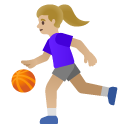
Appearance varies by platform and device. Google Noto, Twemoji, and OpenMoji are open-source.