🤸🏼♀️
The Emoji
Woman Cartwheeling: Medium-light Skin Tone
U+1F938 U+1F3FC U+200D U+2640 U+FE0F · :woman_cartwheeling_mediumlight_skin_tone:
Trend 58
Meaning layers
- interpretation
- Used to express unbothered energy, chaotic excitement, or the feeling of doing something extra or over-the-top. Often signals 'I'm thriving' or 'living my best life' with a hint of dramatic flair.
- tiktok usage
- Appears in captions about thriving after drama, main character energy, or doing something unexpected and fun. Also used ironically to say 'I'm totally fine' when clearly not.
- irony level
- 6 / 10
Platform meanings
- meaning
- Signals carefree energy, thriving, or doing something spontaneous and chaotic. Used in both sincere fitness content and ironic 'I'm fine' humor.
- trend usage
- Paired with trending audios about living your best life, getting over heartbreak, or main character moments. Common in POV and day-in-my-life content.
- hashtags
- #maincharacter#unbothered#gymgirl#livingmybestlife#cartwheel
- virality score
- 62 / 100
Cultural meanings
🇺🇸
Western / Gen-Z
Widely used to signal main character energy, thriving, and unbothered vibes. Heavily used ironically to mock toxic positivity or dramatic resilience.
🇵🇰
Pakistan & India
Primarily interpreted literally as a gymnastics or sports emoji. Used by fitness enthusiasts and young women in active lifestyle content on Instagram and WhatsApp.
🌍
Middle East
Largely taken in its literal athletic sense. Used in fitness and sports contexts; the female depiction may be less commonly used in conservative online spaces.
🌐
Global Neutral
Universally understood as representing physical activity, gymnastics, and energetic movement. Safe and positive across most global contexts.
🇧🇩
Bangladesh
Used mainly in fitness and youth culture contexts. Seen as a symbol of active, healthy living among young social media users.
🇱🇰
Sri Lanka
Interpreted as representing sports and physical activity. Used by fitness influencers and active lifestyle accounts on Instagram and Facebook.
🇨🇳
China
Associated with gymnastics, a highly prestigious sport in China. Used to celebrate athletic achievement and feminine strength in sports contexts.
🇯🇵
Japan
Connected to rhythmic gymnastics and school athletic culture. Used to express lively, energetic girlhood and athletic grace.
🇰🇷
South Korea
Used in K-fitness and idol culture contexts to signal energetic, healthy, and youthful femininity. Popular among gym content creators.
🇹🇼
Taiwan
Interpreted as a fun, active emoji associated with sports and cheerful energy. Common in youth and fitness social media content.
🇭🇰
Hong Kong
Used in fitness and wellness content. Associated with active, modern femininity and athletic lifestyle culture.
🇵🇭
Philippines
Popular in cheerleading, dance, and gym communities. Used to express excitement, energy, and celebration of athletic activity.
🇮🇩
Indonesia
Used among fitness enthusiasts and young women in active lifestyle content. Seen as a positive, energetic symbol of health.
🇹🇭
Thailand
Associated with gymnastics and dance. Used in youth culture to express playful energy and physical vitality.
🇻🇳
Vietnam
Primarily used in fitness and sports contexts by younger social media users. Signals active, healthy living.
🇲🇾
Malaysia
Used in fitness communities and by active lifestyle influencers. Seen as a lighthearted symbol of energy and wellness.
🇸🇦
Saudi Arabia
Typically used in sports and fitness contexts. With growing women's sports culture, it has become more visible in female empowerment and athletic content.
🇦🇪
UAE
Used in cosmopolitan fitness and wellness communities. Reflects the UAE's active embrace of international fitness culture and female athleticism.
🇪🇬
Egypt
Primarily literal in meaning, used in sports and fitness content. Growing use among young women in gym and wellness communities online.
🇹🇷
Turkey
Used in gymnastics and fitness communities. Associated with energetic, youthful femininity and athletic achievement.
🇮🇷
Iran
Interpreted in its athletic, gymnastic sense. Usage is generally limited to private or semi-public fitness and youth content online.
🇳🇬
Nigeria
Used in fitness and empowerment contexts. Gen Z Nigerians also use it to signal thriving or unbothered energy, mirroring Western usage.
🇿🇦
South Africa
Used both literally for gymnastics and sports, and ironically in youth culture to signal living one's best life or thriving despite adversity.
🇬🇧
UK & Ireland
Used both genuinely in fitness contexts and ironically to signal unbothered or extra energy. British humor adds a layer of self-deprecating sarcasm.
🇫🇷
France
Primarily associated with gymnastics and physical culture. Used in fitness and wellness content, with occasional ironic usage among younger users.
🇩🇪
Germany
Taken mostly in its literal athletic sense. Used in fitness, gymnastics, and sports communities with straightforward positive meaning.
🇪🇸
Spain & Italy
Associated with energetic, joyful physical expression. Used in sports and dance contexts, as well as celebratory social media posts.
🇧🇷
Brazil
Highly popular in gymnastics, cheerleading, and dance communities. Also used to signal joy, energy, and thriving in everyday social media posts.
🇲🇽
Mexico
Used in fitness and dance contexts. Among younger users, adopted with ironic or celebratory meanings similar to US Gen Z usage.
🌎
Latin America
Broadly used in fitness and celebration contexts across Latin America. Signals energetic positivity and physical vitality.
🇦🇺
Australia & NZ
Used in fitness and outdoor culture contexts, as well as ironically to signal carefree, unbothered energy in casual online communication.
How its meaning shifted
- 2010
Emoji did not yet exist in this form. General gymnastics representation was minimal on early platforms.
- 2015
Introduced around this period as part of Unicode's expanding sports emoji set. Used primarily literally for gymnastics and physical activity.
- 2020
Gained ironic and cultural usage alongside the rise of 'unbothered' and 'main character' internet aesthetics. Skin tone variant became more widely used for personalization.
- 2026
Firmly established in both literal fitness contexts and ironic Gen Z communication. Part of standard 'thriving' and 'delulu' meme vocabulary across TikTok and Instagram.
See it on every platform
Adjacent emojis
- Often confused with
- person doing cartwheelwoman runningperson turning somersault
- Can replace
- dancerwoman dancingflexed biceps
Share & embed
Frequently asked
01What does the 🤸🏼♀️ Woman Cartwheeling: Medium-light Skin Tone emoji mean?
A woman performing a cartwheel, shown with medium-light skin tone. Depicts gymnastics, acrobatics, physical agility, and energetic movement.
02What does 🤸🏼♀️ mean on TikTok?
Signals carefree energy, thriving, or doing something spontaneous and chaotic. Used in both sincere fitness content and ironic 'I'm fine' humor.
03What does 🤸🏼♀️ mean on WhatsApp?
Expresses excitement, energy, or a lighthearted 'I'm doing great' vibe in personal chats.
04What does 🤸🏼♀️ mean in Gen-Z slang?
Used to express unbothered energy, chaotic excitement, or the feeling of doing something extra or over-the-top. Often signals 'I'm thriving' or 'living my best life' with a hint of dramatic flair.
05Is the 🤸🏼♀️ emoji safe to use?
Represents gymnastics, athletic activity, physical fitness, and energetic joy. Entirely positive and safe in standard usage.
06What does 🤸🏼♀️ mean in texting?
The cartwheel motion psychologically evokes freedom, childhood playfulness, and uninhibited self-expression. It taps into the joy of movement and the release of emotional tension through physical action.
07What is the shortcode for 🤸🏼♀️?
The shortcode for Woman Cartwheeling: Medium-light Skin Tone is :woman_cartwheeling_mediumlight_skin_tone:
08What does 🤸🏼♀️ mean in dating?
Can signal someone who is fun, spontaneous, and adventurous in a flirtatious context. May suggest 'I'm flexible' with a playful wink.
Safety & usage
- Safe meaning
- Represents gymnastics, athletic activity, physical fitness, and energetic joy. Entirely positive and safe in standard usage.
- Caution
- Occasionally used to mock or minimize someone's distress by implying they are overreacting or should 'just be happy.' Can contribute to toxic positivity narratives.
No significant safety concerns. The ironic 'I'm fine' usage could occasionally be used dismissively, but the emoji itself carries no harmful connotations.
How it looks across platforms
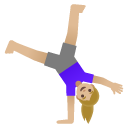
Appearance varies by platform and device. Google Noto, Twemoji, and OpenMoji are open-source.