👷🏿♀️
The Emoji
Woman Construction Worker: Dark Skin Tone
U+1F477 U+1F3FF U+200D U+2640 U+FE0F · :woman_construction_worker_dark_skin_tone:
Trend 48
Meaning layers
- interpretation
- Used to signal hustle culture, hard work aesthetics, and being unbothered while grinding. Also reclaimed as a symbol of not needing anyone's help — building your own life literally and figuratively.
- tiktok usage
- Appears in 'that girl' and 'boss mode' content, often paired with productivity motivation or 'I built this myself' energy. Also used ironically when doing basic tasks.
- irony level
- 4 / 10
Platform meanings
- meaning
- Represents grind culture, DIY empowerment, and women in trades. Used in transformation content and hustle motivation videos.
- trend usage
- Appears in #GirlBoss and #WomenInTrades content, DIY renovation reveals, and 'building my empire' motivational audios.
- hashtags
- #WomenInConstruction#GirlBoss#HardHatBeauty#BuildingMyLife#WomenInTrades
- virality score
- 52 / 100
Cultural meanings
🇺🇸
Western / Gen-Z
Embraced as a symbol of female empowerment, racial diversity, and breaking gender norms in the workforce. Often used in motivational content and 'building era' personal branding.
🇵🇰
Pakistan & India
Used to celebrate working women in a conservative context, though the specific trade connotation may be secondary to the general 'hardworking woman' message. Growing use in urban feminist spaces.
🌍
Middle East
Carries significance as women in some Gulf and Levantine countries push for inclusion in male-dominated industries. Used cautiously but with growing empowerment connotation.
🌐
Global Neutral
Universally understood as representing a woman doing construction or skilled labor work. Widely used to signal diversity, hard work, and female empowerment.
🇧🇩
Bangladesh
Resonates strongly given the large female labor force in Bangladesh — seen as empowering and representative of working-class women's dignity and contributions.
🇱🇰
Sri Lanka
Represents women in labor and construction sectors, which are significant in Sri Lanka's economy. Used in labor rights and women's empowerment contexts.
🇨🇳
China
Understood as a working woman emoji. In a culture that historically promoted gender equality in labor, it's seen as normal and positive rather than groundbreaking.
🇯🇵
Japan
Interpreted with admiration as women in trades are underrepresented in Japan. Used in discussions about gender diversity in the workforce and 'rikejo' (women in technical fields) culture.
🇰🇷
South Korea
Used in conversations about breaking the 'glass ceiling' and gender parity in professional fields. Resonates with young Korean feminists and career women.
🇹🇼
Taiwan
Seen positively as representation of gender diversity in professional roles. Taiwan's relatively progressive gender policies make this emoji widely accepted and celebrated.
🇭🇰
Hong Kong
Used in contexts of women's rights, labor movements, and professional diversity. Carries meaning of resilience and strength in current sociopolitical climate.
🇵🇭
Philippines
Resonates in a culture with strong female workforce participation. Used to celebrate OFW (overseas Filipino workers) women and local working-class heroines.
🇮🇩
Indonesia
Used to represent hardworking women in a Muslim-majority context where women increasingly enter professional and trade sectors. Seen as empowering and modern.
🇹🇭
Thailand
Interpreted as a symbol of female strength and labor — Thailand's history of strong female market and trade workers makes this relatable and positive.
🇻🇳
Vietnam
Resonates strongly — Vietnamese culture has long celebrated women's roles in labor and national building. Seen as a respectful representation of working women.
🇲🇾
Malaysia
Used in diverse Malaysian contexts to celebrate women in trades and construction, aligning with government diversity initiatives and empowerment campaigns.
🇸🇦
Saudi Arabia
Increasingly relevant as Vision 2030 opens more sectors to women. Used to celebrate Saudi women entering previously restricted professional fields.
🇦🇪
UAE
Aligned with the UAE's active promotion of women in the workforce and construction sector. Used positively in professional and national pride contexts.
🇪🇬
Egypt
Used to honor the 'working woman' archetype common in Egyptian culture. Resonates in conversations about women's economic empowerment and informal labor.
🇹🇷
Turkey
Represents women's roles in Turkey's growing construction industry. Used in feminist discourse and labor rights conversations.
🇮🇷
Iran
Used carefully in feminist and underground contexts to celebrate women's professional aspirations despite social restrictions on women in certain fields.
🇳🇬
Nigeria
Highly relevant — Nigeria has a large female informal construction and trade labor force. Used proudly to celebrate working women and Afro-feminist empowerment.
🇿🇦
South Africa
Resonates powerfully given South Africa's history and ongoing conversations about Black women's economic inclusion and participation in skilled trades.
🇬🇧
UK & Ireland
Used in discussions about closing the gender gap in construction — one of the UK's most male-dominated industries. Appreciated in diversity and trades apprenticeship contexts.
🇫🇷
France
Used in professional and feminist circles to discuss gender parity in skilled trades. French culture's emphasis on labor rights makes this particularly resonant.
🇩🇪
Germany
Fits well in Germany's Ausbildung (vocational training) culture where skilled trades are highly respected. Used to celebrate women entering trade apprenticeships.
🇪🇸
Spain & Italy
Used to celebrate women challenging traditional gender roles in Mediterranean cultures where construction is historically male-dominated. Growing feminist movement usage.
🇧🇷
Brazil
Used to honor 'mulheres guerreiras' (warrior women) in a culture that celebrates female resilience. Common in content about working-class Black Brazilian women.
🇲🇽
Mexico
Resonates with the strong Mexican tradition of honoring working women — 'la mujer trabajadora.' Used in labor rights and feminist content.
🌎
Latin America
Broadly used across Latin America to celebrate women in non-traditional roles and to highlight the invisible labor of working-class women in the region.
🇦🇺
Australia & NZ
Highly relevant in a culture actively trying to recruit women into construction and trades. Used in vocational campaigns, feminist content, and diversity initiatives.
How its meaning shifted
- 2010
This specific emoji did not exist in 2010. The construction worker concept was represented by a generic male figure without skin tone options.
- 2015
Still not available. Basic construction worker emoji existed but lacked gender and skin tone variants. Women in trades representation was largely absent from emoji keyboards.
- 2020
Fully available and gaining traction. Used in diversity conversations, BLM-adjacent empowerment content, and early pandemic 'essential workers' tributes. Momentum building in professional and feminist spaces.
- 2026
Widely embraced in career content, TikTok 'building era' trends, and DEI professional contexts. Normalized as part of representation vocabulary and increasingly used by actual women in trades to represent their profession.
See it on every platform
Compare with
Adjacent emojis
- Often confused with
- woman office workerwoman farmerconstruction sign
Share & embed
Frequently asked
01What does the 👷🏿♀️ Woman Construction Worker: Dark Skin Tone emoji mean?
A woman wearing a hard hat and construction vest with dark skin tone, representing a female construction worker or laborer in the building/infrastructure industry.
02What does 👷🏿♀️ mean on TikTok?
Represents grind culture, DIY empowerment, and women in trades. Used in transformation content and hustle motivation videos.
03What does 👷🏿♀️ mean on WhatsApp?
Signals hard work or that someone is busy working. Often sent when telling someone you're in the middle of a task or project.
04What does 👷🏿♀️ mean in Gen-Z slang?
Used to signal hustle culture, hard work aesthetics, and being unbothered while grinding. Also reclaimed as a symbol of not needing anyone's help — building your own life literally and figuratively.
05Is the 👷🏿♀️ emoji safe to use?
Represents a woman construction worker with dark skin tone — a straightforward, positive representation of labor diversity and female empowerment in trades.
06What does 👷🏿♀️ mean in texting?
Evokes feelings of competence, self-reliance, and breaking gender norms. Psychologically linked to identity affirmation and professional pride, especially for women of color in male-dominated fields.
07What is the shortcode for 👷🏿♀️?
The shortcode for Woman Construction Worker: Dark Skin Tone is :woman_construction_worker_dark_skin_tone:
08What does 👷🏿♀️ mean in dating?
Rarely used as a flirt emoji. Could be used playfully to say 'I'm building something great — want to be part of it?' or to signal independence.
Safety & usage
- Safe meaning
- Represents a woman construction worker with dark skin tone — a straightforward, positive representation of labor diversity and female empowerment in trades.
- Caution
- No inherently toxic usage. Could theoretically be used in a condescending way to mock women in trades, but this is rare and context-dependent.
Generally safe for all audiences. No significant misuse patterns documented. The skin tone specification (dark) adds a layer of racial representation that should be used respectfully.
How it looks across platforms
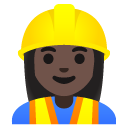
Appearance varies by platform and device. Google Noto, Twemoji, and OpenMoji are open-source.